



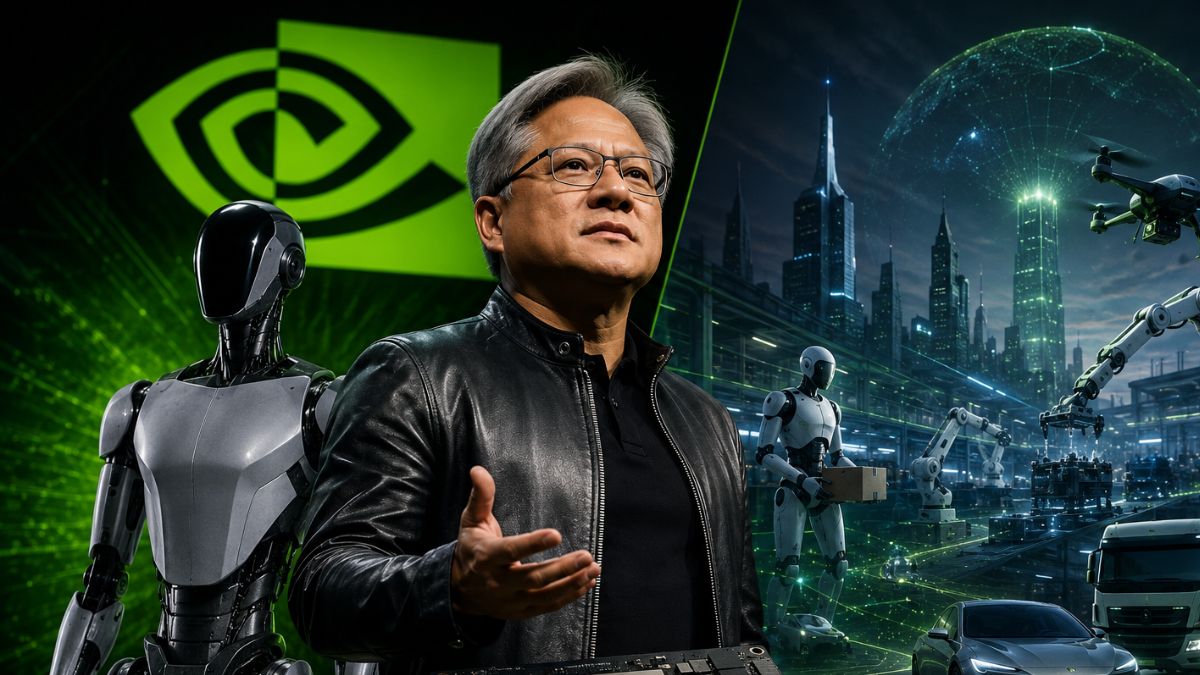
Artificial intelligence may be driving Nvidia’s record growth today, but the company increasingly sees robotics as the next frontier. From humanoid robots and autonomous machines to self-driving cars and robotic factories, Nvidia is positioning itself as the technology backbone of what CEO Jensen Huang calls the era of “physical AI.”
Now, Chinese humanoid robot maker Unitree has landed one of its most significant endorsements yet. Nvidia has selected Unitree’s H2 humanoid robot as the foundation of the first robotics system it is selling to leading research institutions, including Stanford University and ETH Zurich.
The new platform combines Unitree’s nearly six-foot-tall H2 humanoid robot with Nvidia’s Jetson Thor computing system, powered by the company’s latest Blackwell GPU architecture. Rather than simply supplying chips, Nvidia is now packaging hardware, software and simulation tools into a complete robotics development platform for researchers.
For Unitree, the partnership provides access to some of the world’s most prestigious robotics laboratories. For Nvidia, it is another step toward a future where robots become a major driver of growth beyond traditional artificial intelligence applications.
A market Nvidia believes could be enormous
Nvidia CEO Jensen Huang has been increasingly vocal about the potential of robotics. Last year, he told shareholders that robotics, alongside artificial intelligence, represented Nvidia’s largest growth opportunity.
“We have many growth opportunities across our company, with AI and robotics the two largest, representing a multitrillion-dollar growth opportunity,” Huang said. He has also outlined a future where robots become as common as computers and smartphones are today.
“We’re working towards a day where there will be billions of robots, hundreds of millions of autonomous vehicles, and hundreds of thousands of robotic factories that can be powered by Nvidia technology,” Huang said.
The company expects rapid expansion in robotics over the next five years as advances in AI make machines more capable of understanding, reasoning and interacting with real-world environments.
Nvidia wants to supply the brains, not build the robots
Unlike some robotics companies, Nvidia is not trying to become a robot manufacturer. Instead, it wants to provide the hardware, software and simulation tools that power robots built by others.
The strategy shows that Nvidia’s approach in AI, where its chips and software have become foundational infrastructure for developers and companies around the world. “We stopped thinking of ourselves as a chip company long ago,” Huang said.
Today, Nvidia increasingly describes itself as an AI infrastructure and computing platform provider, offering everything from processors and networking equipment to software frameworks and cloud services.
The launch of a new humanoid robot platform
The company’s latest step came with the unveiling of a new robotics research platform that combines Chinese robot maker Unitree’s nearly six-foot-tall H2 humanoid robot with Nvidia’s Jetson Thor computing system, powered by the Blackwell GPU architecture. The platform is aimed at universities and research institutions working on advanced robotics.
During a keynote speech in Taipei, Huang introduced what he called fully integrated humanoid reference robot.
“Today, we’re announcing the Nvidia Isaac Root, a reference humanoid robot, all fully integrated, 25 degrees of freedom on that on each hand made by Sharpa, 31 degrees of freedom on the robot, six feet 150 pounds, just like me,” Huang said.
“This platform runs the new Thor, and our entire software stack, data generation stack, data simulation stack, the runtime, all integrated into a robot that is designed for everyone to use,” he added.
The company says the system was built specifically for researchers who would otherwise face significant challenges assembling such a sophisticated robotics platform from scratch.
“We built this for higher education and university researchers, because for them to build this is insanely hard to do,” Huang said.
Building a complete robotics ecosystem
Nvidia’s Jetson platform has already become one of the most widely used edge AI computing systems in robotics. The current Jetson AGX Orin is commonly used in autonomous machines, however the next-generation Jetson AGX Thor has been designed specifically for demanding applications such as humanoid robots.
Nvidia has also developed Isaac, a comprehensive robotics platform that includes developer tools, AI models, perception systems and software frameworks. The company’s Isaac GR00T platform is designed specifically for multimodal humanoid robots, helping them understand their environment and perform tasks more effectively.
Another important piece is Omniverse Replicator, which allows developers to create synthetic training data and test robots inside realistic digital simulations before deploying them in the real world. This reduces development costs and speeds up training. One notable aspect of Nvidia’s latest robotics strategy is its focus on academia.
The company is making advanced humanoid robot systems available to leading research institutions, including Ai2 in Seattle, the Stanford Robotics Center, ETH Zurich in Switzerland and UC San Diego’s Advanced Robotics and Controls Laboratory.
Rev Lebaredian, Nvidia’s vice president of physical AI simulation, said the goal is to increase access to cutting-edge robotics technology. “It’s a move taking frontier humanoid research out of the hands of only the world’s largest tech companies and AI unicorns, and putting it in reach of every lab,” he told Bloomberg
The upgraded Unitree H2 Plus robot is expected to become available later this year, further expanding access to advanced humanoid research platforms.
The role of self-driving cars
Meanwhile, humanoid robots often attract the most attention, Nvidia believes autonomous vehicles could become the first major commercial success story for physical AI. Huang has previously said self-driving cars are likely to be the earliest large-scale application of the technologies now being developed for robotics.
The company’s Drive platform already provides chips and software used by automakers including Mercedes-Benz, giving Nvidia another pathway into autonomous systems beyond humanoid robots.
Competition is massively increasing
Nvidia is not alone in pursuing the robotics opportunity. Intel Corporation has been developing robotics solutions focused on physical AI, combining edge computing hardware, AI software tools and computer vision technologies. Its Robotics AI suite includes simulation tools, reference applications and software libraries aimed at accelerating robot development. Meanwhile, Advanced Micro Devices is expanding its robotics portfolio through embedded processors, Kria system-on-modules and robotics development kits designed to support intelligent machines.
For Nvidia, robotics is about extending AI beyond screens and into the real world. The company believes future robots will require enormous computing power for training, simulation and operation, creating demand for the same combination of chips, software and infrastructure that made Nvidia the dominant force in artificial intelligence.