



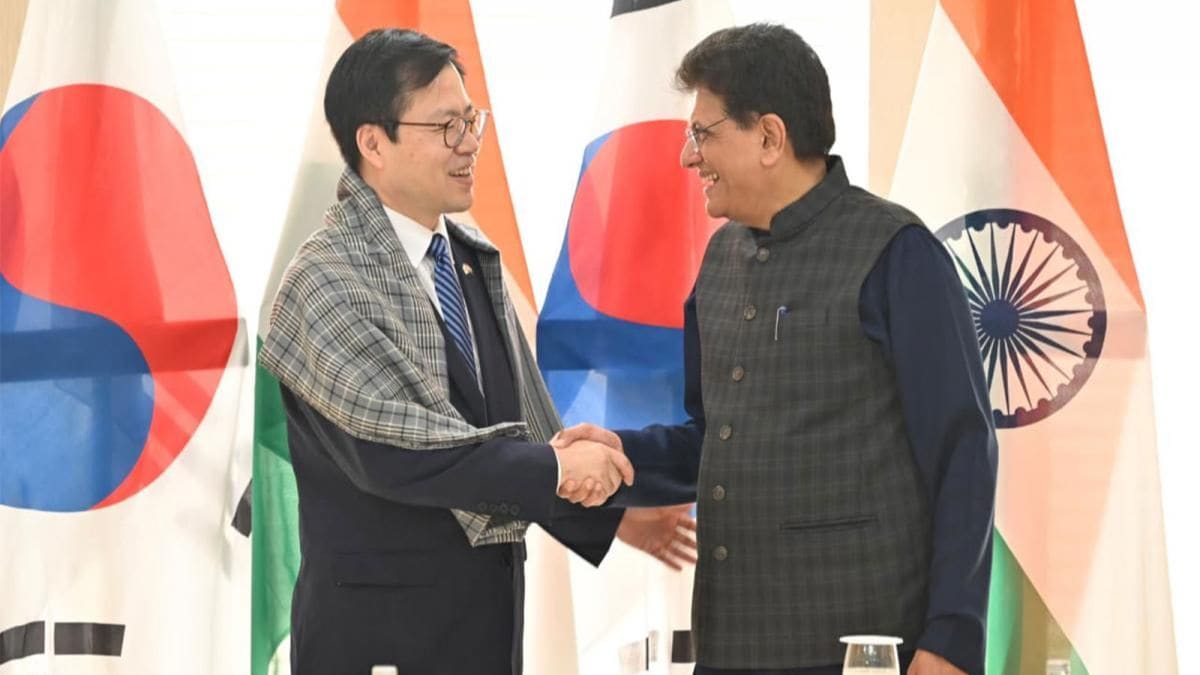
India and South Korea on Monday set the target of nearly doubling annual bilateral trade to $50 billion by 2030, and announced upgrading their Comprehensive Economic Partnership Agreement (CEPA) within a year, after talks between Prime Minister Narendra Modi and visiting South Korean President Lee Jae Myung. Currently, trade between the two countries stood at $ 27 billion.
The leaders said both countries are set to transform the trusted partnership to a futuristic partnership. “From chips to ships, from talent to technology, and from environment to energy, we will realise new opportunities for cooperation across all sectors,”Modi said.
“I also hope the progress will be made in negotiations to upgrade CEPA to create an institutional framework for Indian and Korean firms to realise stable and sustainable partnership,” Lee said. CEPA between India and South Korea was signed in 2009 and came into force in 2010. Since the outcome of the agreement was in South Korea’s favour, the review of the agreement was agreed to in 2016. Since then 11 rounds of talks have been held.
Modi announced establishment of a Korean Industrial Township to facilitate the entry of Korean companies, especially small and medium enterprises, into India. The talks during the visit resulted in four outcomes, 15 memorandums of understanding (MoUs) and six announcements. The two sides adopted a Comprehensive Framework for Partnership on Shipbuilding, Shipping and Maritime Logistics and expressed support for a range of B2B collaborations in the space.
An MoU was signed between National Payments Corporation of India and Korea Financial Telecommunications and Clearings Institute for phased integration of the digital payment systems of the two countries.
Another MoU was signed between the International Financial Services Centres Authority of India and the financial regulators of Korea for cooperation and consultation for development and supervision of cross-border financial products.
The two leaders agreed to cooperate across the critical minerals value chain including strengthening linkages between the geological survey organisations of the two countries for mapping and exploration of critical minerals through the use of artificial intelligence.
They supported collaboration in recovery of critical minerals from unconventional sources such as e-waste and mine tailings, as part of circularity initiatives. Framework for India-Korea Digital Bridge was also signed after the talks focusing on AI, data governance and digital businesses.
The two leaders also decided to launch a Korea-India Defence Accelerator innovation platform to connect businesses, incubators, investors, defence startups and universities from both sides.
JSW Steel, POSCO ink pact for steel plant
Sajjan Jindal-led JSW Steel has entered into a joint venture agreement with South Korean steel major POSCO to set up a 6 million tonne per annum steel plant in Odisha, according to a statement on Monday. The announcement was made at the India-Korea Business Forum, organised as part of South Korean President Lee Jae Myung’s visit to the country.
In 2005, POSCO signed a memorandum of understanding with the Odisha government to set up a $12 billion mega steel project, but dropped the project more than a decade later due to land acquisition issues and other clearances. JSW Steel said the agreement marks a significant step towards deepening strategic collaboration between the two steel companies.