



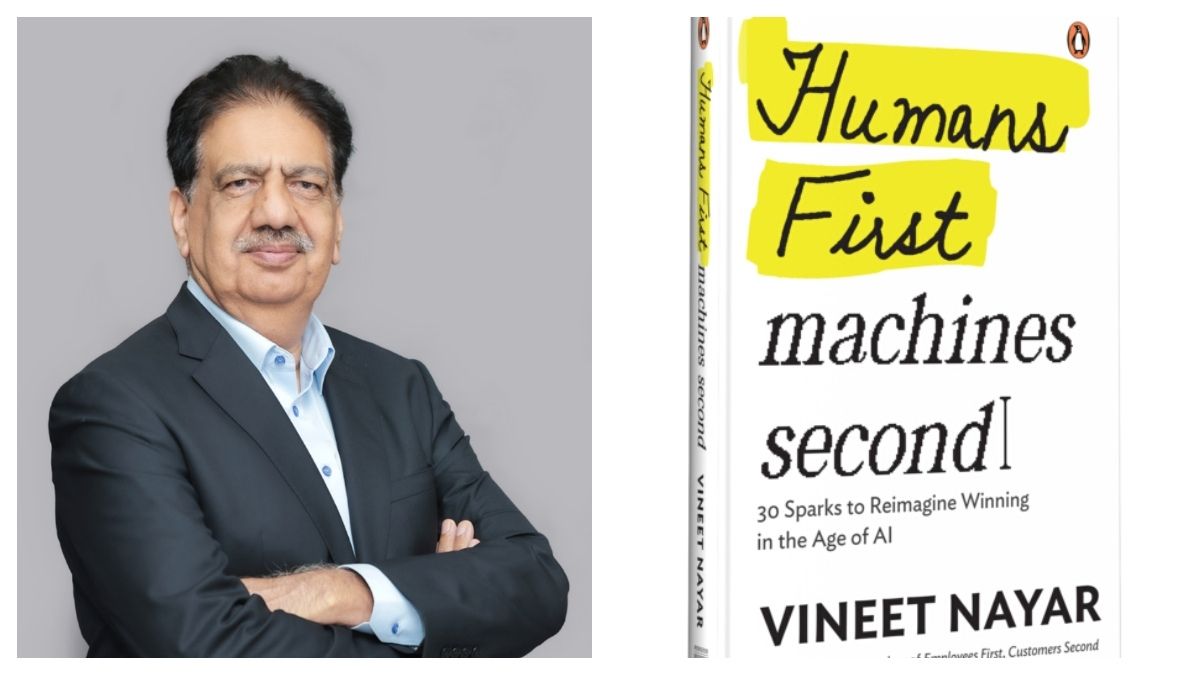
Vineet Nayar, former CEO of HCL Technologies and founder-chairman of Sampark Foundation, challenges global trends on AI by advocating a people-first approach in his new book, Humans First, Machines Second. In an interview, he talks of how we need to ride the AI wave not in blind faith on technology, but in believing in human potential. Edited excerpts:
Your turnaround of HCL Technologies is credited to a people-first approach and became a case study at Harvard Business School. Years later, how do you think the philosophy remains relevant, especially in the AI era?
The whole philosophy of employee first, customer second was that if you respect your employees, energise and motivate them, the clock speed of the organisation goes up. With AI coming in, what is happening is that the emphasis on productivity is going down and emphasis on innovation and new ideas is going up. And success really is in how you apply AI to solve unsolved problems or how you solve them in different ways than done before. For that you need humans — inspired, fearless and creative. So it is a continuation of the old thought which has become more relevant now than ever before.
But the world is on a different tangent because we see even within the Indian IT industry, the traditional system of hiring big, campus placements, etc, changing. Layoffs are happening worldwide, even at HCL Tech…
I think the way to understand this is to ask three fundamental questions. Number one, is the investment in technology going up or down? Is the opportunity size increasing or decreasing? The only reason you need less people to address the opportunity size is only because you are wrong-footed.
Organisations that are wrong-stepped with what I call traditional services, which are largely being taken over by technology, are not relevant for customers, and, therefore, their growth is going down and their employee pool is going down. If a company thinks that the opportunity size is big and I need to reinvest, then the number of people required to be deployed is going to only go up.
Worldwide, the number of people in technology is going to go up, not down. But for some companies that are not going to reinvent themselves to be relevant in the age of AI, the number of employees is going to go down and that is what you are seeing today.
So you think the layoffs are some sort of a temporary resizing or restrategising by the industry?
It is a company issue rather than an industry issue. That is point one. And yes, there will be a temporary dip and then there will be a hockey stick growth because the technology spend is only increasing, opportunity size is only increasing and you will need people to do more things in newer ways.
How do you think companies should reassess their strategies to have a more people-focused approach?
Before technology like AI and robotics came in, we largely had knowledge workers, say people who knew coding, COBOL or Java or any of these new languages to perform tasks you needed them to perform. However, with AI coming in, the skill you need is the ability to understand the customer problem, ability to apply technology to solve it in a way it has not been solved before.
So you need more what I call imagineers — people who imagine different kind of solutions. But to do that, you do not need industrial processes of HR. You need a culture where people feel unafraid to experiment and innovate. And the only way to do that is to have a people-first approach. You are wrong if you think machines can do everything; it is the human who can innovate, who can conceptualise. If you wish to be relevant in the age of AI, you have to be humans first and machines second.
You write success depends on knowing what to automate and what not to. Obviously that’s not happening right now, as the even the biggest tech companies are floundering on AI. And, of course, there can’t be a specific point when clarity dawns. Do you fear much would be lost in the process?
Any technology follows a hype cycle. Initially everybody is very excited about the possibility of what it can do. The internet came in 1993 but it was only in the 2000s that a Google or Facebook or Amazon were launched. The use came a little later. So I would believe that we are in what I call the ugly duckling stage where the hype of AI, and what AI can do far exceeds what it is actually doing. Right now we are seeing a lot of talk but very little benefit other than cost cutting. But AI is not for cost cutting; AI is for doing something that has not been done before.
But cost cutting is being counted as one of its biggest advantages?
Let’s start with the fundamentals of doing business. It is being different to your competitor so that you can create or offer value which is different to your competitor. The bigger the differentiation, the higher the profit, the higher the growth.
Now, AI can be used for cost cutting. That is actually right, but everybody can do it. If you use AI for automating a call centre or cutting cost in coding, that is all red ocean; everybody will do it and it will soon be a commodity. But if you use AI to create new value for your customer, something that has not been done before, or solve a non-solved problem, then you are a sole winner. Then you don’t ask how many employees, you don’t ask productivity questions; you ask value questions.
What are your thoughts on AI’s massive use of energy and water, and if this is a bigger threat than AI replacing humans?
I think the concern is right, but I truly believe this will result into us finding either alternate sources of energy or more efficient use of those sources of energy. I think in the next five years and with the oil crisis in the Middle East, we will see tremendous amount of money pouring into making energy more productive.
You come across in the book less as a tech veteran and more as a management leader. Do you see yourself as such?
I don’t know what I see myself as. But this god-worship of AI made me wake up and think that I needed to offer an alternative perspective, which is what I have done with this book.
Do you believe we as humans are dumbing ourselves if we take to AI for the smallest of tasks? And that might be AI’s biggest danger?
I think right now it is the new kid in town getting a lot of attention and people are using it for all kinds of things — playing around with it, getting surprised. It is just that somebody has to get up and start using it in a different way.
Is this wisdom coming from a veteran or a warning?
I would say it is an idea floated in the world and for people to judge whether that idea applies to them or not. I don’t think it is wisdom, because it is not a lived experience, and it is about what is going to happen in the future. It is not an alarm bell because predominantly I believe the future is very bright. I feel there is a massive opportunity for humans out there to maximise your wins and gains in the age of AI. I am very excited about AI and what is going to happen in the future.
How do you personally use AI?
At Sampark Foundation we work with 2 lakh schools and 2 crore children. We use AI engines inside the classroom to analyse the teaching happening there by running the data through our home-grown LLM. A second area I am personally invested in is drug discovery using AI simulations.