



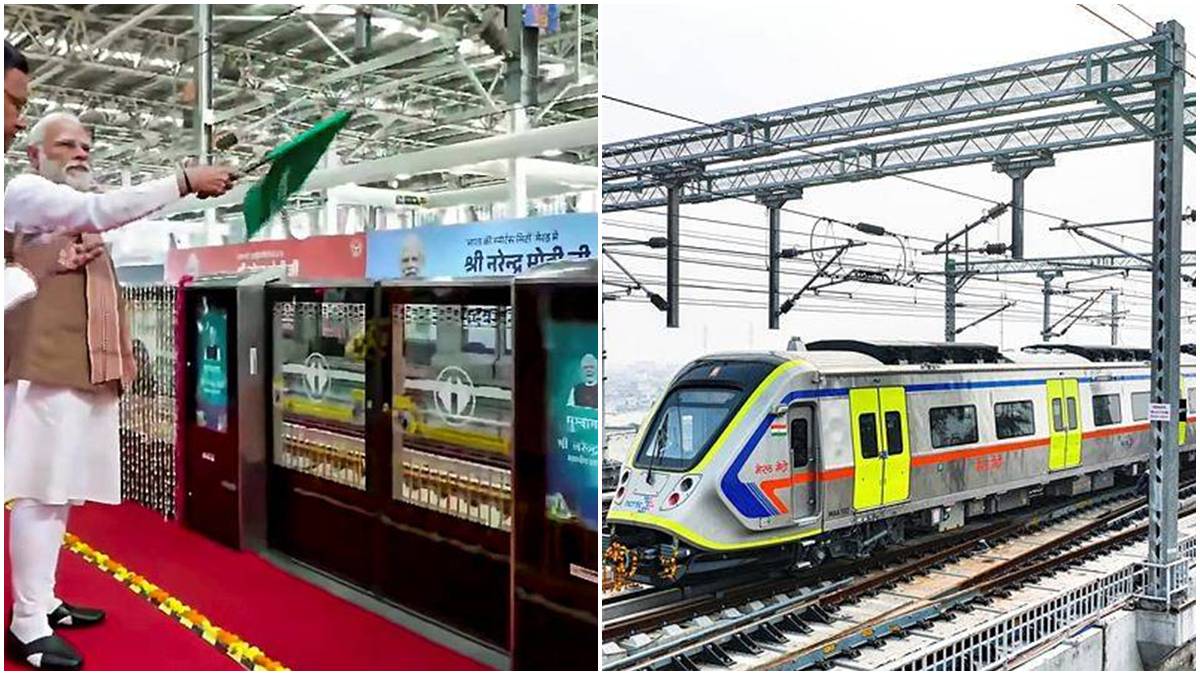
Prime Minister Narendra Modi on Sunday flagged off the Meerut Metro and inaugurated India’s first Namo Bharat Regional Rapid Transit System (RRTS), dedicating the full 82-km Delhi-Meerut corridor to the nation. The launch ceremony was conducted at Shatabdi Nagar Namo Bharat Station after which the Prime Minister undertook a metro ride to Meerut South.
The inauguration marks the completion of the entire Delhi-Meerut RRTS stretch, including newly opened sections between Sarai Kale Khan and New Ashok Nagar (5 km) in Delhi and Meerut South to Modipuram (21 km) in Uttar Pradesh.
Delhi gets high-speed link to Meerut: All you need to know
The Delhi-Meerut corridor spans 82.15 km, connecting Sarai Kale Khan in Delhi to Modipuram in Meerut, as per a report by The Indian Express. It is India’s first Regional Rapid Transit System (RRTS). A new chapter of semi-high speed rail designed to link major urban centres across a wider region faster than conventional metro systems.
With a design speed of 180 kmph, the Namo Bharat trains can run at up to 160 kmph, maintaining an average speed of around 90 kmph. The corridor has 16 stations, including main stops like Anand Vihar, Ghaziabad, Sahibabad, Modinagar, Muradnagar, Shatabdi Nagar, Meerut South, Modipuram and Begumpul.
Sarai Kale Khan, the originating station, is designed as a multi-modal transport hub, connecting with Hazrat Nizamuddin Railway Station, ISBT, the Delhi Metro Pink Line and Ring Road.
The RRTS aims to reduce travel time between Delhi and significantly, while easing road congestion and promoting regional economic integration.
Fare details
The prices for the Meerut Metro are likely to be similar to those for the Delhi Metro or Noida Metro. Early estimates say that the base ticket could cost about Rs 10, while the highest fare could be between Rs 40 and Rs 50. The Uttar Pradesh Metro Rail Corporation (UPMRC) will send out the official fare notice.
Namo Bharat vs Meerut Metro-Features and speed explained
While both operate on the same corridor in Meerut, Namo Bharat and Meerut Bharat serve different mobility purposes. The Meerut Metro runs on a 23 km stretch between Meerut South and Modipuram Depot. It is designed for a top speed of 135 kmph with a maximum operational speed of 120 kmph. Thus, making it India’s fastest metro system.
Namo Bharat features include:
- 2×2 transverse seating
- Overhead luggage racks
- Mobile and laptop charging sockets
- Double-glazed panoramic safety windows
- Public announcement and dynamic route display systems
- CCTV surveillance and fire detection systems
- Automatic plug-in doors and platform screen doors (PSDs)
- Dedicated wheelchair spaces
- A premium Coach with reclining seats
- A reserved coach for women
The trains are built for high acceleration and deceleration to match the high operational speeds and closely spaced stations.
Meerut Metro features include:
- Air-conditioned three-car trainsets
- Seating capacity of 173 and total capacity of over 700 passengers
- USB charging points and dynamic route maps
- CCTV cameras and emergency communication systems
- Reserved seating for women and senior citizens
- Platform Screen Doors for safety and crowd control
- Universal accessibility with lift access for stretchers and wheelchairs
What is the Regional Rapid Transit System (RRTS)?
The RRTS is a new-generation rail system designed for inter-city regional travel, faster than conventional metro systems but optimised for daily commuters. Unlike city metros that operate within urban limits, RRTS connects neighbouring cities with fewer stops and higher speeds.
With this launch, the Delhi–Meerut RRTS becomes the first operational corridor under India’s broader regional rapid transit vision.
In a post on X, Uttar Pradesh Chief Minister Yogi Adityanath described the inauguration as a “golden chapter” in the development journey of the state. The Prime Minister also inaugurated and dedicated projects worth approximately Rs 12,930 crore.