



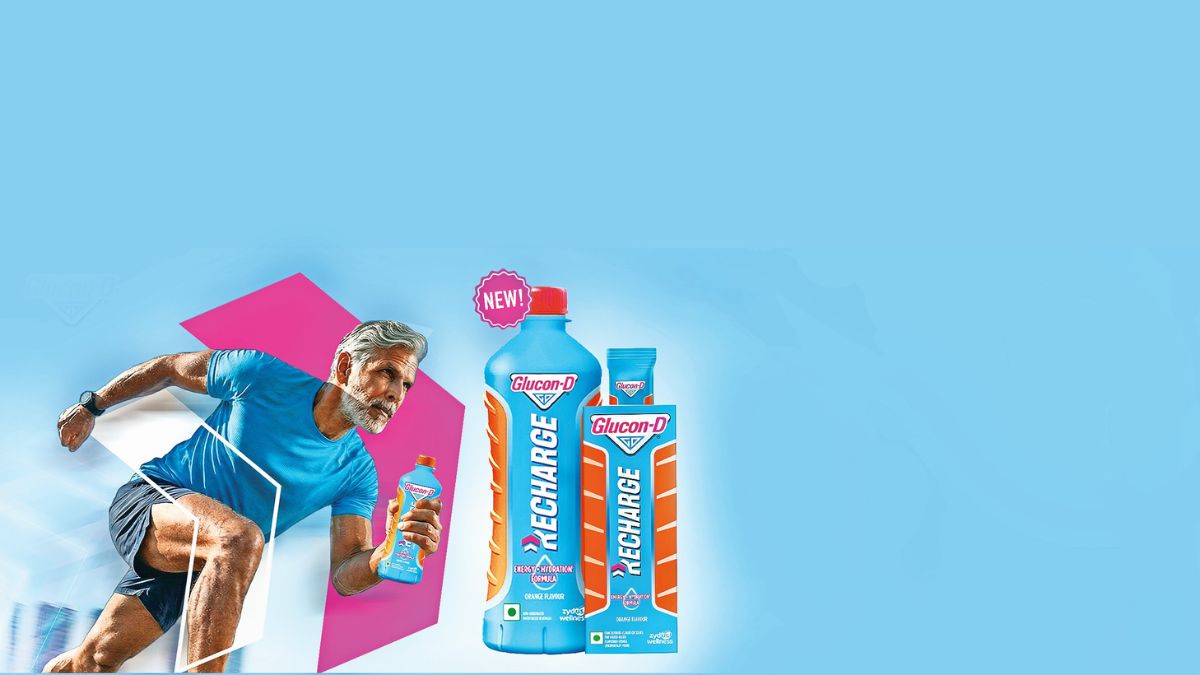
Legacy glucose powder beverage brand Glucon-D recently made its way into the performance and sports hydration segment with its new launch, Glucon-D Recharge. The new product range, combining glucose and electrolytes, will be sold in ready-to-drink bottles and sachet sticks. The launch marks the 93-year-old brand’s foray into a category that is estimated to be around Rs 650 to Rs 700 crore.
From a consumer lens, this launch is a natural progression for the brand, says Tarun Arora, CEO, Zydus Wellness.
“Our Glucon-D powders continue to support moments like heat-induced fatigue and daily tiredness, while Recharge fits into more active use cases such as after a walk, a run, or any sustained physical effort. We are aligning the brand with how consumers live today, more active, and looking for solutions that support them through everyday movement,” he says.
What do experts say?
Glucon-D’s brand equity and trust built over the past nine decades give it tremendous credibility, say experts, noting that the brand holds around 60% of India’s energy drink market today. Its challenge, however, will be to evolve the brand perception from just a “summer drink for children” to “science-backed performance hydration for active adults” without alienating existing consumers.
As per industry estimates, the category has been growing annually by around 10-12%, a positive sign for new entrants. That said, it is largely dominated by global brands such as PepsiCo’s Gatorade, which controls over half the market. Coca-Cola’s Powerade and HUL’s Liquid IV are major contenders in the category, in addition to a few digital-first brands.
Stiff competition
Clearly, Glucon-D Recharge faces stiff competition in a relatively niche market. Arora says the brand’s strategy hinges on leveraging Glucon-D’s reputation as a trusted household name to accelerate category adoption and drive market penetration. Another major focus is to make the category more familiar and approachable, since consumer surveys have indicated that most people find the performance hydration category intimidating, often associated with athletes.
Indeed, category penetration is in low single digits, which points to significant headroom for growth. “The performance hydration category is seeing strong momentum from two sets of players.
The first includes global brands expanding their footprint and the second is D2C startups, who are building scale through quick commerce and e-commerce. Our differentiation lies in scientifically designed formulations, backed by a disciplined approach to building the brand within the Glucon-D ecosystem,” says Arora.
Glucon-D Recharge is being sold at Rs 60 for a 500-ml pack and Rs 165 for a pack of five sachets. Gatorade and Powerade sell 500-ml bottles at Rs 50, but also offer 250-ml packs at a price of Rs 20. Experts say Zydus Wellness could take a leaf out of Reliance Consumer Products’ playbook — it disrupted the beverages category offering Campa Cola in small Rs 10- packs — to boost sampling and drive growth for Recharge.
Recipe for growth
Santosh Sreedhar, partner, Avalon Consulting, says new entrants in the category will need to play a different game, going beyond merely replicating the moves of incumbents. “New brands that localise their proposition will democratise the category by addressing everyday energy needs and will be able to target a larger market. Comparatively, global brands are built on performance athlete narratives that resonate with a small, premium segment in India,” says
Sreedhar.
“We want to address this by offering solutions combining scientific efficacy with trust and accessibility,” says Arora. One way in which the brand is building awareness and familiarity is by collaborating with fitness enthusiast Milind Soman for its marketing.
Brand experts, however, argue that while Soman is a great fit for Recharge and brings affinity across age groups, his following is skewed more towards urban and fitness-literate consumers. “Soman is useful for elevating brand perception, but that doesn’t automatically reach Glucon-D’s mass buyer. So, the
brand should continue broader communication to everyday consumers,” points out Nisha Sampath, managing partner, Bright Angles Consulting.
She adds that much like Amul, Glucon-D connects with mass consumers such as housewives, children and those participating in sports. “This is the audience that Glucon-D needs to address, and it is distinct from Gatorade’s. The first step is to build strong credibility around formulations for Recharge, whether it is through sports or medical professionals. Measurable results and product proof are also important,” says Sampath.
That apart, Sreedhar bats for an attractive price architecture and innovation in flavour. “In the carbonated drinks and juice categories, brands that introduced region-specific flavours like kokum, jamun, etc. have seen growth in localised sales, as it is a powerful differentiator. Targeting the Rs 10-20 price point with the right packaging could also address a larger market,” observes Sreedhar.
Experts add a note of caution while navigating health concerns around sugar consumption, stressing that the brand should directly address these rather than sidestep them. “This will allow Glucon-D to claim its place as the country’s hydration expert, while anchoring the Recharge portfolio around low and no sugar formulations,” says Sampath.