


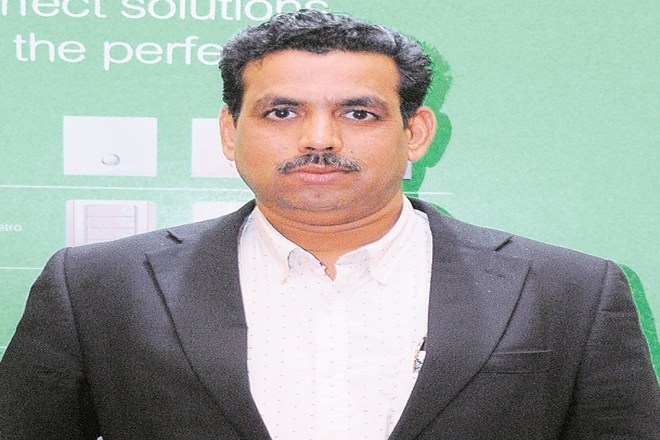

Global energy management and automation giant Schneider Electric has been gradually getting into the retail space in the country. In the last 20-25 years, the company has already established itself as a formidable B2B brand in the Indian power sector. Though a late entrant in retail, it wants to be among the top three players in the Rs 5,000-crore market for MCBs and wiring devices in the next three years. In an interview with Anupam Chatterjee, Srinivas Shanbhogue, vice-president —retail, Schneider Electric India, shares the company’s plans to make inroads in the segment, betting on the changing taste and lifestyle of Indian consumers. Excerpts:
How do you want to capture the retail market in the country?
We want to get into every home and every room, and the retail route is the best way to do that. We feel that the consumer market is the biggest thing in the future. Today, the country has close to two lakh electrical outlets spread in every nook and bylane. Currently, the presence of Schneider Electric is not palpable in these retail shops. It has been about two years since we started our B2C journey and we have started making inroads. We have slowly started developing products and solutions keeping the consumer market in mind. In another three years, we want to be one of the top three players in this domain.
What products do you offer in this segment?
Primarily, we have two product lines in the retail segment: Protection equipment such as miniature circuit breakers (MCBs), residential current circuit breakers (RCCBs) and distribution boards. The second line is wiring devices (switches and sockets). We want to remain focussed and not come up with an entire basket of products. A lot of companies are already present in this crowded market offering a plethora of products.
In this crowded market, how do you plan to get more visibility?
We want to create safety awareness among consumers, to insulate themselves from the frequently heard fire accidents and short circuits. People spend a lot of money in the residential segment, especially on the extrinsic aspects such as tiles and toilets. Not much is spent on safety of the property and people living inside. We are creating awareness not only among consumers, but also in the huge electrician fraternity in the country who are engaged in installation and maintenance of these products. Unlike other countries, most of the electricians here are semi-skilled with a lot of school dropouts taking up the profession. We are trying to train them, educating them about the products they should be using and instilling the importance of safety. We have already trained more than 50,000 electricians through our programmes.
Are you planning to come up with stand-alone retail shops in the future?
We believe in the partner model. Today, we have more than 500-600 distributors and close to 5,000 points of sale. We will keep expanding them and through these people we will showcase and create experience zones in the cities for people to get a feel of the products. Also, we use the digital space. We are the first company in the country to come up with an exclusive app for our partners to explore the entire gamut of our products. Electricians can use this app to canvass our product line to the houses they visit.
What makes India different from the other global markets?
We already have strong presence in the retail segment in most of Europe, Australia and south-east Asia. We are catching up in China. India is a diverse market with value of properties ranging from Rs 25 lakh to Rs 25 crore. Unfortunately, the industry has traditionally been a laggard in the front of luxury, which is one of the biggest trends we see here right now. There are not many varieties of MCBs and switches that the market offers right now. You find the same switch in the Rs 25-lakh house and the Rs 25-crore mansion. We want to be the first company to cater to the smallest affordable homes to the largest palaces.
Which are the main growth drivers in this business?
The population here is essentially young, brand-conscious and interested in technology and other new trends. Contrary to the scenario prevalent two decades ago, people now want to constantly update their gadgets. This allows us to launch products in developed countries and India simultaneously. Nowadays, people are fascinated by the idea of connected homes where they want to control their home-lighting through mobile apps. We want to latch on to this trend and develop a lot of connected products. We have launched quite a few products keeping this in mind. We want to offer different products for different societies, providing wider range and choice.