




India’s unsecured lending cycle may be entering a new phase, with personal loans emerging as the key driver of growth for banks and non-banking financial companies. UBS expects improving asset quality, surplus system liquidity and a more supportive lending environment to help revive credit growth, with NBFCs positioned to benefit from the shift.
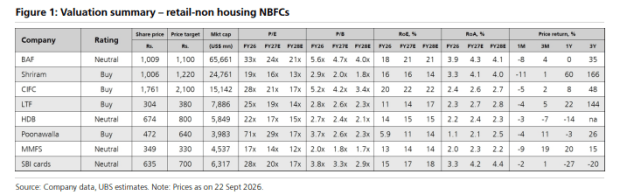
In its September 22 report, UBS has identified L&T Finance, Cholamandalam Investment & Finance, Shriram Finance and Poonawalla Fincorp as its most favoured NBFCs. It also likes ICICI Bank, HDFC Bank and Axis Bank among lenders that could benefit from a pickup in personal loans.
UBS on L&T Finance: ‘Buy’
UBS upgraded L&T Finance from ‘Neutral’ to ‘Buy’ and raised its target price to Rs 380 from Rs 350. The brokerage sees the company leading its NBFC coverage on loan growth, supported by faster expansion in personal loans and a shift towards higher-yielding segments.
UBS expects L&T Finance to sustain a 24% loan compound annual growth rate over FY26-FY28, with loan growth estimated at 25% in FY27 and 24% in FY28. “LTF has had strong loan growth acceleration from 14% in FY25 to 25% in FY26, with further acceleration in Q1FY27. That has been driven by a strong pick-up in personal loan growth, with a partnership model and new AI initiatives aiding overall agility across products,” UBS said.
UBS also expects loan growth of 25% in FY27 and 24% in FY28 for L&T Finance, while its net interest margin forecast stands at 8.6% and 8.4%, respectively.
UBS on Shriram Finance: ‘Buy’
UBS has retained a ‘Buy’ rating on Shriram Finance and included the company among its four most-favoured NBFCs. The brokerage expects loan growth of 19% in both FY27 and FY28.
Shriram Finance has a large commercial vehicle franchise, with commercial vehicles, construction equipment and tractors accounting for 53% of its loan book. Cars and two-wheelers contribute another 28%, while business loans and MSME lending account for 13%.
UBS expects net interest margin to improve to 10% in FY27 from 8.9% in FY26 before easing slightly to 9.9% in FY28. The brokerage expects the company’s growth to be supported by the broader recovery in credit demand, while improving conditions in personal loans and other retail segments should add to the growth mix.
The brokerage has also pointed to improving asset quality across unsecured products. According to UBS, credit bureau data for August showed some of the strongest recent trends in the 1-30 day and 30-90 day past-due buckets across banks and NBFCs. That backdrop forms part of the broader case for a recovery in lending growth.
UBS on Poonawalla Fincorp: ‘Buy’
Poonawalla Fincorp is one of the four NBFCs UBS lists under its most-favoured names. The brokerage expects the lender to remain among the fastest-growing names in its coverage, with loan growth estimated at 36% in FY27 and 32% in FY28.
Poonawalla has a relatively high exposure to personal loans and business lending. UBS’s loan mix shows personal loans accounting for 28% of its book, business loans and micro, small and medium enterprise lending another 27%, and loans against property 28%.
The brokerage expects the company’s net interest margin to recover to 7.7% in FY28 from 7% in FY27.
Poonawalla’s estimated 36% loan growth in FY27 is the highest among the large NBFCs covered by UBS, followed by 32% growth in FY28. The brokerage’s sector view is that the improvement in personal loan growth should help earnings growth across its preferred lenders as the earlier earnings downgrade cycle comes to an end.
UBS on Cholamandalam Investment & Finance: ‘Buy’
Cholamandalam Investment & Finance Company, or CIFC, is another stock UBS has retained under its most-favoured NBFC names. The brokerage estimates loan growth of 23% in FY27 and 21% in FY28.
The company’s loan book remains diversified across commercial vehicles, construction equipment and tractors, cars and two-wheelers, loans against property and business lending. Commercial vehicles, construction equipment and tractors account for 33% of loans, while cars and two-wheelers contribute 20% and loans against property 23%.
UBS expects CIFC’s net interest margin to remain stable at around 6.9% in both FY27 and FY28, compared with 6.8% in FY26. The brokerage has also raised its earnings estimates for the company.
“Personal loans are likely to lead the next leg of growth,” UBS said in its sector thesis, pointing to improving asset quality across unsecured lending and a recovery in personal loan growth.
Bajaj Finance: UBS upgrades to ‘Neutral’
Bajaj Finance Ltd. also features prominently in the UBS report, but the brokerage does not rate it ‘Buy’. UBS upgraded the stock from ‘Sell’ to ‘Neutral’ and raised its target price to Rs 1,100 from Rs 910. The change indicates expectations of cyclical earnings upgrades, yield-accretive growth and stronger asset quality.
UBS said Bajaj Finance’s asset-quality problems have largely been addressed. Stage 2 and 3 urban personal loans declined to 2.8% in June 2026 from 3.2% in March 2025, while credit costs fell to 1.5% in the first quarter of FY27 from more than 2% in FY26.
“Bajaj Finance’s growth delta is driven by secured segments, such as vehicles and gold. While gold yield is similar to the company’s other yields, vehicles have lower ROA; thus, given BAF’s size, maintaining ROA at ~4% structurally will be difficult,” UBS said.
The report therefore places Bajaj Finance alongside the preferred NBFC names as a key beneficiary of the improving unsecured lending cycle, but its current UBS rating is ‘Neutral’, rather than ‘Buy’.
Why UBS sees a new personal loan cycle
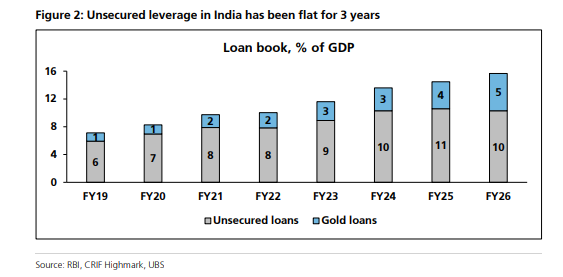
UBS’ preference for these NBFCs comes against a broader shift in India’s unsecured credit market. The brokerage said unsecured leverage has remained broadly stable for the past three years after rising from 6% of GDP in FY19 to 10% in FY24.
At the same time, gold loans expanded from around 1% of GDP to about 5% by FY26. UBS expects gold loan growth to moderate as gold prices stabilise, potentially leaving more room for personal loans to drive the next phase of unsecured credit growth.
The brokerage also expects system liquidity to remain supportive. UBS is building in a 15-20 basis point increase in FY27 funding costs, but believes the impact of higher rates should remain manageable because of the liquidity surplus.
Disclaimer: This article is based on UBS Global Research’s India Financials: The beginning of an unsecured upcycle? report dated September 22, 2026. The views, estimates, ratings, targets and forecasts cited above are those of UBS and are subject to change. This article is for informational purposes only and should not be construed as investment advice, a recommendation to buy or sell any security, or a guarantee of future returns. Investors should conduct their own research and consult a qualified financial adviser before making investment decisions.