



The goods and services tax (GST) collections for January fell marginally to Rs 86,318 crore from Rs 86,703 crore in the previous month, belying the government’s expectations that a shrinking of transitional credit claims and an expansion of the base might have taken the revenue to a higher orbit. Analysts felt that lower-than-expected GST revenue for the first month of 2018 might force the government to hasten the introduction of anti-evasion measures such as invoice-matching and reverse charge on transactions with unregistered dealers, besides the e-way bill, which is slated to be rolled out from April. The stagnation in collections might also lead to tighter scrutiny of residual transitional credits and a slower pace in refunding the tax to exporters, even though they are expecting a pick-up in refunds towards the end of the financial year. The possibility of significant rate cuts at the GST Council’s March 10 meeting has also been dented, given the lack of strong evidence suggesting lower rates will boost compliance to an extent necessary to add incremental pace to revenue growth. According to a government statement, 69% of eligible taxpayers — nearly 58 lakh — had filed returns for January by February 25, slightly higher than the previous month. This was even as over 1 crore businesses are now registered for GST ( just over 87 lakh taxpayers are required to file the monthly returns). The total collection under central GST and state GST for January stood at Rs 25,560 crore and Rs 33,440 crore, respectively.
These figures include transfers of funds from integrated GST to both CGST and SGST by way of settlements. This reflects that the CGST revenue, constrained so far owing to the huge transitional credit claims (about Rs 1.6 lakh crore), is yet to gather pace. The recent Budget has estimated monthly CGST revenue during the current fiscal to be Rs 27,675 crore and an additional over Rs 20,238 crore is expected to reach the central exchequer as its share of the accumulated IGST, taking the Centre’s total share of GST (gross, before mandatory transfers to states) to Rs 47913 crore. As against this, the Centre’s average monthly GST proceeds for 2018-19 is projected to be Rs 54,491 crore, a growth of 14%. Though this was not seen by many as overly ambitious, the current trend in collections retains the threat of a shortfall. As for states, since they are to be compensated for any revenue shortfall from the revenue level a 14% annual growth from the relevant 2015-16 base would entail, subdued GST buoyancy is less of a serious threat to their revenue.
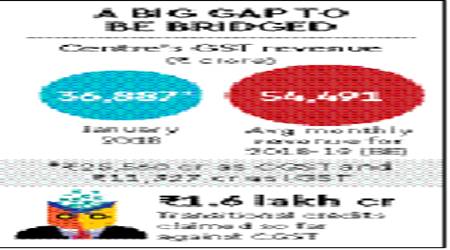
The government said: “Further, Rs 11,327 crore is being transferred from IGST to CGST account and Rs 13,479 crore is being transferred from IGST to SGST account by way of settlement of funds on account of cross utilisation of IGST credit for payment of CGST and SGST respectively or due to interstate B2C transactions.” It added that Rs 8,331 crore was collected through the compensation cess in January. Although 17.65 lakh assesses had signed up for composition scheme till last month, over 1 lakh of them have opted out of the scheme to be regular taxpayers. GST collections dwindled from a high of over Rs 92,000 crore in July to around Rs 80,000 crore in November before rebounding to Rs 86,703 crore in December. Pratik Jain, partner and leader, indirect tax, PwC India, said: “With the roll-out of the e-way bill getting deferred to April and a continuing shortfall in the number of monthly returns getting submitted, we may see administrative tightening and more rigorous anti-evasion measures in the next few months. One can also expect a closer scrutiny of opening credit claimed by businesses.” According to MS Mani, senior director at Deloitte India, “It is good to see that more than 1 lakh taxpayers have opted to move out of the composition scheme and become normal dealers — this will pave the way for an expansion of the tax base and lead to more collections.”