



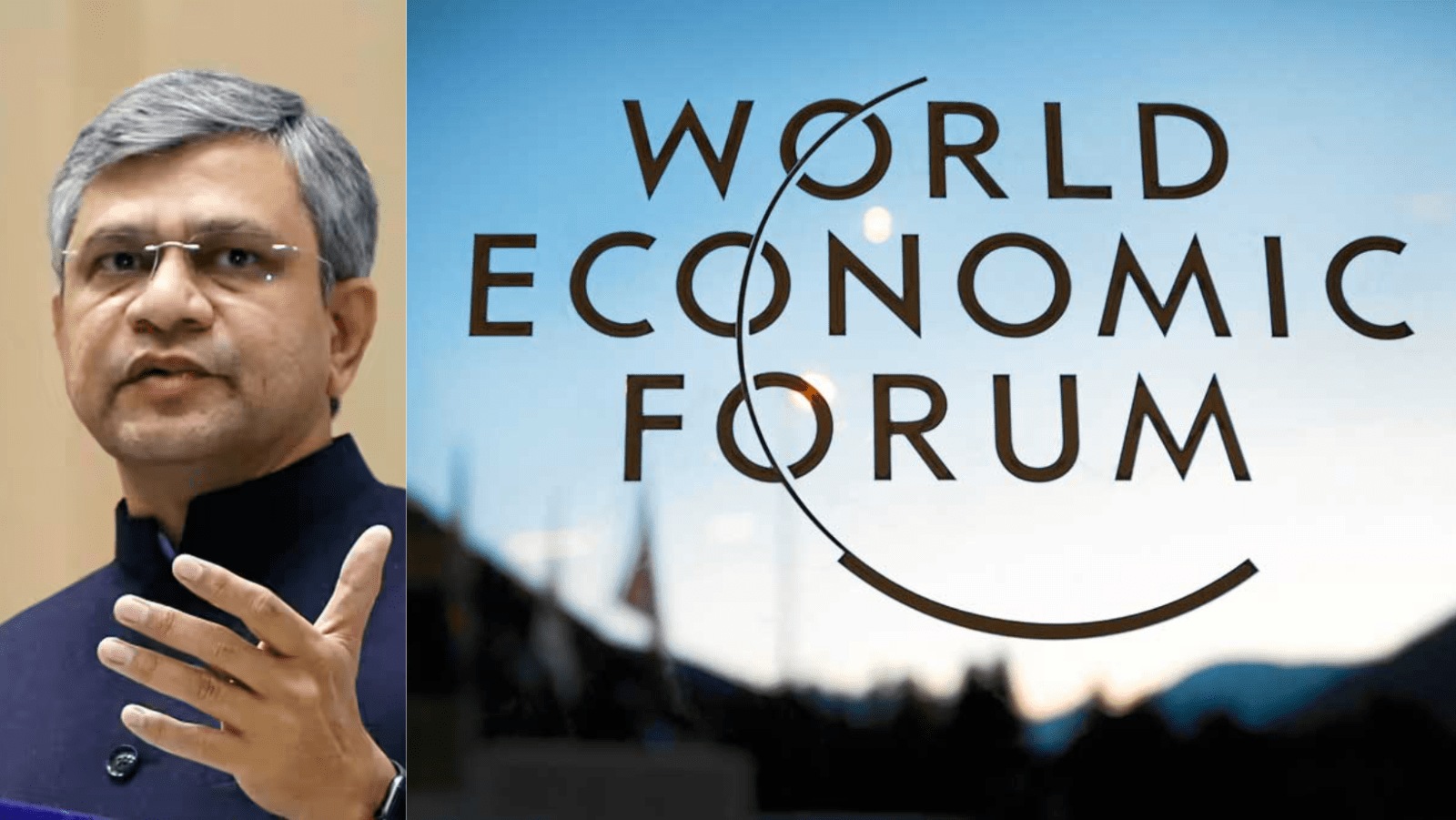
As the Alpine town of Davos opens its doors to the world’s most influential decision-makers, India arrives at the World Economic Forum Annual Meeting 2026 with one of it largest delegations ever. The five-day summit, beginning January 19, is being held under the theme ‘A Spirit of Dialogue’, at a time when the global economy is dealing with slowing growth, geopolitical tensions, technological change and weakening trust between nations.
India’s largest and most diverse delegation
At least four Union Ministers are attending, including Railways Minister Ashwini Vaishnaw, Agriculture Minister Shivraj Singh Chouhan, Renewable Energy Minister Pralhad Joshi, and Civil Aviation Minister K. Rammohan Naidu. National Security Advisor Ajit Doval is also part of the delegation.
Six Chief Ministers are expected, which clearly shows India’s push to showcase states as independent investment destinations. These include Maharashtra’s Devendra Fadnavis, Andhra Pradesh’s N. Chandrababu Naidu, Assam’s Himanta Biswa Sarma, Madhya Pradesh’s Mohan Yadav, Telangana’s A. Revanth Reddy, and Jharkhand’s Hemant Soren.
The purpose of the large delegation could be that India’s growth story is no longer limited to a few big cities, but spread across competitive state ecosystems.
The India Pavilion and a clear investment pitch
The India Pavilion carries a good message that is, ‘Partner with Bharat and subscribe to the future.’ Industry body Confederation of Indian Industry also has parallels to this through its pavilion slogan, ‘Partner India Inc, subscribe to a reliable future’. Several Indian IT majors have also set up lounges and pavilions, with artificial intelligence as the common theme. Wipro is pitching “AI and beyond”, Tata Consultancy Services says it is embedding AI into every service.
Infosys, HCL Technologies, and Tech Mahindra are close by. Several state governments, including Andhra Pradesh, Karnataka, Maharashtra, Madhya Pradesh, Jharkhand, Uttar Pradesh, Kerala and Telangana, are using the platform to present investment-ready projects in manufacturing, infrastructure, clean energy, electric mobility and digital services.
States take centre stage
Day one at Davos saw India rely less on rhetoric and more on readiness. Maharashtra set the tone early, with Chief Minister Devendra Fadnavis creating a sort of cultural diplomacy and economic intent. Welcomed by members of the Indian diaspora through traditional Lezim performances and the Wari pilgrimage tradition, he said, “For a moment, it felt as if I was in Maharashtra, not Zurich.”
Fadnavis outlined Maharashtra’s ambition to become a $1 trillion economy by 2030 and spoke of the proposed ‘MahaNRI Connect’ platform to bring the global Marathi diaspora into a structured system for collaboration. “Our diaspora is doing meaningful and transformative work across the world,” he said. “These efforts should connect back to Maharashtra.”
Assam Chief Minister Himanta Biswa Sarma is attending WEF for the first time and is expected to hold more than 17 high-level meetings, while Telangana is highlighting data centres, green energy and emerging technologies. Kerala is pitching opportunities in tourism, healthcare and human capital.
Corporate India brings proof of quality
Indian industry arrived with evidence in Davos. The World Economic Forum announced that Hindustan Unilever Limited factories in Gandhidham and Pondicherry had been recognised as Advanced Fourth Industrial Revolution Lighthouse sites. According to WEF, the Gandhidham plant reduced water use by 17 per cent and cut Scope 1 and 2 emissions by 90 per cent, the Pondicherry unit achieved 25 per cent volume growth and a 23 per cent reduction in defects using machine learning-driven optimisation. For India, this recognition strengthened its case as a serious manufacturing and innovation hub.
Global risks, Indian confidence
WEF’s Global Risks Report has warned that geoeconomic conflicts are the biggest threat facing major powers in 2026, but cybersecurity remains India’s top risk. Tariffs and supply chain disruptions could heighten the risk of a slowdown. However, the tone from WEF leadership on India remains optimistic.
“Dialogue is not a luxury, it is a necessity,” said WEF President and CEO Børge Brende. He added, “I still think this year India will be the fastest growing of the large economies. And we have numbers now showing that India can maybe make up for 20 per cent of all global growth… So, then India is not only growing for India, but that growth is also contributing to everyone on our planet.”
He also noted, “The Modi government made some concrete reforms that I did expect, but not so fast and so forcefully. That’s why I am also more bullish on the Indian economy.”
Who will attend the event?
More than 3,000 leaders from governments, businesses, academia, civil society and labour unions are expected at the meeting. Over 60 heads of state or government, 30 foreign ministers, 60 finance ministers and central bank governors, and more than 30 trade ministers will be part of the discussions.
Among them, Donald Trump is set to be the biggest draw. US President is bringing the largest-ever American delegation to Davos, including Secretary of State Marco Rubio, Treasury Secretary Scott Bessent, Commerce Secretary Howard Lutnick, Energy Secretary Chris Wright, and US Trade Representative Jamieson Greer.
Other prominent leaders attending include Canadian Prime Minister Mark Carney, German Chancellor Friedrich Merz, French President Emmanuel Macron, European Commission President Ursula von der Leyen, Chinese Vice-Premier He Lifeng, and Swiss President Guy Parmelin.
Day one at Davos rarely delivers big announcements. It sets the tone. In 2026, India used that opening moment to position itself as a country ready to absorb investment, not just attract attention. Through state-level leadership, factory-level proof and a clear, execution-focused pitch, India has made its intent clear.