



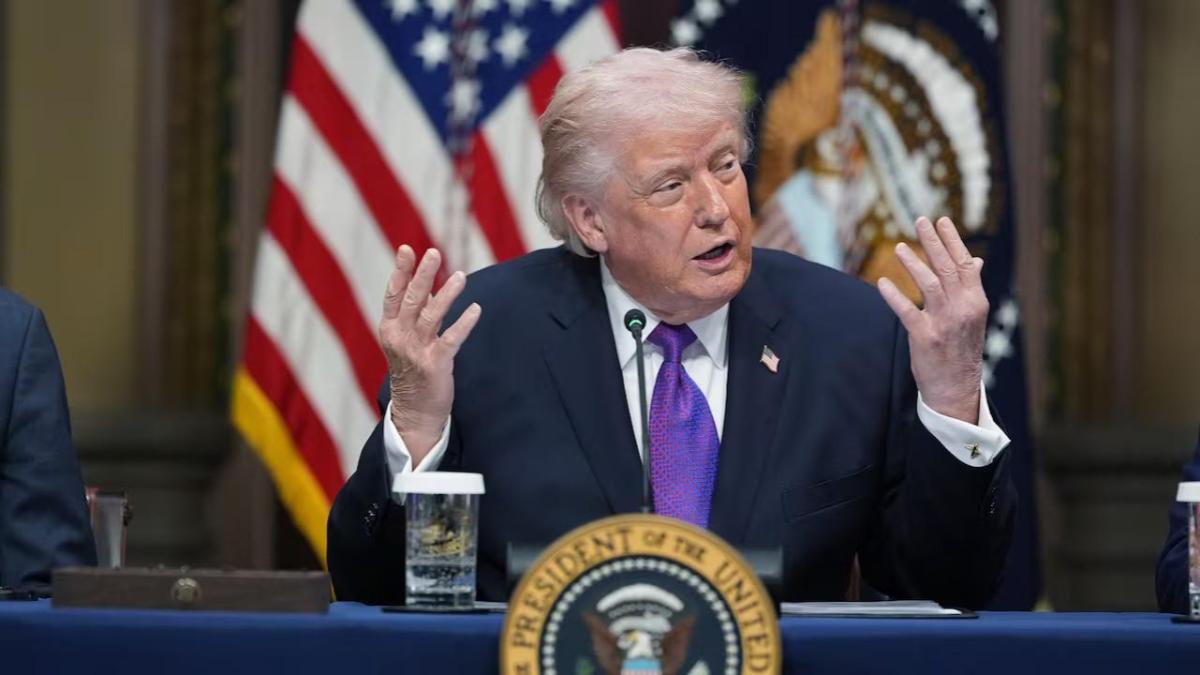
US President Donald Trump has claimed victory over Iran — repeatedly insisting that “nobody has ever seen anything like” his ongoing strikes. Both sides have rejected calls for negotiation and there appears to be no clear timeline or objectives outlined by the US-Israeli forces.
“The situation with Iran is moving along very rapidly. It’s doing very well. Our military is unsurpassed. There’s never been anything like it. Nobody’s ever seen anything like it,” Trump said on Thursday evening.
Trump has claimed dozens of times over the past two weeks that America “won” within the first hour of war. The President has also insisted that US forces were “ ahead of the timetable” and had “practically nothing left to target” — even as the US and Israel continued targeting locations within Iran and Lebanon.
“We have hit them harder than virtually any country in history has been hit, and we’re not finished yet…We took out just about all of their mine ships in one night. We’re upto number 60. I didn’t realise they had that big a navy. I would say it was big and ineffective. But every one of their ships, just about all of their navy is gone, at the bottom of the sea…Right now, they’ve lost their navy, they’ve lost their air force. They have no anti-aircraft apparatus at all. They have no radar. Their leaders are gone,” he said on Wednesday.
But claims of the Iran war being an “unprecedented” situation may not be quite the victory Trump envisions. Crude oil prices remain firmly above the $100 mark and a virtual shutdown of the Strait of Hormuz has strangled global trade. Seven American soldiers have been killed and several others injured — with the POTUS claiming that more were “likely” to die in the war. Pentagon officials were also told during a closed briefing that the first six days of war cost America $11.3 billion. The US has also been forced to withdraw its objections to Russian oil purchase amid the Gulf chaos — temporarily ‘allowing’ countries to purchase Russian oil currently stranded at sea.
The astronomical cost of war
According to the Pentagon, the first week of war cost the United States $11.3 billion. Reports indicate that this figure does not include resources invested in personnel buildup and military hardware ahead of the strike. According to reports by the New York Times and the Washington Post, the US military used $5.6 billion in the first two days of war. The cumulative costs are expected to grow as the Pentagon continues its calculations.
The figure is separate from the multi-billion-dollar damages incurred by American bases amidst Iranian strikes. Hard losses to America include the $1.1 billion Al Udeid Early Warning radar in Qatar, THAAD radar components worth $1 billion and the three F-15E Strike Eagles lost in ‘friendly fire’ over Kuwait (around $282 million). The US has lost at least four MQ-9 Reaper drones worth $120 million and SATCOM terminals in Bahrain and Kuwait worth another $50 million. Many US-linked locations across the Middle East have also suffered extensive structural damage during Iranian strikes.
Soaring oil prices
The Strait of Hormuz closure has also sent gasoline prices soaring across America ahead of the crucial midterm elections. Trump had bragged about gas prices at $2.30 a gallon only last month, but recently insisted that high oil prices were actually a positive change. According to AAA data, gas prices have soared more than 50% over the past two weeks to a national average of $3.60 a gallon. The about-face comes as his team has struggled to offer a clear plan for opening up the critical Strait of Hormuz so tankers full of oil and natural gas are no longer stranded.
“The United States is the largest Oil Producer in the World, by far, so when oil prices go up, we make a lot of money,” Trump insisted via Truth Social on Thursday.
Markets down, trade hit
The Strait of Hormuz remains under a virtual blockade despite claims that the Iranian navy has been decimated. Shipping transits have dropped more than 90% since the war began and global insurance companies remain extremely reluctant to provide ‘war risk’ coverage for the area. This means that many countries around the world are not getting their expected oil and gas. Others face massive export and import losses as ships remain ‘trapped’ in transit or docked at distant ports.
Goldman Sachs slashed their US economic growth outlook in a report released on Monday — warning of a 25% recession risk specifically because of the war and trimming the GDP forecast. They estimate that every 10% rise in oil prices will wipe out roughly 0.2% of GDP growth.
Soldiers dead, four US aircraft crash in two weeks
An American KC-135 aircraft crashed in Iraq with at least five US service members on board. The incident on Thursday night is the fourth publicly acknowledged US aircraft to crash since it joined Israel to attack Iran two weeks ago. According to the American military, none of the four planes was destroyed during actual combat or Iranian strikes. Officials said last week that three American fighter jets were mistakenly downed by friendly fire from Kuwait. All six crew members had ejected safely from the F-15E Strike Eagles and were in stable condition after recovery.
Pentagon said earlier this week that seven American troops have been killed in combat during the Iran war. Another 140 US service members have been injured, including eight severely. Both President Donald Trump and Defence Secretary Pete Hegseth have warned that the Iran war would “likely” claim more American lives before it ends.
US caves on Russian oil purchase
The United States has now ‘allowed’ countries to purchase Russian oil currently stranded at sea after spending months punishing various nations for trading with Moscow. US Treasury Secretary Scott Bessent insisted the move was temporary as he ‘unsanctioned’ approximately 128 million barrels of oil till April 11.
But it comes as an awkward about-face for the US after it spent months accusing India of “financing Putin’s war machine” in Ukraine and imposing a stiff 25% tariff. This was lifted days before the Iran strike — with the US insisting that New Delhi had promised to pivot away from Russian oil. Energy Secretary Chris Wright dubbed it a “practical way to get supply flowing and ease pressure” last Friday.
“We reached out to our friends in India and said: Buy that oil and bring it into your refineries,” he told ABC News during a recent interview.