



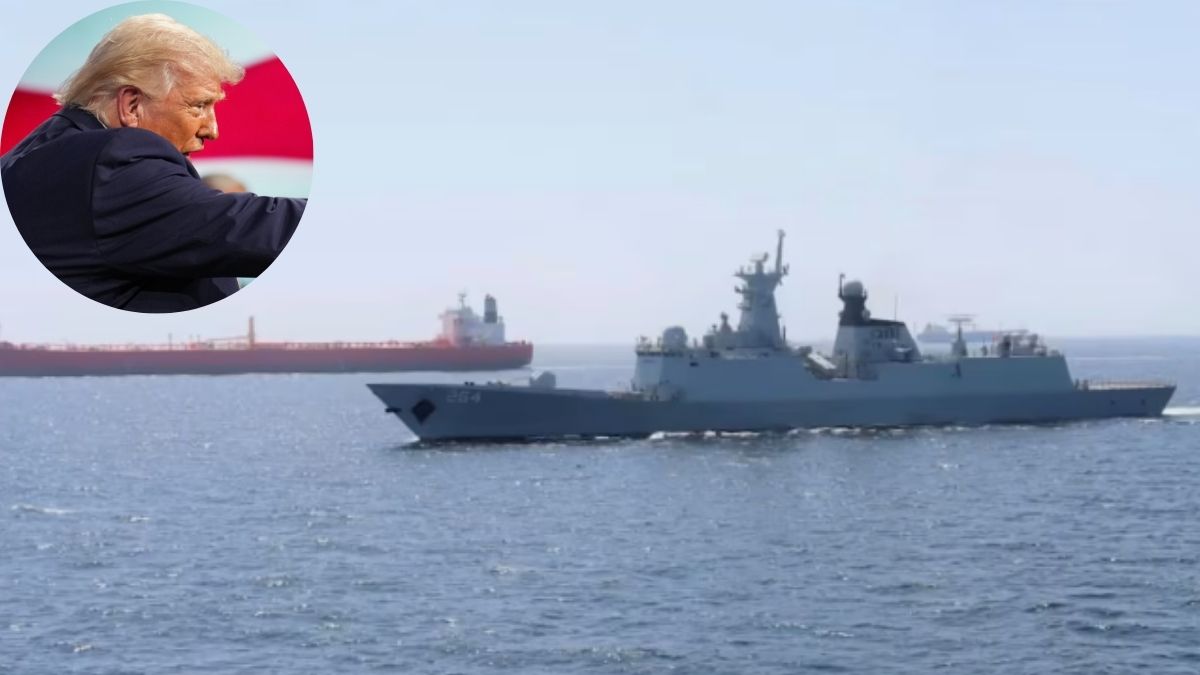
The two-week ceasefire between the United States and Iran has sent Brent crude crashing nearly 14% to around $94-95 per barrel and triggered a euphoric rally across global stock markets. Sensex surged nearly 3,000 points (4%) to 77,605 on Wednesday, the Nifty jumped 3.85% to 24,014.
But beneath the relief rally lie far more consequential questions that markets have not yet priced in: Is the Strait of Hormuz open? Will operations return to the pre-war era, and who will control the corridor after the guns go silent?
Even though there were reports of two ships crossing the strait after the announcement, a Wall Street Journal report states Iran is still threatening to destroy the ships if they do not seek permission.
“You must receive permission from Iranian Sepah navy for passing through the strait. If any vessel tries to transit without permission, will be destroyed,” an Iranian official was heard saying in an audio shared by WSJ.
Meanwhile, A senior Iranian official has told Reuters they could open the Strait of Hormuz on Thursday or Friday.
Strait of Hormuz: A Reality Check
The situation is far from normal at Hormuz, with over 800 vessels trapped in the Persian Gulf as shipowners scramble to understand the fine print of the deal, according to a Bloomberg report.
Lloyd’s Market Association has clearly warned that the ceasefire likely won’t lead to a quick resumption of transits, stating the risks to transit haven’t been eliminated overnight.
“Time will tell whether it is a pause or a peace but, in the meantime, it is highly unlikely that trade into the Gulf will simply resume. The region remains at heightened risk with none of the underlying tensions resolved,” Neil Roberts, head of marine and aviation at the LMA told Bloomberg.
‘The ships previously unable to leave will now try to do so as soon as the owners and master deem it is safe to do so,” he added.
Henning Gloystein of the Eurasia Group is cautious too. “The first thing to see is whether ships can safely pass through the Strait of Hormuz,” he told CBS news. “If they pass freely, it’s possible that Qatar starts repairs to its Ras Laffan facilities, but I don’t think they can ramp up production within the two-week ceasefire window.”
Meanwhile, Danish shipping company Maersk echoed his statement that the ceasefire could open some opportunities, but does not yet provide enough security certainty to resume normal operations.
“At this point, we take a cautious approach, and we are not making any changes to specific services,” the shipping group said in a statement.
“Any decision to transit the Strait of Hormuz will be based on continuous risk assessments, close monitoring of the security situation, and available guidance from relevant authorities and partners,” it added.
The deal that isn’t quite a deal
The ceasefire struck between Donald Trump and Iran itself rests on a fundamental ambiguity, and many including vice president Vance have termed it ‘fragile’.
Trump demanded the “COMPLETE, IMMEDIATE, and SAFE OPENING” of the strait. But, Iran’s Foreign Minister Abbas Araghchi offered something different, a safe passage through the Strait of Hormuz via coordination with its Armed Forces and with due consideration of technical limitations.
The gap between those two statements is where the post-war order of the world’s most important energy chokepoint will be negotiated.
Peace talks are expected to begin in Islamabad on Friday, April 10.
‘Hormuz is not a tool to end the war — it’s how Iran wins the aftermath’
Mohammad Eslami of the University of Tehran and Zeynab Malakouti of the National University of Singapore told Democracy Now this week that Iran’s thinking on the Strait has undergone a fundamental shift since the war began on February 28.
According to Eslami, Iran now regards its pre-war decision not to assert control over the strait as a “historical mistake.” Tehran is not treating Hormuz as a temporary bargaining chip to trade for a ceasefire, it sees the waterway as a permanent strategic lever for the postwar period.
The domestic legal track confirms this. Iran’s parliament has already passed legislation formalising transit tolls on vessels passing through the strait.
Trump also wants a piece of this toll. in an interview with ABC News he has hinted at a joint toll between US and Iran. Something, Iran needs to agree upon.
The Conversation lays out three scenarios for the Strait’s future. The most likely, it concluded, is a ceasefire that leaves the strait predominantly in Iranian hands, with Tehran imposing ongoing tolls on foreign shipping, a practice prohibited under international law during peacetime, but one Iran may pursue regardless.
The second scenario, a US ground operation, was deemed unlikely given the absence of allied support.
The third, a UN-mandated naval coalition, remains a possibility, with the UK coordinating discussions with Australia and other partners on April 2, and UN Security Council Resolution 2817 already addressing navigation security in the Gulf.