



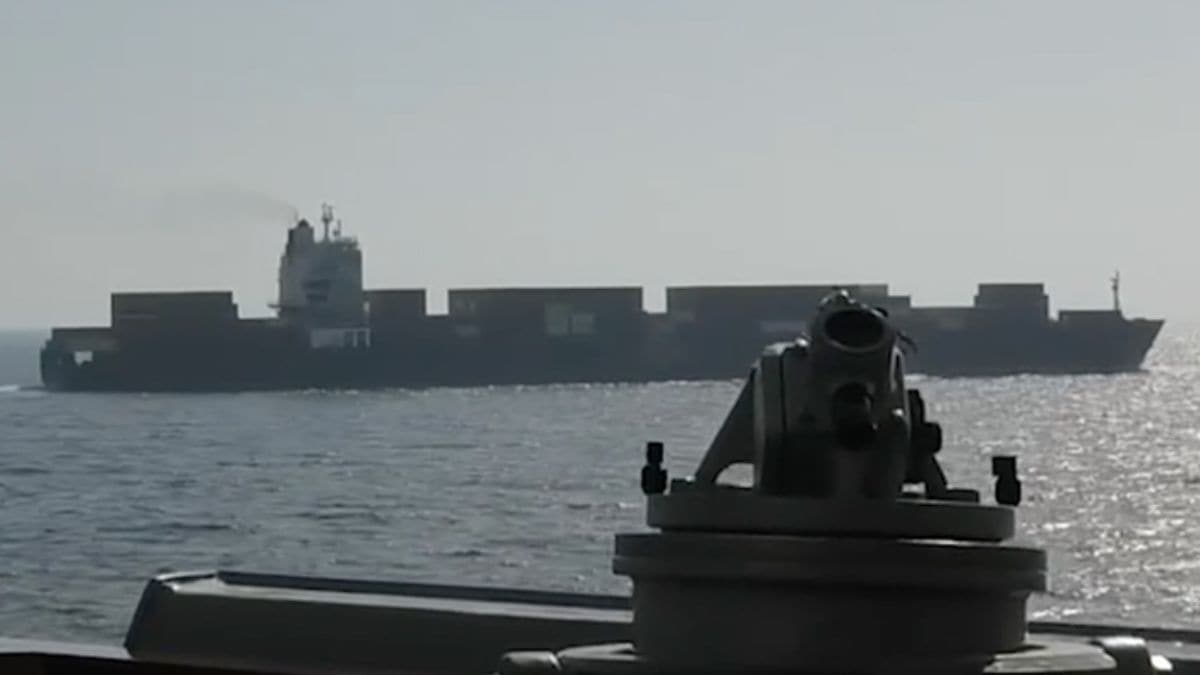
The United States has seized an Iranian-flagged cargo ship named Touska after firing at its engine room to stop it in the Gulf of Oman. The move marks the first time the US has used force in the naval blockade of Iranian ports that began last week.
US President Donald Trump announced the operation on Sunday, April 19, saying the ship tried to break through the blockade near the Strait of Hormuz.
The action comes at a highly sensitive moment, with American officials preparing for a second round of peace talks with Iran in Pakistan. Those talks were expected to begin as early as Monday, but Iran has now canceled its participation, citing the continued US naval blockade and ‘unrealistic American demands.’ Tehran has already described the ship seizure as a violation of the ceasefire and warned of a “swift response,” raising fresh fears that the fragile truce may not survive.
US Navy seizes an Iranian-flagged ship near Strait of Hormuz- where is it now
US Central Command, which oversees American military operations in the Middle East, said the ship refused to stop for six hours despite repeated warnings. The Navy then ordered the crew to evacuate the engine room before firing several rounds from a 5-inch MK45 gun into that section of the vessel to disable it. After that, US Marines boarded the ship and took control.
Trump also said the Touska had already been under sanctions imposed by the US Treasury Department, and that the vessel is now in American custody. Before Sunday’s incident, more than a dozen ships had reportedly turned back after warnings without any force being used.
Iran officially rejects all negotiations with US
Tensions between Iran and the United States appeared to rise further after Iranian military-linked figure Ebrahim Zolfaghari claimed that Tehran has rejected all negotiations with Washington, saying the “peace deal is now cancelled” and the Strait of Hormuz is “fully closed again.” While there has been no full official confirmation yet from Iran’s top leadership, State-linked broadcaster Press TV reported that the country’s military command said Tehran would respond soon to the US action.
🚨 🇮🇷 Iran officially rejects all negotiations with the US.
— Ebrahim Zolfaghari (@Irantimes72) April 19, 2026
Peace deal is now cancelled.
Strait of Hormuz fully closed again. pic.twitter.com/FwVQgr4r3u
At the same time, Iranian state television quoted a member of the country’s negotiating team saying there was no clear path toward productive talks with Washington this week. “We do not envision a clear prospect for ‘productive’ Iran-US negotiations,” the official said, denying reports that Iran planned to join the upcoming talks.
Iranian media blamed Washington for hurting the process, accusing the US of “overreach, unreasonable and unrealistic demands, frequent changes in positions, continuous contradictions,” along with continuing the naval blockade and using threatening language.
Iranian officials did not directly respond to President Donald Trump’s announcement about a new round of talks. But reports in Iranian state media suggested the meeting may not happen after all.
Shortly after news broke of the US seizure of the Iranian ship, Iranian media reported on a phone call between President Masoud Pezeshkian and Pakistani Prime Minister Shehbaz Sharif earlier on Sunday, PBS reported. According to those reports, Pezeshkian accused the United States of bullying and unreasonable behaviour. He also warned that recent US actions had increased doubts that Washington could once again follow old patterns and “betray diplomacy.”
In a separate diplomatic contact, Pakistani Foreign Minister Ishaq Dar held a phone conversation with Iran’s Foreign Minister Abbas Araghchi.
Pakistan did not officially confirm that a second round of talks was taking place. Still, security was being tightened across Islamabad.
Ceasefire under strain
A ceasefire had been in place, but both countries have accused each other of breaking it. The US sees the blockade as legal enforcement. Iran, however, has called it a “siege” and warned it could keep the Strait of Hormuz closed unless restrictions are lifted.
US officials had signalled that Vice President JD Vance, special envoy Steve Witkoff and other senior figures would travel to Islamabad for face-to-face talks aimed at ending the conflict. Trump had earlier sounded hopeful about the next round of negotiations. At the same time, he warned Iran that tougher strikes on infrastructure could follow if no deal was reached.
Earlier on Sunday, Trump again warned Iran in a strongly worded social media post. “We’re offering a very fair and reasonable DEAL, and I hope they take it because, if they don’t, the United States is going to knock out every single Power Plant, and every single Bridge, in Iran,” he wrote.
“NO MORE MR. NICE GUY!”
Strait of Hormuz crisis deepens
Before the US-Israel war on Iran began, around one-fifth of global oil and liquefied natural gas passed through the narrow waterway. Iran had briefly reopened the strait during the ceasefire but shut it again last week. Tehran has now announced new shipping rules and said parliament is working on a law to regulate movement through the route.
Iran’s Parliament Speaker Mohammad Bagher Ghalibaf said the country would not allow others to use the strait while Iranian vessels remain blocked.
The Joint Maritime Information Centre said Iranian forces had carried out multiple attacks on ships in the strait and that mines had also been detected. It described the overall threat level as “critical.”
Oil prices jump, markets turn nervous
Markets reacted immediately to the latest developments. Brent crude surged as much as 7.9% to $97.50 a barrel at the market open. US stock futures fell, while the dollar strengthened as investors moved toward safer assets. This came after oil had dropped sharply on Friday, when hopes of a peace deal had briefly lifted sentiment. Brent had fallen 9% to around $90 a barrel, while diesel prices in the US and Europe also declined.
Experts warn – ‘Kinetic Expansion’ of US sanctions
James Kraska, a professor of international maritime law and visiting professor at Harvard Law School, earlier described the blockade as a major shift in US strategy. Speaking in an analysis published by The New York Times, Kraska called it a “kinetic expansion” of earlier American sanctions on Iran.
His point was that Washington had moved beyond economic pressure and entered a stage where military force is now being used to enforce policy at sea.
James Holmes, chair of maritime strategy at the Naval War College, said, “From a legal standpoint, a blockade is an act of war.” Still, Holmes added that the US action could be viewed as permissible within the wider military campaign known as Operation Epic Fury.
Jennifer Kavanagh, senior fellow and director of military analysis at Defence Priorities, said the legal picture is less clear-cut. She added that the legality of a blockade under international law can be “more ambiguous” and often depends on whether it is truly effective. That means it must not only be announced, but also properly enforced in practice.
Jennifer Kavanagh, senior fellow and director of military analysis at Defence Priorities, said the legal picture is less clear-cut. She added that the legality of a blockade under international law can be “more ambiguous” and often depends on whether it is truly effective. That means it must not only be announced, but also properly enforced in practice.
Kavanagh also warned that if the US tries to widen the operation into what she described as a “global blockade,” it could face legal objections and diplomatic pushback.
Beyond legal debates, many security and energy analysts are focused on what happens next. Several experts have warned that Iran could retaliate, either by targeting shipping routes or taking action against US or allied vessels. There are also concerns that the seizure could damage already fragile peace talks expected to take place in Pakistan.