



As the conflict between the alliance of US-Israel and Iran enters its fifth week, international observers interviewed by Reuters note that how the United States has spread its military resources throughout the war has also evolved with time.
In recent updates pertaining to the ongoing war in West Asia, The United States has reported two separate aircraft incidents linked to the ongoing Iran conflict, with rescue operations underway.
While Washington has not officially confirmed Iran’s claim that it shot down the warplanes, US officials have indicated that a F-15E Strike Eagle went down over Iran on Friday, with one crew member rescued and another still missing.
Around the same time, a second aircraft, an A-10 Warthog, crashed near the Strait of Hormuz, with its pilot safely recovered.
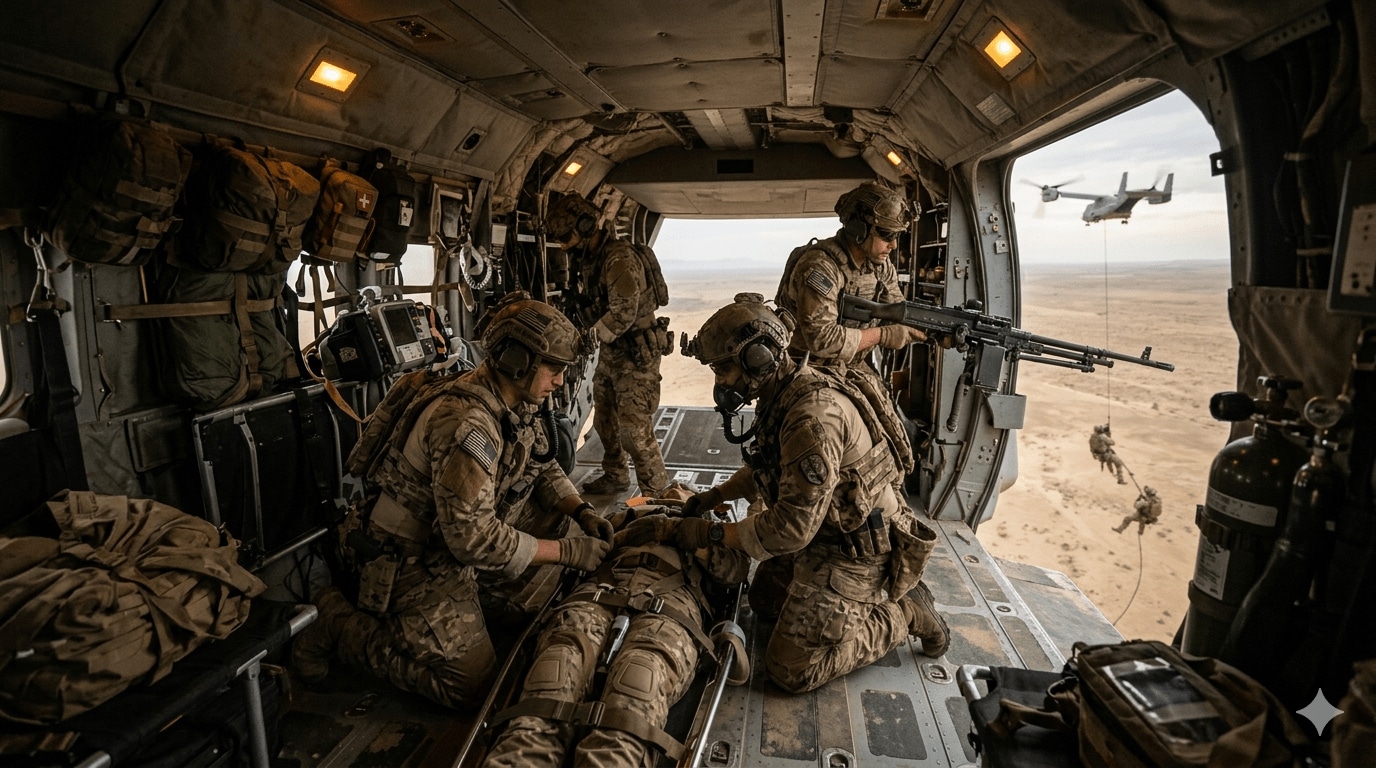
As media reports of the United States ‘successful’ high stake rescues take over the internet, the public attention has shifted to how officers deployed for US military’s Combat Search and Rescue (CSAR) missions are trained.
The United States’ CSAR unit is known for handling the most complex and time‑sensitive rescue operations recorded by the American government.
Inside the training of officers deployed for CSAR missions
The motto of the CSAR, reflects exactly what they stand for, a duty to maintain a solemn commitment ensuring no service member is left behind.
As per reports published by The Indian Express, these personnel are trained as both elite combatants and paramedics, undergoing one of the most demanding training programmes in the military that last for approximately two years.
As per reports, these officers receive training to achieve mastery in different cross sectional skills that are essential for any person to survive the nature of the mission these officers are deployed on. This includes parachuting, diving, survival training, resistance and escape techniques, and full paramedic certification.
Unlike standard search and rescue, CSAR is a surgical strike intended to “assist, locate, and recover” personnel in active combat zones. As the recent incidents involving the F-15E Strike Eagle and A-10 Warthog demonstrate, these missions are often a race against time and enemy patrols.
Speaking to CBS News, a former commander detailed that a standard mission might involve a team of at least 24 pararescue jumpers deployed via Black Hawk helicopters. The process is a high-speed choreography: parachuting into the site, establishing secure contact with the isolated personnel, providing immediate life-saving medical aid, and evading enemy capture during the extraction window.
Jonathan Hackett, a former US Marine Corps Special Operations specialist, explained to the BBC that these teams often “work backwards” from the last known location of missing personnel and subsequently expand the search based on terrain and possible movement.
He added that this could also be a “non-standard assisted recovery mission,” potentially involving re-established local contacts to aid rescue efforts.
History of CSAR missions
While airborne rescue dates back to WWI, the true “para-rescue” legacy began in 1943 in Burma (modern-day Myanmar), when combat surgeons famously parachuted into the jungle to treat wounded soldiers.
Notably this development took place just a year before the first helicopter rescue took place behind Japanese lines. Modern CSAR operations took shape during the Vietnam War, when missions became larger and more complex as the conflict dragged on.