



By Kashif Anwar
In recent years, Chinese actions have been viewed from a geopolitics perspective intended to disrupt the US-led global order. Since the arrival of President Xi Jinping in 2013, he launched the Belt Road Initiative in 2013, the Asia Infrastructure Investment Bank (AIIB) in 2014, the New Development Bank in 2015 and the 2015 and 2019 Chinese Defence White Paper, to name a few were seen as a strategic concern for the US and the West. However, for a long time, Deng Xiaoping’s statements like ‘Reform is China’s Second Revolution’ and ‘hide your strength and bide your time’ not only guided the rise of China as it helped China keep a low profile and not be viewed as a threat.
In recent years, China has also attempted to expand its influence in the South Pacific region. The visit by Chinese Premier Wen Jiabao to Fiji in 2006 and President Xi Jinping in 2014 were a major historical visit for China, which began cooperation between China and the Pacific Islands Countries (PIC) and later ten PIC became a part of the BRI. Furthermore, since 2006 China’s economic cooperation, trade and financial aid were made under the China-Pacific Economic Development and Cooperation Forum, which helped China strengthen its One China Policy. As China refutes the Chinese threat labelling, many PIC have raised concerns regarding the recent China-Solomon Islands agreement as they see more such agreements could make the region an epicentre of future great power competition, undermining its peace and stability.
The relevance of the South Pacific Region
With the development of the Indo-Pacific to counter the Chinese threat, the significance of the South Pacific region has only multiplied in recent times. The geographical location of these small islands is of great strategic significance, and they are currently located west of the US Indo-Pacific region strategy. It also becomes critical for the US to secure its position in the wake of the rise of Chinese influence in the PIC. Further, a sizable number of ships transit the region with PIC rich with substantial natural resources reflecting the region’s significance. Recently, the relationship between the US and China has intensified, affecting China’s relationship with others like Australia and New Zealand, major regional powers in the region.
Today among others, the South Pacific region looms large on global geopolitics, and countries started to have an interest in Sino-US geopolitics in the region. Meanwhile, the region was intertwined with imperial rivalry and geopolitical competition in the past; as a result, colonies were established in the late 19th century and early 20th century. Further in the 1940s, the region saw intense rivalry between Imperial Japan and the US for dominance. Later, during the Cold War, the US and Australia saw the region as critical for accessing their security partner and conducting trade. Since the end of the Cold War, the region subsequently took a back seat regarding geoeconomics and geopolitical. Subsequently, it was revived in the early years of the 21st century.
The withdrawal of the US from the Trans-Pacific Partnership (TPP) in 2017, further strengthened China’s economic relationship with the PIC under the BRI. With a change in the geopolitical landscape of the South Pacific region, the US current and new military base in the region will act as a deterrence and counter China’s expansion in the region. With the current US military base in Vanuatu and Hawaii the shift of the US marines from Okinawa to Guam and the US to jointly use a military base in the Republic of Palau reflect the USA’s intention to strengthen its position in the Pacific region.To strengthen its position, the US is building a new military base in the Federated States of Micronesia, located in the middle of the Pacific Ocean, to protect and secure US strategy in the region.
China’s Pacific Outreach and Implication for the US
When Chinese President Xi Jinping visited Fiji in 2014, he became the first Chinese President to visit Fiji. During his visit, he argued for a shift in China’s cooperative relationship to a strategic partnership with the PIC. Since then, the China-Pacific Economic Development and Cooperation Forum have played a significant role. In 2019, in its third meeting, the forum, along with eight measures, signed the China-Pacific Island Countries Program of Action on Economic Development and Cooperation. The China-Pacific Economic Development and Cooperation Forum Since its inception in 2006havestrengthened economic relations between China and the PIC and assisted the PIC in its social and economic development. Further, since 1998, China has continued to provide financial aid to the Secretariat of the Pacific Regional Environment Programme (SPREP) so that the PIC could address the socio-economic losses that climate change has caused in their countries.
In such circumstances, China’s relationship and financial assistance to the PIC over the years has only increased. On the other hand, China started to use the region to strengthen its’ One-China Policy’, project itself as a responsible country worldwide, secure its ‘Core Interest’, and address the Sino-US strategic competitive relationship. Although it’s too early to conclude, the PIC will become a part of China’s core interest. China intends to expand its influence using economic dominance to expand its military influence till the Third Island Chain – they aren’t officially demarcated – which is centred on Hawaii and contains the PIC.
The recent agreement between China and the Solomon Islands carries a lot of weightage as it has far-reaching consequences and has worried the US, Australia, and New Zealand. The involvement of Australia in ensuring stability in the Solomon Islands is of utmost importance. However, the recent closeness between China and the Solomon Islands PM Manasseh Sogavare became a concern for Australia and the West. As the pact allows China to dock its warship on the island and perform intelligence gathering, along with allowing China to send forces to assist in maintaining and ensuring law and order on the island. Such agreement shows China intends to displace the US as the predominant power and force in the West Pacific Ocean. Furthermore, considering the island’s geographical location, it further allows China not only to exert control in the region but could also threaten the communication between the US and its allies.
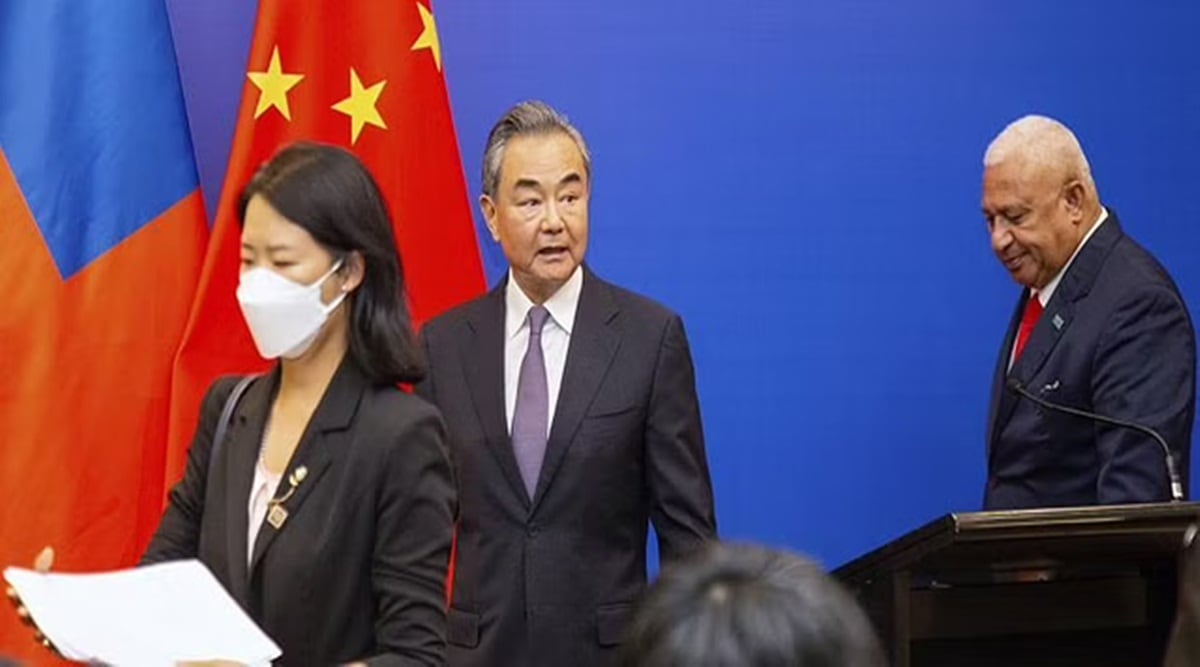
Chinese Foreign Minister Wang Yi’s tour to Fiji was driven to implement its version of the South Pacific Security arrangement with the 8 PIC under its ‘China-Pacific Island Countries Common Development’ document; it created criticism and worried the West. China viewed the document to deepen China’s security and economic ties with the PIC to its advantage. However, due to a lack of support from many Pacific island countries, China withdrew the security aspect from the document. Instead, the PIC and China agreed on five areas to improve economic growth and development in the PIC. Such a visit encapsulates China’s commitment to expand its influence in the Pacific region, pushing the US, Australia and New Zealand to better coordinate and further strengthen their outreach with the PIC. On the other hand, it also shows PIC are worried about China’s intention and although they are open to engaging with China but want to do it on their terms.
In the context of PIC, in recent years, China increased its influence in their domestic politics, like in the case of the Solomon Islands, where the National Development Fund funded many pro-Beijing Parliament members in conjunction with the Chinese Embassy. Further, Vanuatu PM Bob Loughman’s recent push to amend the constitution created an uproar which allows dual citizens to hold office, paving the way for Chinese nationals to hold government office in the country. Such developments are concerning and problematic for the West as China is increasing its influence in the South Pacific region.
In such a situation, the US has vowed to increase more high-level visits to the PIC to increase its engagement with the Pacific region and further counter China in such a critical region for the US. To address the issue, White House Indo-Pacific coordinator Kurt Campbell argues the US needs more diplomatic facilities in the Pacific region with greater engagement with the PIC. As China expanded its reach within the Pacific Rim countries, it was also able to counter the US dominance using its economic strength and influence, with the BRI being at the forefront as an important tool and vision.
As Campbell further argues, without referring to China, the US sees sovereignty as central to the PIC and attempting to compromise it raised serious concerns for the US. Considering the seriousness of the situation and geo-location of the PIC, the US has expedited the opening of the US Embassy in the Solomon Islands. In such a situation, Campbell reiterated and envisioned that Fiji would eventually become one of the ‘hubs’ of engagement for the US. The recent visit by the US Secretary of State Antony Blinken to Fiji, the first such visit to Fiji by a top US diplomat in the last four decades, reflects seriousness in the Biden administration towards the PIC.
With sovereignty and aspiration of the PIC being the driving force of the US engagement with the PIC, such islands should be seen more than only being viewed from the theatre for geostrategic competition and pawn in the West vs China. The President of Federated States of Micronesia recently expressed his unwillingness not to be part of any conflict between the West and China.In such a situation, the Indo-Pacific Economic Framework for Prosperity (IPEEP) and a new initiative called Partners in the Blue Pacific could come handy for the US, and the West.
Takeaways
In recent years, geostrategic competition has increased in the Pacific region, especially after China failed to push and include its version of the security arrangement for the PIC as part of the recently signed ‘China-Pacific Island Countries Common Development’ with the PIC. As China has already signed a security agreement with the Solomon Islands, it raised some flags and serious concerns about the Chinese military possibly getting a military base in the southern Pacific.In such a situation, recently, both China and the US continued to woo the PIC at the time when the Russia-Ukraine conflict and the tense relationship between China and Taiwan. As a result of such geostrategic and geopolitical developments across the globe, it raises two pertinent questions.First, whether the Pacific region will become a new theatre of war between the West and China or Secondly, will the current geostrategic and power dominance race between the West and China address the concerns of the PIC or not?
(Author is Research Associate, Centre for Air Power Studies, New Delhi. Views expressed are personal and do not reflect the official position or policy of Financial Express Online. Reproducing this content without permission is prohibited).