



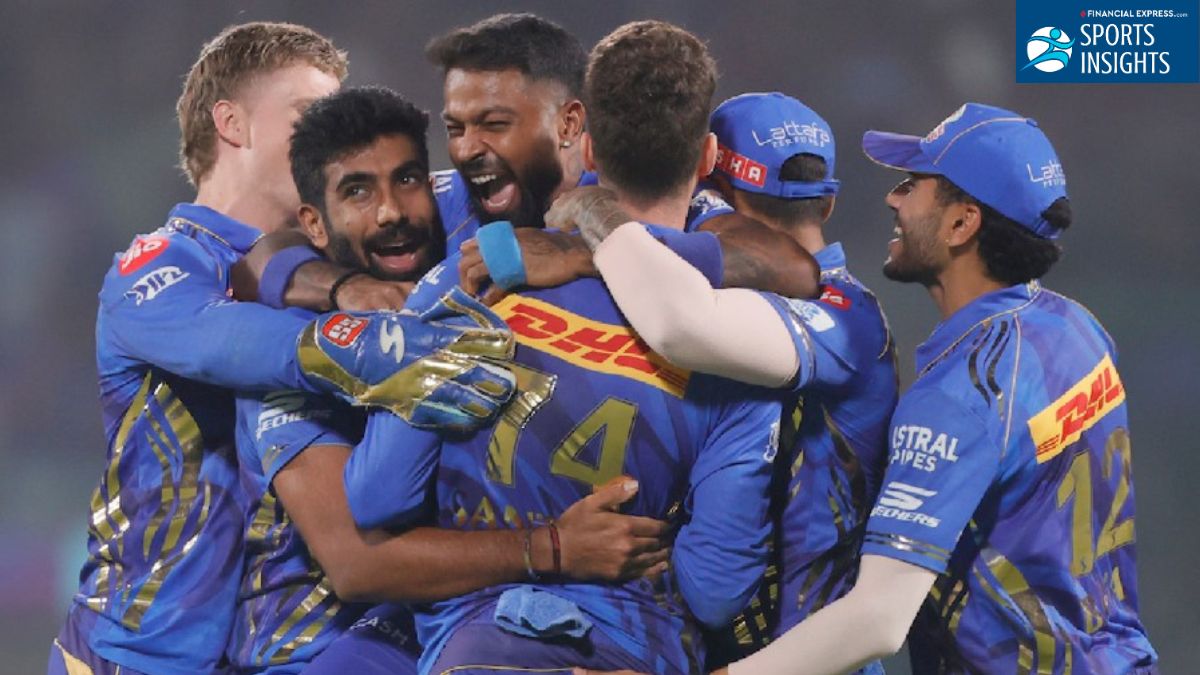
A five-time champion finished ninth. The fortress became a funeral ground. And nobody inside the dressing room looked like they knew each other anymore.
There is a noise that Wankhede makes when Mumbai Indians are winning. It is not the cheer you hear at other grounds. It is a growl. A kind of Mumbai arrogance that says we have seen this before and we will see it again.
In IPL 2026, that noise died early. By May, the ground felt like a library where someone had forgotten to switch off the floodlights. Mumbai played seven games at home. They lost five. Last season, they lost only two at home all season.
This time they were done by May 10. Eliminated by a last-ball loss in Raipur. Eight points from fourteen games. Ninth place. For a franchise that built its name on ruthlessness, this was not a bad year. This was an identity crisis.
The fortress turned stranger
Wankhede has always been Mumbai’s weapon. The bounce, the swing under lights, the short boundaries that suit their hitters. In 2025, they won five and lost two here. In 2026, the pitch played the same but the team looked like they had never met.
They leaked 78 for one against Kolkata in the powerplay. They bled 71 without a wicket against Bangalore. Chennai took 73 in six overs and never looked back. Mumbai’s own powerplay batting crawled at 8.8 an over when the rest of the league was flying past ten.
Think about that. The team that once defined T20 aggression could not keep up with the scoring rate. Their bowlers went at 10.83 in the first six. Only Hyderabad were worse.
In the last two league games, Hardik Pandya tried something Mumbai had not done in eleven years. He bowled three overs of spin inside the powerplay. When you are hiding your fast bowlers inside the first six overs at Wankhede, you have already lost the plot. You are just waiting for the season to end.
Bumrah’s back and the death of fear
Jasprit Bumrah came into this IPL as the best T20 bowler on the planet. He had just won India a T20 World Cup. He had just taken 4 for 15 in a final. And then his back said no. Not loudly. Just a whisper at first. A niggle. The kind of thing that does not show on scans but sits in your run-up like a stone in your shoe.
He bowled his first five games without a wicket. His pace sat in the low 130s. Batsmen who used to freeze against him now blocked him out calmly. Why not? The other end was going for ten an over. Teams worked out a simple plan. See off Bumrah. Murder the rest.
He finished with four wickets in thirteen games. His average was 102.5 In T20 cricket, if you bowl forty overs in a season and average over a hundred, something has gone very wrong. Travis Head hit him for sixes. Sanju Samson did too.
A fifteen-year-old kid named Vaibhav Sooryavanshi took him for two in one over. These were batsmen who used to treat Bumrah like a bad dream. Now they were waking up and choosing to stay awake.
It is easy to say he was injured. But the real tragedy is that Mumbai built a bowling attack that only worked if Bumrah was superhuman. They gave him no help.
Trent Boult, their other big hope, looked hopeless. His pace dropped to the 130s too. He took two wickets in five games and went at nearly twelve an over. Without Boult striking early and without Bumrah terrifying anyone, Mumbai had no powerplay defense.
And in modern T20, if you lose the first six overs with both bat and ball, you are playing catch-up for the remaining fourteen. Mumbai spent the whole season chasing ghosts.
The captain nobody asked for
Hardik Pandya came back to Mumbai with a plan. The plan was simple. Lead like he did at Gujarat. Win trophies. Be the face. Instead he walked into a room that did not want him.
Rohit Sharma had just won India a World Cup as captain. Suryakumar Yadav was now India’s T20 captain. Bumrah was the senior most bowler in the country. And Mumbai decided to bring in an outsider to run the show.
You cannot do that and expect hugs. Murali Kartik said it openly. You keep Rohit, Surya and Bumrah in the same room but bring an external leader. Something will crack. Manoj Tiwary watched Rohit in the dugout and said he looked like a man watching his own house burn down.
His face showed disagreement. His body language showed distance. Small thing, maybe. But in 2026, that is where team culture goes to die. Not in team meetings. In social media screenshots.
On the field, Hardik looked reactive. His field placements chased the ball. His bowling changes looked like he was picking names from a hat. He scored 206 runs at strike rate below 140. He took four wickets at eleven and a half an over.
And he could not bowl his full quota because his body, like Bumrah’s, was holding secrets. A captain who cannot bowl, cannot bat long, and cannot command the room.
The kids who fought alone
Here is the part that hurts if you love this team. While the big names collapsed, the young ones tried. Ryan Rickelton, a South African wicketkeeper Mumbai barely talked about before the season, finished with 448 runs. Average of nearly 41. Strike rate touching 187.
He played like he had nothing to lose because he did not. Tilak Varma got a hundred. Naman Dhir made runs when the top order had already left the building. An Afghan kid named Allah Ghazanfar, just twenty years old, took fifteen wickets and became their leading wicket taker.
Corbin Bosch, another nobody from the bench, took twelve wickets in six games and caught a ball that made the fielding coach cry.
These were not star buys. These were fillers. Emergency lights. And they were the only ones keeping the power on. Rickelton’s 123 not out came in a season where Suryakumar Yadav, the MVP from 2025, managed only 270 runs.
Teams worked Surya out. Bowled wide outside off, changed pace, kept him away from his flick and sweep zones. Without support, he kept taking risks early and kept walking back.
Rohit played nine games because his hamstring kept snapping. He made two good scores, 78 and 84, but spent half the season as an Impact Player. A legend reduced to a cameo. A captain reduced to a spectator.
The drops that tell the story
In one game against Punjab, Mumbai dropped five catches. Five. In a single evening. Against Kolkata, senior players collided under a skier and let it fall. The league dropped 169 catches this season. Each drop cost teams over 24 runs on average.
Mumbai’s hands looked like they were thinking about something else. Maybe the Instagram drama. Maybe the captaincy meeting where nobody spoke. Maybe the fact that the dressing room had split into two camps and neither side trusted the other.
Kieron Pollard, the batting coach, stood at the press conference after the last game and said this was a season of what-ifs. That is coach speak for we know we were terrible and we do not know why. But everyone knew why.
A team that forgets how to catch is a team that has forgotten how to care. And Mumbai used to care more than anyone.
What comes after the fall
Mumbai have now gone six seasons without a title. That matches their drought from 2008 to 2012. Back then, they were building something. Now they are watching it rot. The next auction cycle will force hard choices.
Hardik has had three seasons. Two bottom-half finishes. Zero playoff appearances. The captaincy experiment has failed. The question is whether they go back to Rohit, Bumrah or Surya for culture, or hand someone else the keys. Either way, they cannot continue with a leader half the room does not follow.
They also need bowlers. Real ones. Fast ones who can push the scoreboard in the powerplay so Bumrah does not have to be God every single night. And they need to fix the fitness. Too many niggles, too many hamstrings, too many backs that whisper instead of roaring.
The aura of Mumbai Indians was never just about Rohit or Bumrah or the five trophies. It was about a room where everyone knew the price of losing and refused to pay it. In 2026, they paid it again and again. At home, abroad, in the field, and inside their own heads.
Wankhede will be loud again someday. But first, Mumbai need to remember who they are. And that might be the hardest comeback of all.