



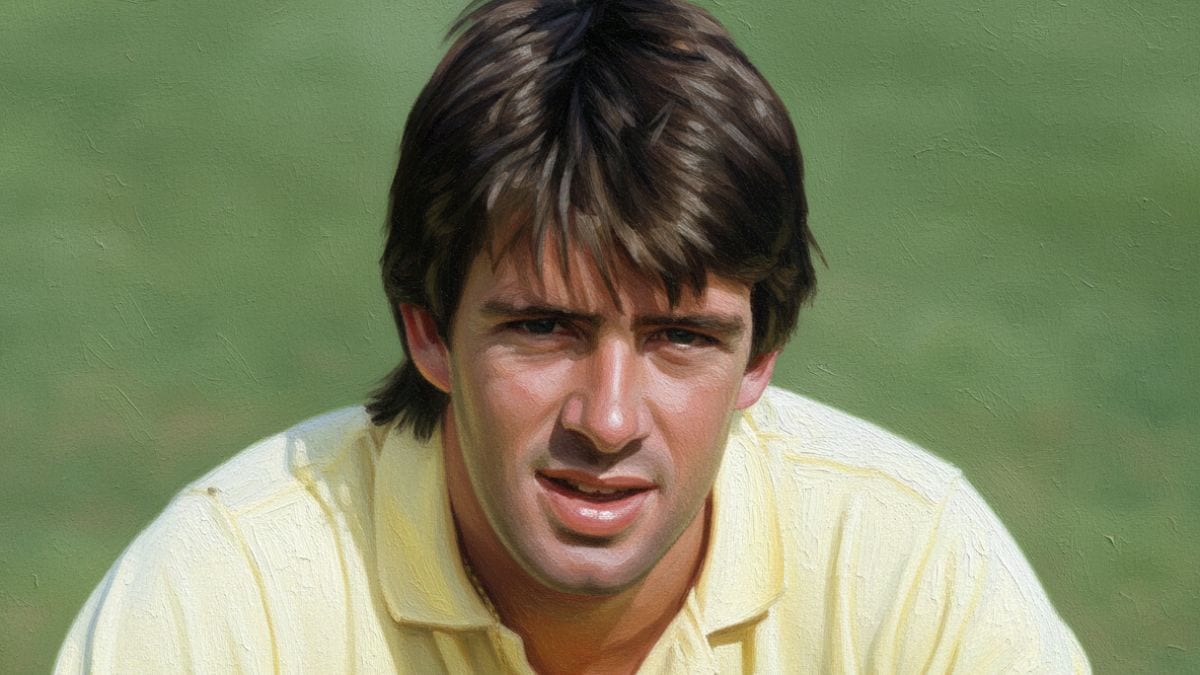
Australia were playing Sri Lanka in the Austral-Asia Cup. They were 172 for two. Dean Jones looked set. Team needed a push. Allan Border, his captain, did what captains do. He threw the bat to Simon O’Donnell and told him to go have a hit. Border knew what O’Donnell had been through.
Maybe that is why he called on him. Or maybe he just needed someone to hit the ball hard. Either way, he picked the right man. What happened next did not look like batting. It looked like a man taking back something that had been taken from him.
The knock that was not about cricket
O’Donnell walked in like he owned the place. Not in a showy way. Just a quiet certainty. The first ball he faced, he seemed to say, I have seen worse than you. And he had.
Ravi Ratnayeke ran in and bowled quick. O’Donnell sent one ball so high it hit the roof of the stadium. The next one he pinged over long-on like he was playing tennis.
Champaka Ramanayake tried to bowl yorkers. O’Donnell treated them like full tosses. Asanka Gurusinha moved back on the fence, thinking he could breathe easy. The ball sailed over his head and into the empty seats.
50 runs came in 18 balls. Let that sit for a moment. Eighteen balls. No one had ever done it that fast. No one had even broken the twenty-ball mark before. He finished on 74 from 29 deliveries. Six sixes. Four fours. Australia made 332 for three.
It was their highest one-day total ever. The numbers are nice but they do not tell you the real story.
World Cup secret that almost killed him
Rewind three springs. The 1987 World Cup in India and Pakistan.
Australia won it for the first time. The whole team danced and jumped. O’Donnell was there but not really there. He had a lump near his ribs that he could feel growing. An X-ray showed he was missing a rib. The doctors used a word he did not want to hear. Cancer.
Non-Hodgkin’s lymphoma. Aggressive. Spreading. The kind that does not wait for a tournament to finish.
He told no one. Not the team doctor. Not the press. Not even his closest teammates. When he missed the team bus after the semi-final win in Lahore, they fined him for unsporting conduct. He did not explain. He could not. He was trying not to collapse from exhaustion.
The cancer was eating him alive while he was taking wickets. 9 of them in 7 matches. He was one of Australia’s best players in that World Cup. While dying inside.
Later, people asked why he kept quiet. He said it was not courage. It was selfishness. He could not walk away from a World Cup. That is what he said. But people who have fought real fights know the truth. Sometimes you do not tell anyone because saying it out loud makes it real.
Fine and the lonely battle
That fine stayed on his record. A small mark against his name for something that was not his fault. He paid it and said nothing. Imagine that. Being punished for trying to stay on your feet while your body betrays you.
The team flew back to Australia with the trophy. O’Donnell checked into a hospital. Surgery came first. Then the long wait. Will it work? Will I live? Will I ever play again? Those questions do not have easy answers. Cricket seems very small when you are looking at hospital ceilings.
Months passed. The game went on without him. But he watched. He waited. He fought.
Road back from the edge
By 1989, he was back. Not just playing but dominating. In 37 one-day games after his recovery, he took 50 wickets at 25 each. Only two bowlers in the whole world took more in that period. With the bat, he made 587 runs at nearly a hundred strike rate. In those days, that was like seeing a man fly.
He was not the same player. He was better. When you have looked at your own mortality, a fast bowler does not seem that scary anymore.
That day in Sharjah was the full stop at the end of a very long sentence. It was not a fluke. It was a man who had learned that life is short and you must hit the ball hard while you can.
Why those twenty-nine balls mattered more than any hundred
Every six he hit that day was a reply to the cancer. You tried to take me out. I am still here. Every boundary was for the nights in hospital when he thought he might never bat again. The eighteen-ball fifty was a message to anyone who has heard bad news from a doctor. It said, this is not the end unless you say it is.
He went on to captain Victoria to a Sheffield Shield title. For a while, he held the record for most ODI wickets by an Australian. But those are just footnotes. The real story is this: a man got knocked down by something bigger than any bowler and got back up. Not just to live but to fly.
Why those twenty-nine balls mattered more than any hundred
Cricket loves numbers. We talk about averages and strike rates and records. We forget that some fifties are not measured in runs. They are measured in heartbeats. In hospital visits. In days you did not think you would see.
Simon O’Donnell’s seventy-four in Sharjah was one of those knocks. It did not just go over the boundary. It crossed the line between giving up and going on. It flew over the fence and into the lives of people who needed to see it.
That is why we still talk about it. Not because it was fast. But because it meant something.
Some players make runs. Some make history. A very few make hope. On that burning day in Sharjah, Simon O’Donnell made all three.