



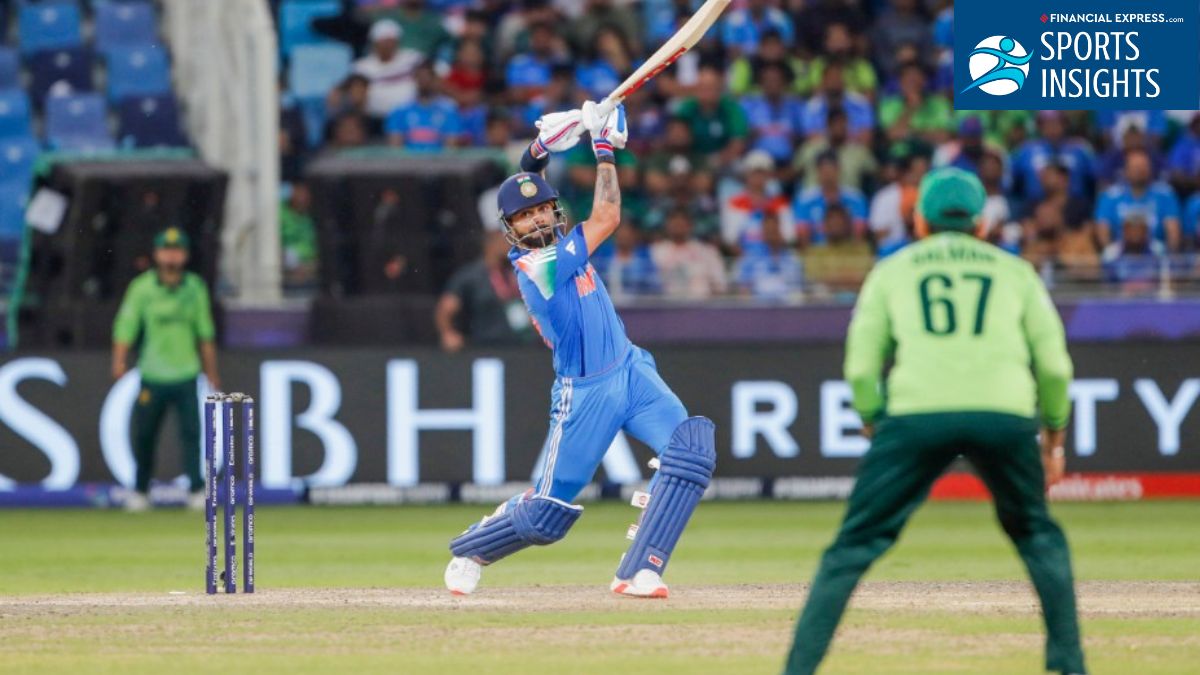
There is a noise that follows India and Pakistan. It builds for weeks, lives in headlines and then explodes on the day. In 2012, that noise found its master. On that September night in Sri Lanka Kohli didn’t merely face Pakistan. He played like he had already seen the ending and was simply walking through the scenes.
The world knew him then as a young man with a loud bat and a louder mouth. What they missed was the coldness. The ability to stand in heat that makes others melt and treat it like a breeze. That September night in Sri Lanka, Pakistan scored 128.
On paper, it was a joke. In reality, it was a trap. India had lost their way in Super Eights before. Pakistan had a way of making small totals look like mountains.
Virat Kohli walked in early. Gautam Gambhir had fallen for a duck. The required rate was not scary but the history was. Pakistan’s bowlers were hungry. The crowd was divided and loud. He played 61 balls that night. He scored 78 runs. He never looked like he was trying.
This was the start of something. Not just a win. A pattern.
The 2012 Blueprint: Calm in the chaos
Pakistan had a plan that evening. They always do. Shahid Afridi would attack early. The new spinner, Raza Hasan, would trouble the openers. The field would squeeze. The pressure would build. It works on paper. It works in meetings. It rarely works against men who refuse to panic.
Kohli refused. Virender Sehwag came back that day and played like Sehwag always played. Hit first, think later. But Kohli was the anchor and the engine. When Sehwag fell, the job was half done. Pakistan needed three quick wickets. They needed Kohli to blink.
He never did. He found gaps that were not there. He ran singles like they were stolen goods. He put away the bad balls without celebration. When he edged Afridi through an empty slip, the match was already gone. Pakistan just did not know it yet.
Mohammad Hafeez, the Pakistan captain, looked like a man carrying a weight he could not name. He spread the field when he needed catchers. He brought catchers when the runs had already flowed. Body language is a real thing in these matches. Kohli walked like he owned the ground. Hafeez walked like he was borrowing it.
India won with three overs to spare. The jinx of Super Eights was broken. The real story was smaller and larger. One man had decided that pressure was a myth.
Numbers that tell a story
178 runs in five innings. That was Kohli’s 2012 World Twenty20. He averaged 46. He struck at over 122. He was India’s highest run scorer. This was not a fluke. He would do it again in 2014. Again in 2016. Again in 2022.
Against Pakistan specifically, the list grows like a taunt. 78 not out in 2012. 36 not out in 2014, a small knock that finished a chase. 55 not out in 2016, played on a track that ate others alive. 57 in 2021, a loss but not a failure.
Then 82 not out in Melbourne, 2022, the one that will be shown at every tournament opening for the next fifty years.
Three Player of the Match awards against Pakistan in T20 World Cups. Three times he was the difference between a nation celebrating and a nation explaining.
The Melbourne innings deserves its own paragraph. India needed 28 from eight balls. Pakistan had the game. The stadium was blue but silent. Then Kohli hit a six that should not have been possible. Then another.
Then he ran like a man who knew exactly where the fielders were not. When the winning runs were hit, he did not celebrate immediately. He looked exhausted. He looked relieved. He looked like a man who had done this before because he had.
Psychology of the unblinking eye
What makes a player own a rivalry? Talent is the starting point. Preparation is the foundation. But there is something else. The ability to see the same moment as everyone else and feel something different.
Pakistan teams of the past walked onto the field against India with a swagger. They had the fast bowlers. They had the mystery spin. They had the belief that came from not overthinking. India, for years, carried the weight of expectation like a stone.
Somewhere around the early 2000s, that shifted. Sachin Tendulkar‘s six off Shoaib Akhtar in 2003 is often pointed to as the moment. The truth is slower. It was built by men like Kohli who decided that the occasion would not define them. They would define the occasion.
In 2012, Pakistan’s batsmen tried to be brave and ended up being reckless. Their captain tried to be careful and ended up being scared. Kohli simply played cricket. He did not play the history. He did not play the noise. He played the ball.
This became his method. In 2014, he walked into a chase of 130 on a pitch where the ball was turning with bounce. He made 36 not out and never looked troubled.
In 2016, on a surface in Kolkata that helped bowlers more than any other in the tournament, he made 55 not out and made it look like a different game than the one others were playing.
Pakistan’s bowlers are not gentle. They have pace. They have skill. They have the ability to make the ball talk. Against Kohli in these moments, they looked like they were speaking a language he had already learned.
End of an era and the empty chair
February 15, 2026. Colombo again. India and Pakistan will meet in the T20 World Cup group stage. The heat will be the same. The noise will be the same. The man who made this fixture his personal property will not be there.
Virat Kohli retired from T20 internationals after the 2024 World Cup. He left with a trophy, which is how stories should end. But he left a hole in this specific contest. For fourteen years, when India played Pakistan in a World Cup, there was a guarantee. Not of victory. But of a performance. Of a man who would not shrink.
Who takes that now? The question is unfair to ask of any player. Rivalries are not inherited like property. They are built like houses, brick by brick, failure by failure, success by success.
Tilak Varma has the technique. Abhishek Sharma has the audacity. Surya Kumar Yadav has the shots. But do they have the history? Do they have the scar tissue of 2012 and 2014 and 2016 and 2022? Do they walk onto the field knowing that they have done this before, that the moment is not bigger than them?
Kohli did not start with that belief. He built it. The 2012 innings in Colombo was the foundation. Every match against Pakistan after that added a floor. By 2022, he lived in a tower that no one else could see the top of.
The new men and the old ghosts
Pakistan will come to Colombo with their own questions. They have not beaten India in a T20I match since 2021. The ghost of keep losing when it matters most still travels with them.
The format has changed now. Batters are more aggressive now. Strike rates of 140 are considered slow in some circles. The 2012 method of building an innings, of taking the game deep, of knowing that the last four overs are yours, might look old-fashioned.
But T20 cricket has a way of returning to basics when the pressure is highest. In the World Cup, the madness of franchise leagues meets the reality of national expectation. The player who can slow down while the world speeds up is still the most valuable.
Kohli was that player. In 2012, when others swung wild, he placed the ball in gaps. In 2022, when the math said impossible, he found possibilities. It was never about power. It was about presence.
What remains when the player leaves
Legacies are tricky things. They live in memory, which fades. They live in video, which flattens. They live in numbers, which lie. Kohli’s legacy against Pakistan will be told in stories. The night in Colombo when he was 23 and looked 33. The night in Melbourne when he was 33 and looked 23.
The 2026 match will happen without him. Someone else will open, or bat three, or finish. They will face the same opponent, the same pressure, the same history. They will either add to the story or become a footnote in it.
Pakistan will hope that the end of Kohli means the end of the curse. India will hope that the habit of winning survives the man who built it. Both hopes are reasonable. Neither is certain.
What is certain is that for a stretch of time that covered 6 World Cups and 12 years, one batsman made this fixture predictable. Not the result. The performance. You knew India would compete because you knew Kohli would not fade.
That is gone now. The rivalry continues. The noise will be the same. But the silence in the middle, the calm that made the chaos manageable, that was his gift. It is not transferrable. It must be earned again, ball by ball, match by match, failure by failure, success by success.
Colombo waits. The heat will be high. Someone will have to decide not to freeze.