



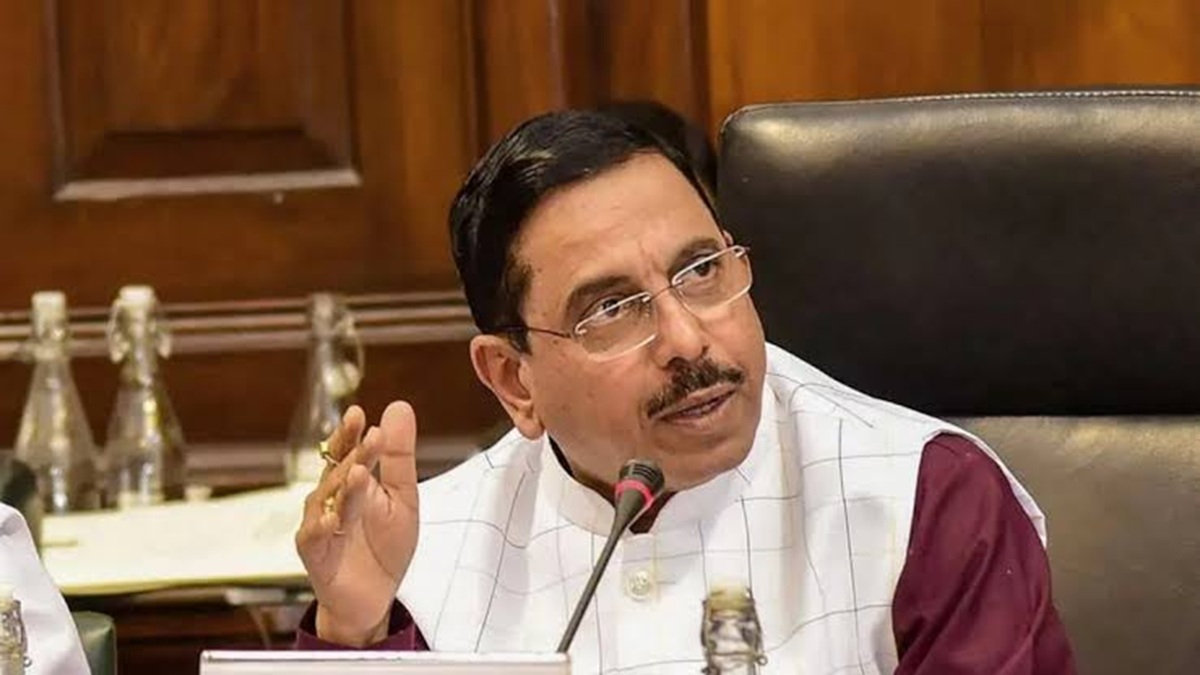
Union minister Pralhad Joshi was on Saturday assigned the additional charge of the Ministry of Education, hours after Dharmendra Pradhan resigned from the Union Council of Ministers. Amid sustained student protests over repetitive paper leaks in competitive national level entrance examinations and the government’s handling of the controversy.
Joshi, who currently heads the ministries of Consumer Affairs, Food and Public Distribution and New and Renewable Energy, will take charge of education alongside his existing responsibilities.
Joshi enters the ministry at one of the most politically sensitive moments for India’s education establishment. The government has faced protests over examination integrity, accountability at the National Testing Agency and police action against demonstrators at Delhi’s Jantar Mantar.
The appointment also places a seasoned member of parliament who has been associated with PM Modi’s cabinet with 2019 at the centre of the government’s response to the student-led movement demanding an improvement in the management of the Indian education system.
Joshi has spent more than two decades in the Lok Sabha, managed the government’s legislative business as parliamentary affairs minister and handled economically significant portfolios covering coal, mines, food distribution and renewable energy.
Born in Karnataka and educated in Hubballi and Dharwad, Joshi began his working life as a businessman before rising through the BJP’s district and state organisation. His political career has combined strong roots in northern Karnataka with long experience in Parliament and the Union Cabinet.
An overview of Joshi’s profile: Education and early life
Pralhad Venkatesh Joshi was born on November 27, 1962, in Vijayapura, Karnataka, to Venkatesh Joshi and Malatibai. He is married to Jyoti Joshi and the couple has three daughters.
Joshi holds a Bachelor of Arts degree. His Lok Sabha profile says he studied at KS Arts College in Hubballi and Karnataka University in Dharwad. His 2024 election affidavit records that he completed his BA in 1983 from Kadasiddeshwar Arts College, affiliated with Karnataka University.
He describes his profession as that of a businessperson. The BJP’s Karnataka unit has also described him as an industrialist by vocation before he entered full-time politics.
Assets rose to Rs 21.09 crore in 2024
Joshi and his family declared total assets worth Rs 21.09 crore in his affidavit for the 2024 Lok Sabha election, according to data compiled by the Association for Democratic Reforms from Election Commission filings.
Pralhad Joshi’s assets and liabilities: 2019 vs 2024
| Financial disclosure | Lok Sabha 2019 | Lok Sabha 2024 | Increase | Growth |
| Movable assets | Rs 3.04 crore | Rs 8.98 crore | Rs 5.94 crore | 195.3% |
| Immovable assets | Rs 8.10 crore | Rs 12.11 crore | Rs 4.02 crore | 49.6% |
| Total assets | Rs 11.14 crore | Rs 21.10 crore | Rs 9.96 crore | 89.4% |
| Liabilities | Rs 5.17 crore | Rs 8.01 crore | Rs 2.84 crore | 54.9% |
According to his election affidavits, Joshi’s declared assets nearly doubled between the 2019 and 2024 Lok Sabha elections, rising by about Rs 9.96 crore. The sharpest increase was in movable assets, which grew by over 195%, while his liabilities also rose by nearly 55% during the five-year period.
This included movable assets worth approximately Rs 8.98 crore and immovable assets of Rs 12.11 crore. The affidavit also recorded liabilities of Rs 8.01 crore.
His declared assets have increased sharply over successive elections. In 2019, Joshi had declared assets of Rs 11.13 crore and liabilities of Rs 5.17 crore. His total declared assets therefore rose by about Rs 9.96 crore, or nearly 89 per cent, between the two elections.
Earlier affidavits listed assets of Rs 4.19 crore in 2014, Rs 1.44 crore in 2009 and Rs 77.60 lakh in 2004. These are self-declared figures submitted by the candidate and compiled by ADR from Election Commission records.
Early politics: Save Kashmir and rising through BJP
Joshi’s emergence in public life was closely linked to the agitation over the Idgah Maidan in Hubballi in the early 1990s. According to the BJP’s account of his political career, he helped organise a movement between 1992 and 1994 seeking to hoist the national flag at the ground, also known as Kittur Rani Chennamma Maidan.
He was also associated with a “Save Kashmir” campaign during the period. These movements helped establish him as a recognisable political figure in the region and preceded his rise through the BJP organisation.
Joshi served as president of the BJP’s Dharwad district unit between 1995 and 1998 and subsequently became its district general secretary. He was the Karnataka BJP’s general secretary from 2006 to 2013 and later headed the party’s state unit.
Dharwad MP since 2004
Joshi first entered the Lok Sabha in 2004 by defeating the incumbent Congress candidate BS Patil in his first parliamentary contest from Dharwad, then known as Dharwad North.
He subsequently retained the seat in the 2009, 2014, 2019 and 2024 general elections, making him a five-term Lok Sabha MP. Joshi’s parliamentary assignments before joining the Cabinet included membership of the standing committees on chemicals and fertilisers, transport, tourism and culture.
From coal and mines to food and renewable energy
Joshi was inducted into the Union Cabinet when Prime Minister Narendra Modi began his second term in May 2019. He was given charge of three ministries: Parliamentary Affairs, Coal and Mines.
As parliamentary affairs minister, Joshi coordinated legislative business, negotiated with Opposition parties and steered the government’s agenda through often-disrupted parliamentary sessions.
His coal and mines portfolios placed him at the centre of the government’s efforts to expand domestic coal production, auction mineral blocks, attract private investment and reduce delays in bringing mines into operation.
Following the 2024 Lok Sabha election, Joshi was moved to the ministries of Consumer Affairs, Food and Public Distribution and New and Renewable Energy.
The responsibilities cover issues ranging from foodgrain procurement and the public distribution system to consumer protection, solar power and India’s wider energy transition. He will now handle education as an additional portfolio.