




Investors looking for financial stability, consistent cash flows, and steady returns often turn towards high dividend-paying stocks. While there are hundreds of Indian companies that pay dividends, consistency is something most of them lack.
In fact, there are only a handful of such companies that pay dividends regularly, year after year, without a miss. Key among them are the virtually z ero-debt high dividend-paying companies.
In this article, we will explore three such virtually zero-debt, high dividend-paying stocks that you can add to your watchlist for 2026.
The High-Yield Trio: Stability Meets Growth
#1 Coal India: The Undisputed King of Cash Flow
Coal India Ltd. is the single largest coal producer not only in India, but globally, with over 781 million tonnes (MTs) of coal production recorded in FY25. It has a monopoly in the Indian coal mining industry and contributes to over 80% of the coal production.
When it comes to dividends, Coal India’s commitment to its shareholders is unparalleled. This ‘Maharatna’ company has been paying dividends without a miss since 2010, right after it got listed. Its dividend yield for FY25 stood at 6.2%, one of the highest in the market.
The dividend payout ratio has also increased from 42% in FY24 to 46% in FY25. However, this is probably due to the decrease in net profit for FY25, which went from ₹37,369 crore in FY24 to ₹35,302 crore in FY25.
The dividend per share has been increasing consistently since FY20. Here is a snapshot of dividend per share and dividend payout ratio for the last five years –
Dividend Per Share & Dividend Payout Ratio of Five Years
| Financial Year | Dividend Per Share (₹) | Dividend Payout Ratio (%) |
| FY21 | 16 | 77.6 |
| FY22 | 17 | 60.4 |
| FY23 | 24.3 | 47 |
| FY24 | 25.5 | 42.02 |
| FY25 | 26.5 | 46.19 |
So, the dividend per share has been increasing consistently over the years while the dividend payout ratio has been diminishing, indicating that the company’s profits were growing except for the last fiscal year.
Coming to the zero-debt factor, the company has been maintaining a debt-to-equity (D/E) ratio below 0.1 since FY22.
It is quite rare to see companies with minimal debt, offering steady growth, and dividends year after year.
Looking ahead
In the first half of FY26, Coal India signed a deal for setting up a 500 Megawatt (MW) solar power project in Uttar Pradesh, which will be a part of their Green and Renewable Energy Initiatives.
Furthermore, Coal India has incorporated Coal India Ltd. (CIL) Rajasthan Akshay Urja Limited as its new renewable energy subsidiary.
It has also entered into a Memorandum of Understanding with Hindustan Copper Ltd. for collaborating in the copper and critical minerals sectors.
Financials
Sales for the Q2FY26 went down from ₹31,182 crore in Q2FY25 to ₹30,187 crore, while the profit dipped drastically from ₹6,275 crore to ₹4,263 crore during the period.
Valuation
The stock is trading at a Price Earnings (PE) of 8.4x, which is significantly lower than the industry median of 14.9x, indicating a cheap valuation; however, there is no direct peer of Coal India, as it has a monopoly.
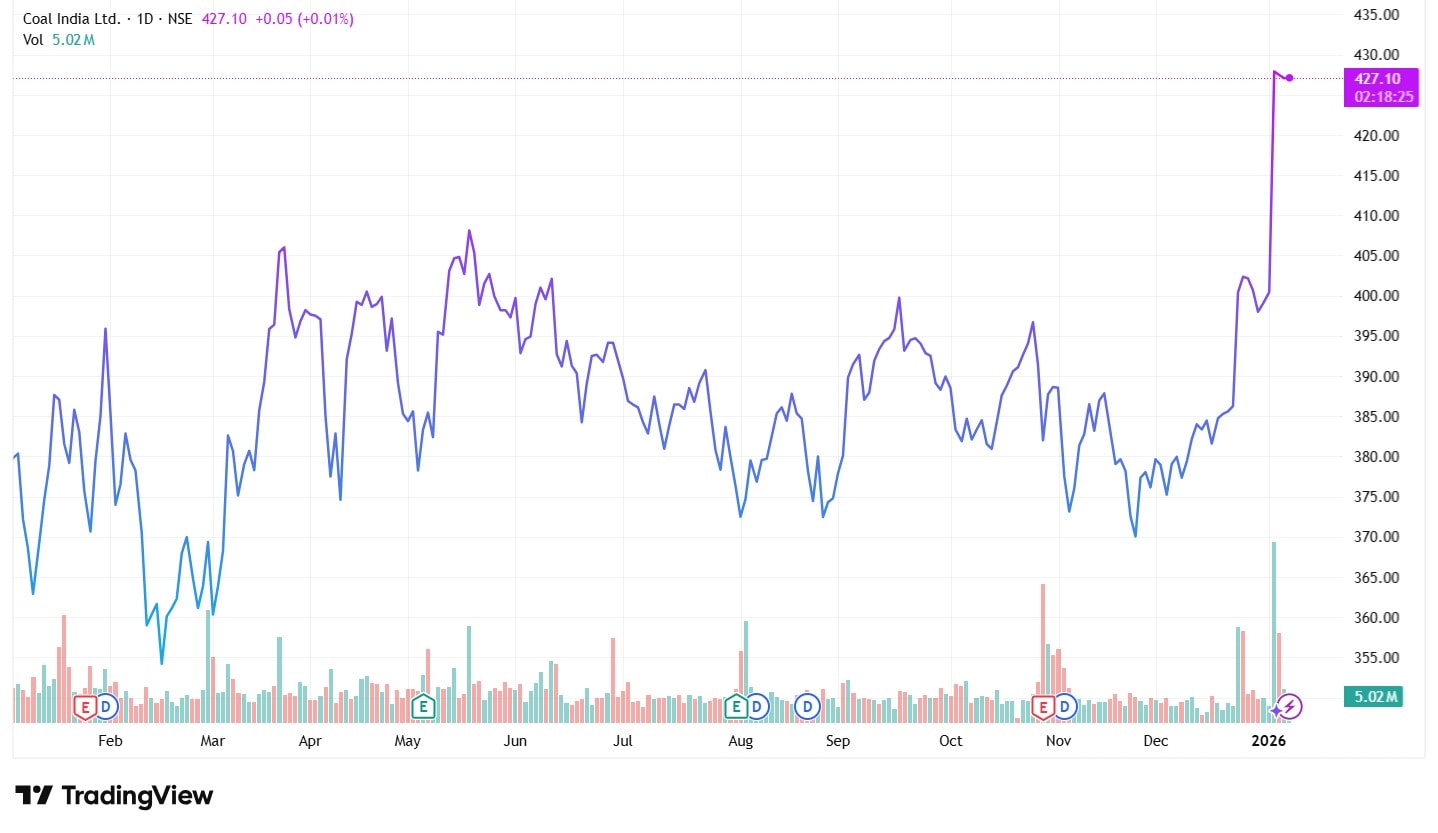
In recent days, Coal India has come in for a strong round of buying in the stock markets. Among other things this is due to the fact that one of its subsidiaries, Bharat Coking Coal Limited is currently out with an IPO. It has also been reported that other subsidiaries of Coal India could also list over the next few years, thus unlocking value.
1-year Share Price Chart of Coal India Ltd.
#2 Castrol’s Pivot: From Engines to AI Data Centres
Castrol India Ltd. is a leading manufacturer and supplier of a wide range of oil lubricants and automobile fluids, which are used across cars, motorcycles, and commercial vehicles as well as for industrial purposes.
While dividends are often paid by the largecap, blue-chip companies, Castrol, being a small-cap company, has been paying dividends without fail since 2000. The current dividend yield of the company is 4.5%, the highest amongst its peers.
The dividend payout for the year 2024* was 139%, which means the company paid a dividend more than its earnings for the fiscal year. The dividend payout ratio has been increasing consistently since 2021, when it stood at 72%.
*Note: The annual financials for Castrol India are available for Calendar Years, that is, January to December. So, the latest annual data available is for January 2024 to December 2024.
Dividend Per Share & Dividend Payout Ratio of Five Years
| Financial Year | Dividend Per Share (₹) | Dividend Payout Ratio (%) |
| 2020 | 5.5 | 93 |
| 2021 | 5.5 | 72 |
| 2022 | 6.5 | 79 |
| 2023 | 7.5 | 86 |
| 2024 | 13 | 139 |
It is not just that this small-cap automobile lubricant company is paying a dividend year after year, with an increasing dividend per share, as well as payout ratio, but they are doing it without a single long-term or even short-term debt in their balance sheet.
The company has literally zero debt in its books, and the debt equity ratio for 2024 stood at just 0.04.
Road Ahead
Castrol India is penetrating deep into the rural areas of India, where motorcycles are one of the most common ways of commuting. They have relaunched one of their all-time favourite products – Castrol Activ, which is widely used for bikes and scooters in India.
One of the reasons for the consistent growth of the company is perhaps its capability to adapt to changes. As the electric vehicles (EVs) are gaining traction worldwide and even in India, Castrol has already started manufacturing EV transmission fluids, EV thermal fluids, and EV greases.
It is not just EVs; Castrol is looking beyond automobiles. It is venturing into making liquid immersion cooling for computing equipment and Data Centres. It has come up with Castrol Single-Phase Immersion Cooling Fluid Technology, which can meet the cooling needs of data centres and computer hardware, etc. Cooling of hardware is essential for ensuring safety and efficient operations.
Financials
Sales for the July-September 2025 quarter went up to ₹1,363 crore from ₹1,288 crore in the corresponding quarter last year. The net profit rose from ₹207 crore to ₹228 crore during the same period.
Valuation
The stock is currently trading at a PE of 19.3x, which is slightly above the industry median of 16.2x.
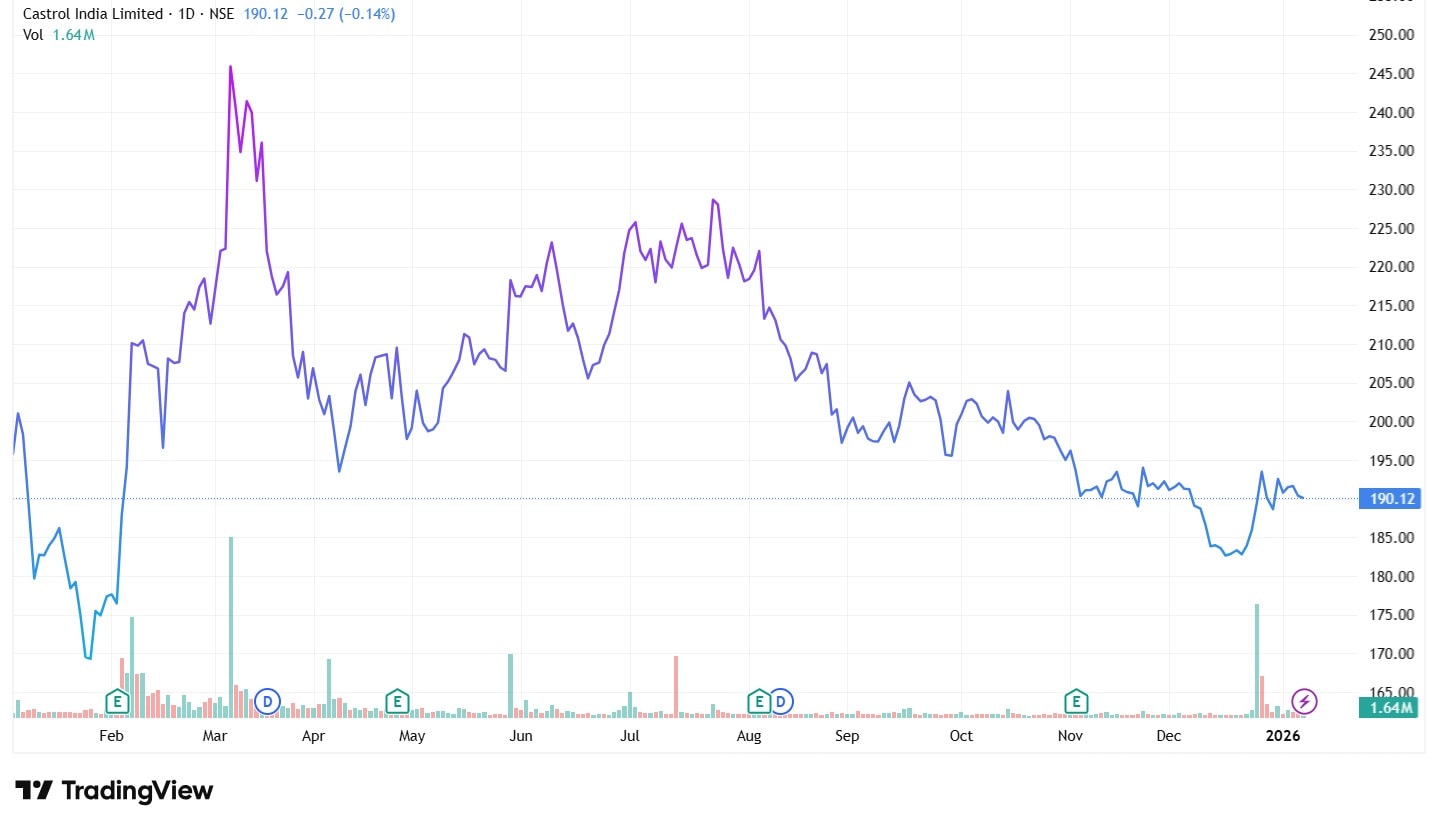
1-year Share Price Chart of Castrol India Ltd.
#3 ITC’s Defensive Moat: Can It Survive the Tax Hike?
ITC Ltd. is the leading FMCG business in India with an 80% share in the organised domestic market for cigarettes. It has over 25 brands that are used across Indian households daily.
It includes Aashirvaad, Bingo, Sunfeast, Fiama, Classmate, Mangaldeep, and others. ITC is also one of the largest exporters of agricultural products in India, and the exports include spices, coffee, tobacco leaf, frozen marine products, and others.
The company also manufactures and supplies paperboards, paper, and packaging material, and holds the largest share as the exporter from India in this space as well.
ITC is another stock that investors often add to their portfolio when they are looking for steady dividends. This company has never failed to pay dividends in the past 25 years. The current dividend yield of the company is 4.2% while the industry median is negligible.
Dividend Per Share & Dividend Payout Ratio of Five Years
| Financial Year | Dividend Per Share (₹) | Dividend Payout Ratio (%) |
| FY21 | 10.75 | 101 |
| FY22 | 11.5 | 93 |
| FY23 | 15.5 | 100 |
| FY24 | 13.75 | 84 |
| FY25 | 14.35 | 52 |
The dividend per share has increased from ₹10.75 in FY21 to ₹14.35 in FY25; however, the dividend payout ratio has been halved, as the profits increased 3x during the period.
It is not just that they have been paying regular dividends for more than 2 decades, but they are doing it without any financial leverage. The balance sheets of ITC are completely free of any debt. Its debt equity ratio is negligible at 0.01 as of FY25.
ITC has been growing its sales and profits by leaps and bounds without any debt and by completely relying on its own profits and reserves.
Future Outlook
ITC is positive about its growth outlook with the GST and interest rate cuts and decreasing inflation rate. The decreasing inflation is helping the company reduce its input cost on one hand, while on the other hand, the demand has been surging due to the GST cut benefit being passed on to the customers. The company is also expecting higher kharif crop output, which can significantly boost its Agri business.
Having said that, urban demand is still being monitored as most growth is coming from rural and suburban demand.
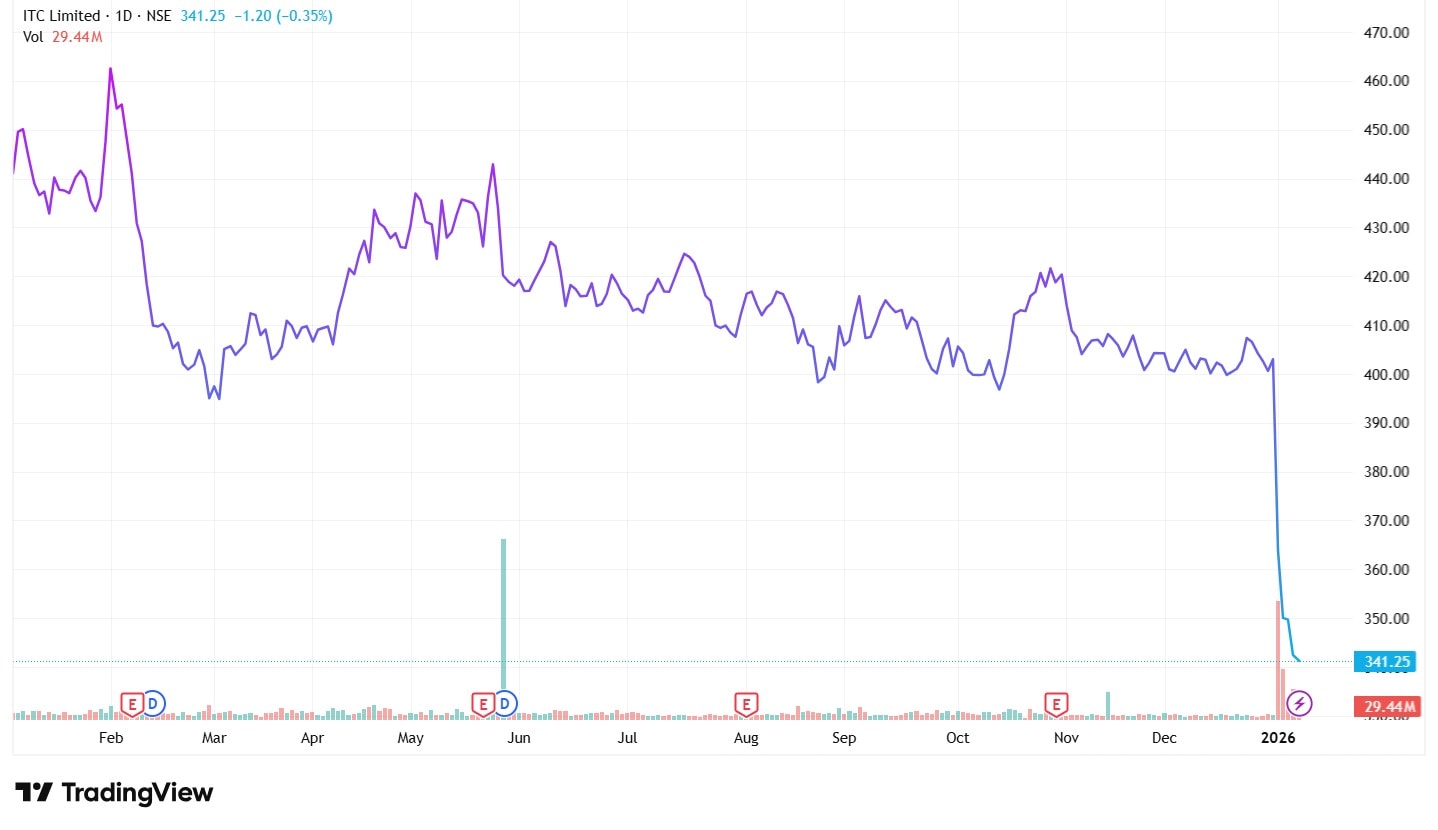
Having said that on 2nd January, 2026, the government announced new excise rates for tobacco products. Excise duty will now be levied at ₹2,050 to ₹8,500 per 1,000 sticks on cigarettes over and above 40% GST, effective from 1st February, 2026. This has come as a big blow to the largest cigarette producer in the country, as prices of the cigarettes will shoot up, potentially taking a toll on demand.
Financials
Sales in Q2FY26 dipped to ₹19,502 crore from ₹19,990 crore in the corresponding quarter last fiscal. However, the net profit surged from ₹5,054 crore to ₹5,187 crore during the same period.
Valuation
ITC is trading at a PE of 21.2x, which is way lower than the industry median of 46.7x. It is quite interesting to see such a blue-chip company with hardly any debt, paying regular dividends, trading so cheaply even in a highly overvalued market. The sharp drop towards the end of this period was on the announcement of the new excise duty structure.
1-year Share Price Chart of ITC Ltd.
Wrapping up
Near debt-free companies which are paying regular dividends are rare finds; they are gems in a volatile market. Their debt-free status makes them more stable than those with a high amount of debt in their books, and regular dividend payments help shareholders with a stream of regular income and stable returns, too. Adding these stocks to the watchlist might be beneficial in case you are looking for stocks that are less volatile and with a solid dividend history.
Disclaimer:
We have relied on data from www.Screener.in throughout this article. Only in cases where the data was not available have we used an alternate, but widely used and accepted source of information.
The purpose of this article is only to share interesting charts, data points and thought-provoking opinions. It is NOT a recommendation. If you wish to consider an investment, you are strongly advised to consult your advisor. This article is strictly for educative purposes only.
Maumita Mitra is a seasoned writer specializing in demystifying the world of investment for a broad audience. She has a keen eye for detail and a knack for explaining complex financial concepts in the simplest manner possible.
Disclosure: The writer and her dependents do not hold the stocks discussed in this article.
The website managers, its employee(s), and contributors/writers/authors of articles have or may have an outstanding buy or sell position or holding in the securities, options on securities or other related investments of issuers and/or companies discussed therein. The content of the articles and the interpretation of data are solely the personal views of the contributors/ writers/authors. Investors must make their own investment decisions based on their specific objectives, resources and only after consulting such independent advisors as may be necessary.