




The Rs 190-Crore Bet on Distressed Balance Sheets
Mukul Agrawal raised his stake in Valor Estate, the company most veteran market participants still refer to by its former name, DB Realty. Meanwhile, Porinju Veliyath added to Aurum PropTech, doing so twice. Once in his personal capacity, and once through Equity Intelligence India, the portfolio management firm he founded.
On the surface, these two corporate entities share almost no DNA. Valor Estate owns physical land, concrete, and hotels. Aurum PropTech owns intangible software platforms and rental applications. One is inherently asset-heavy; the other is aggressively asset-light. Yet, both operate on the same side of the Indian real estate spectrum, and both have spent the better part of the last two years actively repairing heavily distressed balance sheets rather than chasing top-line profit growth.
There is a singular, inescapable catch running through both investments, and it is the exact same catch in each case. According to their most recent filings, neither company earns its reported net profit from its core, day-to-day business operations yet. Here is what a breakdown of the numbers actually reveals.
#1 Valor Estate: A Mumbai Land Bank Play in Deep Value Territory
Valor Estate operated under the name DB Realty until March 2024. The corporate name changed, but the fundamental business mechanics did not. The firm builds and sells residential and commercial projects in and around Mumbai, running a hospitality arm alongside its real estate endeavours. Current company filings put its verified land bank at a substantial 513 acres.
Agrawal has been methodically adding to his position for a full year. He held 1.21% of the company in June 2025. That holding rose to 1.47% by March 2026, and expanded again to 1.57% in the June 2026 filing. At a market capitalization of approximately Rs 6,145 cr, that specific stake carries a valuation of close to Rs 97 cr.
What makes this accumulation notable is the underlying price action it occurred against. The stock is down roughly 47% over the trailing twelve months. It has swung violently between a high of Rs 219 and a low of Rs 83 in the last 52 weeks.
Decoding the Rs 1,136-Crore Debt Evaporation
For a fundamental value investor, the core narrative of Valor Estate is not found in the sales pipeline, but in the liabilities column. Borrowings have practically collapsed. Total debt stood at a suffocating Rs 2,978 cr in FY23. By March 2025 it came down to Rs 1,900 cr. And the May 2026 earnings release stated explicitly that it slashed debt by Rs 1,153 cr during FY26 alone getting it down to Rs 747 cr, with management projecting the entity to be entirely debt-free by FY27.
The cash flow statements corroborate this aggressively optimistic guidance. Cash from operations hit a robust Rs 939 cr in FY26, yielding a free cash flow of Rs 925 cr. For a legacy developer that spent previous cycles bleeding liquidity, this represents a genuine, mathematically verifiable turnaround in capital structure.
The ‘Other Income’ Trap: Analyzing Valor’s Profit Illusion
Let us look at the 5-year financial figures of the company for a better understanding.
| Financial Year | FY21 | FY22 | FY23 | FY24 | FY25 | FY26 | 5Y CAGR |
| Sales (Rs cr) | 25 | 219 | 698 | 357 | 1,133 | 1,593 | 130% |
| EBITDA (Rs cr) | -109 | -98 | -715 | 28 | -119 | 25 | NM |
| Net Profit (Rs cr) | -167 | 22 | -90 | 1,317 | -118 | 27 | NM |
The earnings picture requires a rigorous, skeptical reading here. The 130% sales growth rate calculated over a five-year period appears spectacular only because FY21 was a near-dead year burdened by the pandemic, logging a meagre revenue of just Rs 25 cr. Growth measured off a base that depressed is statistically misleading.
Look closely at FY24. The company reported a Rs 1,317 cr profit. Yet, that windfall did not materialize from selling residential flats. “Other Income” for that fiscal year registered at Rs 1,453 cr. Remove that non-operational line item, and the entire year plunges into a deficit.
The exact same pattern, albeit on a smaller scale, repeated in FY26. Total net profit settled at Rs 27 cr. Operating profit was at Rs 25 cr. However, “Other Income” injected Rs 133 cr into the equation. Strip away that other income, and the fiscal year would have ended in a pre-tax loss of roughly Rs 106 cr. The March 2026 quarter highlights how uneven this transition remains: sales contracted to Rs 87 cr, and the company posted a net loss of Rs 59 cr. Return on Capital Employed (ROCE) for FY26 stood at a measely 1.55%.
Beyond the 400% Surge
The share price of Valor Estate was about Rs 22 in July 2021 and it was Rs 112 as on 24th July 2026, which is over a 400% jump in 5 years.
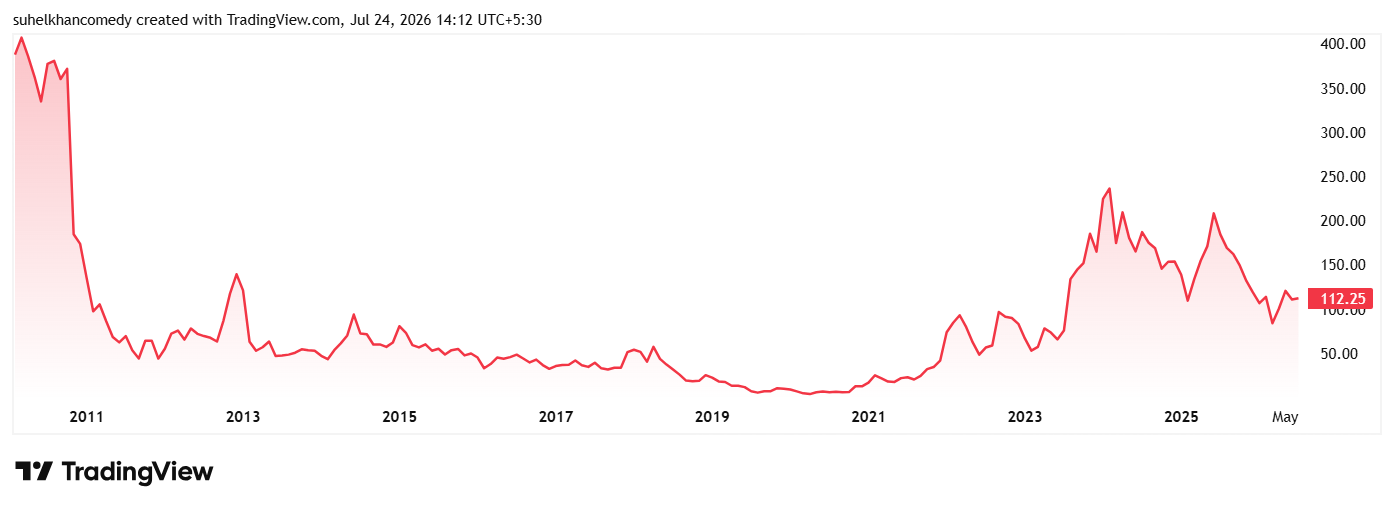
The shares of the company are trading at a negative PE due to losses. Traditional valuation metrics like PE fail here, because Valor has reported net losses in eight of the last eleven years. Book value remains the fairest yardstick. At Rs 75.4 a share against a trading price near Rs 112, the stock exchanges hands at roughly 1.5 times book value.
Retail interest has cooled, with the shareholder count dropping from 1.05 lakh in December 2024 to 89,122 by March 2026, even as the Razack Family Trust (6.31%) and the Rekha Jhunjhunwala family (4.61%) maintain significant anchor positions. Crucially, investors must note that promoters have pledged 44.7% of their holding.
#2 Aurum PropTech: Swapping Concrete for a Digital Ecosystem
Porinju Veliyath’s position in Aurum PropTech is easy to underestimate because it is strategically split. He holds 2.10% in his personal capacity. Equity Intelligence India, his portfolio management vehicle, holds an additional 3.95%. Together, they command 6.05% of the smallcap.
Veliyath added more to both holdings in the June 2026 quarter. The personal holding ticked up from 2.00% to 2.10%, while Equity Intelligence edged from 3.86% to 3.95%. At recent trading levels, the combined block is worth over Rs 103 cr.
This accumulation has been an exercise in extreme patience rather than a dramatic, speculative trade. Equity Intelligence held just 1.54% back in September 2023 and has layered into the stock in almost every consecutive quarter since.
With a current market cap of Rs 1,611 cr, Aurum has undergone a total corporate metamorphosis. It was known as Majesco, a legacy insurance software firm, until 2021. After liquidating its US business, it rebranded and rebuilt its architecture entirely around property technology. It currently operates NestAway and HelloWorld in the rental space, Sell.Do and Aurum Analytica in sales software, and PropTiger in digital transactions.
The Housing.com Catalyst and Margin Realities
The absolute swing factor for any investor evaluating this stock materialized in July 2026, when the board approved the acquisition of Locon Solutions, the parent company of Housing.com, from the REA Group.
Structured as an all-equity share swap, this manoeuvre forces REA India, which already sits on the register with 5.53% from a previous PropTiger deal, into a tighter hold. Absorbing Housing.com, one of India’s most high-traffic digital property portals, is a logistical undertaking orders of magnitude larger than anything Aurum has previously attempted.
The Operational Margin Shift
Read the top-line expansion with the same caution applied to Valor. Aurum’s reported profit of Rs 2,413 cr in FY21 was an extraordinary item derived from the sale of its US operations, not recurring revenue.
| Financial Year | FY21 | FY22 | FY23 | FY24 | FY25 | FY26 | 5Y CAGR |
| Sales (Rs cr) | 10 | 16 | 127 | 214 | 264 | 381 | 107% |
| EBITDA (Rs cr) | -10 | -19 | -16 | 3 | 47 | 84 | NM |
| Net Profit (Rs cr) | 2,413 | -13 | -40 | -66 | -41 | 1 | NM |
The area that actually warrants attention is the operating margin. It sat at a dismal minus 13% in FY23. By FY24, it scraped 1%. In FY25, it jumped to 18%, and by FY26, it hit 22%. That represents a tangible, operational turnaround, executing concurrently while total revenue scaled from Rs 127 cr to Rs 381 cr.
Yet, the core profit paradox remains. FY26 net profit was a marginal Rs 1 cr, and Profit Before Tax (PBT) was actually negative Rs 3 cr. The operating profit of Rs 84 cr was entirely consumed by heavy depreciation (Rs 104 cr) and interest costs (Rs 27 cr). Once again, Other Income of Rs 44 cr was required to bridge the gap and keep the final number positive.
Why Aurum’s Profit is Actually a Negative Core Margin
The June 2026 quarter also must be looked at forensically. Total income surged 57% to Rs 121 cr, and net profit printed at Rs 45 cr (against a loss of Rs 10 cr the prior year). However, a massive Rs 52.35 cr of that figure was a one-time gain from discontinued operations. Stripping that away, the company’s authentic profit before tax margin for the quarter was -6%.
Aurum executed the sale of two physical assets, Q5 and Q6, for Rs 112 cr in May 2026, utilizing the proceeds to immediately clear its lease rental discounting debt. The company is now effectively debt-free. Promoters have signaled confidence, raising their holding to 47.89% in June 2026.
The share price of Aurum Proptech was about Rs 65 in July 2021 and as on 24 July 2026, it was Rs 224, which is a 244% jump in 5 years.
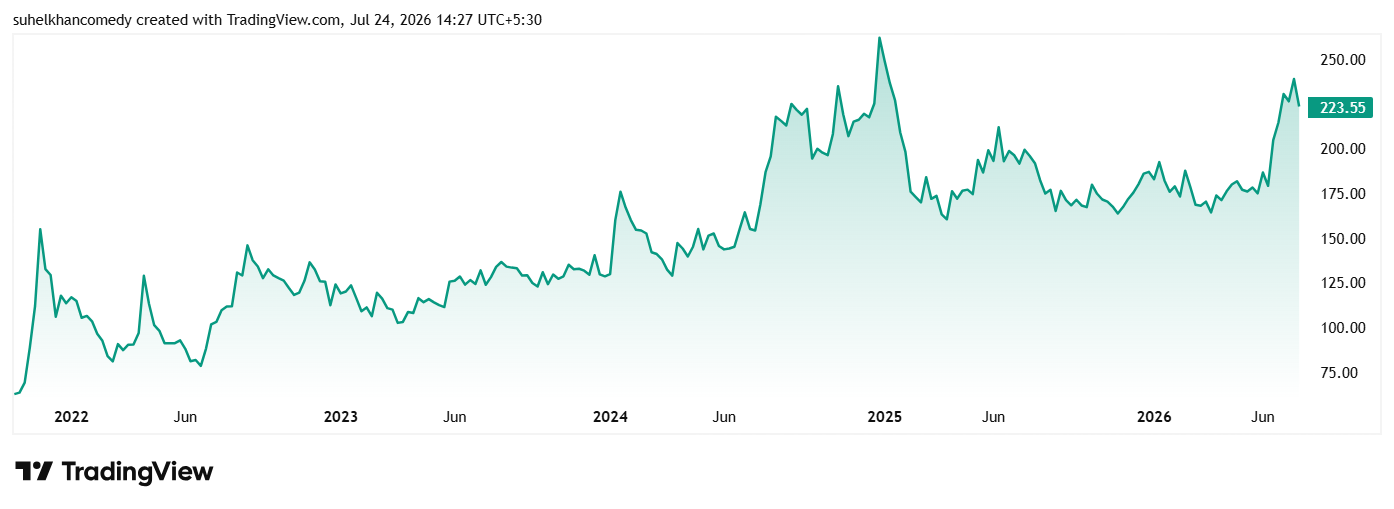
As for the valuation, the share of the company is trading at a PE of 1,708x, reflecting a market that is actively pricing in the speculative premium of an asset-light SaaS ecosystem.
Will the ‘Smart Money’ Patience Pay Off
The structural contrast between the two stocks we saw today is severe. Valor Estate is anchored in physical weight; its inherent value sits locked in premium Mumbai dirt, and its current corporate narrative is defined entirely by aggressive deleveraging. Aurum PropTech is weightless; its value resides in code, scalable software platforms, and the ambition of dominating the digital transaction layer of Indian real estate.
Yet, the existential question looming over both boardrooms is identical: Can either company finally engineer a sustained net profit purely from its core business operations, without requiring the artificial life support of asset liquidations or “Other Income”?
Valor Estate has not yet managed to cross that threshold. Aurum PropTech has inched closer, but its cash flows are still ultimately devoured by depreciation.
This underlying reality is exactly what makes the June 2026 accumulation by Agrawal and Veliyath so fascinating. They are not buying a current stream of earnings. They are utilizing fundamental analysis to buy heavily sanitized balance sheets, executing calculated bets that the operational earnings will inevitably follow the debt reduction. For retail investors tracking this smart money, the next two quarters of corporate filings will be crucial. Add these 2 stocks to a watchlist now to track them closely.
Disclaimer:
Note: We have relied on data from http://www.Screener.in and http://www.trendlyne.com throughout this article. Only in cases where the data was not available, have we used an alternate, but widely used and accepted source of information.
The purpose of this article is only to share interesting charts, data points and thought-provoking opinions. It is NOT a recommendation. If you wish to consider an investment, you are strongly advised to consult your advisor. This article is strictly for educative purposes only.
Suhel Khan has been a passionate follower of the markets for over a decade. During this period, he was an integral part of a leading Equity Research organisation based in Mumbai as the Head of Sales & Marketing. Presently, he is spending most of his time dissecting the investments and strategies of the Super Investors of India.
Disclosure: The writer and his dependents do not hold the stocks discussed in this article. The website managers, its employee(s), and contributors/writers/authors of articles have or may have an outstanding buy or sell position or holding in the securities, options on securities or other related investments of issuers and/or companies discussed therein.