



Two of India’s most followed and looked upon super investors just realigned their portfolios, and it has raised some valid questions in the investor circles.
Radhakishan Damani, the founder of D’Mart who is known for being a long-term value investor sold off a TSF group holdings company he had held on for 8 years. On the other hand, Market Master Vijay Kedia known for his SMILE investing sold off an auto ancillary manufacturer after holding it for close to 3 years.
Investors across the board are trying to figure out the reason behind these sell offs. Let us dive in to see if there are some hidden patterns.
Precision Camshafts: Kedia Exits as Fundamentals Stall
Incorporated in 1992, Precision Camshafts Limited is a manufacturer and supplier of camshafts in India and globally.
With a market cap of Rs 1,448 cr, the company supplies more than 150 varieties of camshafts for passenger vehicles, tractors, light commercial vehicles and locomotive engine applications.
Market Master Kedia held a stake in Precision Camshafts since March 2023 through his personal portfolio as well as Kedia securities, which was 2.10% in all. As of the quarter ending June 2025, he has partially or fully exited the stake he held under his personal portfolio as the holding has fallen below 1%.
Recent exchange filings reveal his holding even in Kedia securities has fallen below 1% meaning a partial or complete sell off.
A Disconnect Between Price and Performance
Let’s look at the financials for Precision Camshafts to try and find the reason for this sell-off.
The sales of the company were seeing a strong upward trend till FY23 which dropped in FY24 and finally saw a big drop in FY25.
| Year | FY20 | FY21 | FY22 | FY23 | FY24 | FY25 |
| Sales/Cr | 746 | 709 | 895 | 1,080 | 1,031 | 865 |
For H1FY26, the sales recorded by the company were 393 cr.
EBITDA (Earnings Before Interest, Taxes, Depreciation, and Amortization) also logged a similar trajectory. For H1FY26, the EBITDA logged was Rs 28 cr.
| Year | FY20 | FY21 | FY22 | FY23 | FY24 | FY25 |
| EBITDA/Cr | 112 | 61 | 114 | 111 | 101 | 82 |
Net Profits however saw an upward trend after losses of Rs 1 cr in FY21. For H1FY26, profits of Rs 32 cr have been recorded by the company.
| Year | FY20 | FY21 | FY22 | FY23 | FY24 | FY25 |
| Profit/Cr | 26 | -1 | 46 | 46 | 40 | 54 |
The share price of Precision Camshafts Ltd was around Rs 45 in January 2021 and as on 16th January 2026 it was Rs 152, which is a 238% jump in 5 years.
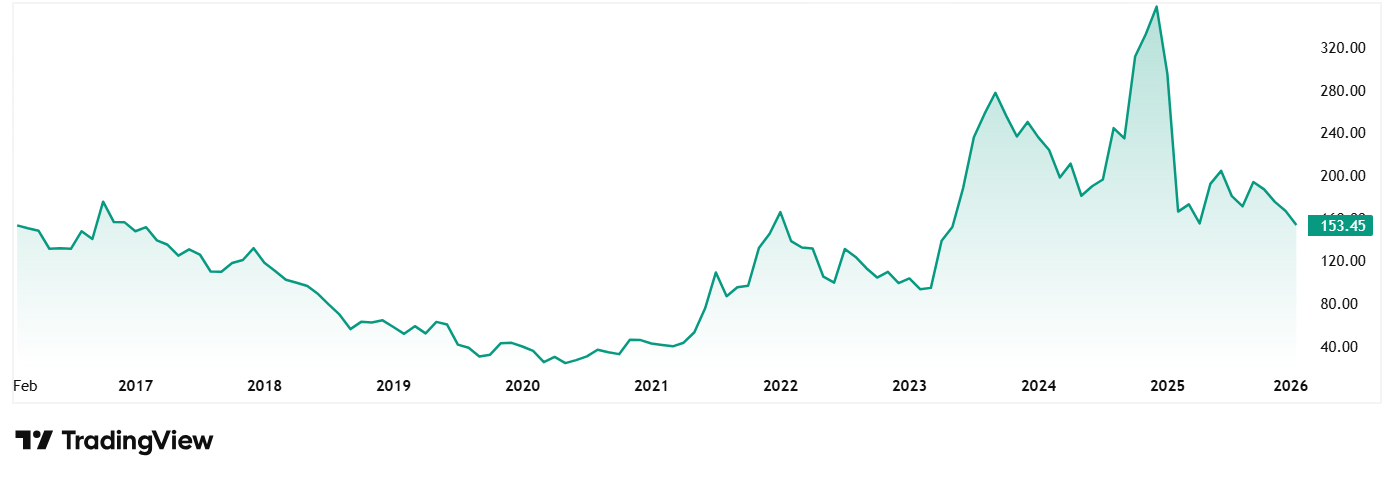
The company’s stock is trading at a PE of 44x, while the industry median is 29x. The 10-year industry median PE for the company is 37x and the industry median for the same period is 25x.
While the stock price more than tripled, the company’s actual business has stalled, with sales dropping and core profits drying up. The current earnings are mostly propped up by extra non-business income rather than actual product sales. Vijay Kedia likely cashed out to secure his massive gains once the growth story ended, moving his money before the weakening fundamentals could pull the price back down.
Tsf Investments: Damani Books Profits After a 540% Surge
Incorporated as ‘Sundaram Finance Securities Limited’ in August 1954, the company’s name was changed to Sundaram Finance Holdings Limited in March 2017. The company is now called TSF Investments.
With a market cap of Rs 9,656 cr, the company is primarily engaged in the business of Investments, business processing, and support services. It has a 100% subsidiary which is an outsourcing company offering various support services to large and mid-sized firms in and outside India. The TSF group, which is one wing of the original TVS Group of companies, is primarily a holding company with stakes in some of India’s top auto ancillary companies.
The Retail King Radhakishan Damani held a stake in the company since 2018, which as per the recent exchange filings have fallen below 1%, hinting at a complete or partial sell off.
Let us analyse the company’s core financials to see if there is a strong reason for this.
The company’s sales grew from Rs 93 cr in FY20 to Rs 155 cr in FY25, which is a compounded growth of 11%. For H1FY26, the sales recorded are Rs 429 cr.
EBITDA grew from Rs 31 cr in FY20 to Rs 116 cr in FY25 logging in a compound growth of 30%, and for H1FY26, the EBITDA is Rs 97 cr.
The net profits grew at a compound rate of 39% from Rs 78 cr in FY20 to Rs 412 cr in FY25, and for H1FY26 the profits recorded are over Rs 260 cr. The net profit includes income it earns from its subsidiary companies.
The share price of Tsf Investments was around Rs 68 in January 2021 and as on 16th January 2026 it was Rs 435, which is a jump of 540% in 5 years.
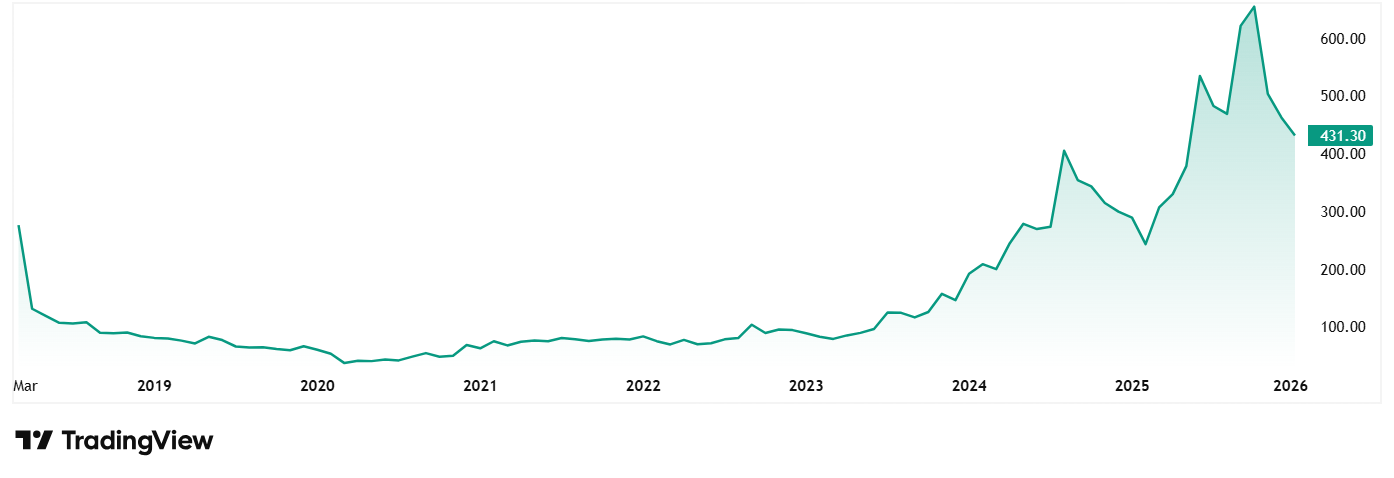
The share is trading at a PE of 21x, while the industry median is 31x. The company also has a dividend yield of 1.4%, while the industry median currently is a flat 0.
Damani likely exited his position because the stock has probably achieved its full value after an incredible 540% rally. For a value investor, selling isn’t always a sign of trouble; it’s often about booking massive profits once the initial undervalued price moves toward a fair market valuation.
By liquidating his stake at the peak of this strong growth cycle, he frees up cash to hunt for the next undiscovered multibagger, a very Warren Buffett thing to do. In short, he chose to book a multi-bagger return rather than stay through the inevitable plateau that usually follows such a rapid price surge.
Value Realisation vs. Business Fatigue
These exits by Radhakishan Damani and Vijay Kedia serve as a reminder of the difference between a great company and a great investment. While one investor walked away from a business where the operational engine was beginning to falter, the other departed a thriving enterprise simply because the market had finally recognized its worth, leaving little alpha on the table.
These sell off have raised some very valid questions for the investors who follow them. Is it time to follow the super investors out the door, or does the strong momentum in one and the potential turnaround in the other still offer value?
The only way to find out is to add these stocks to a watchlist and keep a close eye on them.
Disclaimer:
Note: We have relied on data from www.Screener.in and www.trendlyne.com throughout this article. Only in cases where the data was not available, have we used an alternate, but widely used and accepted source of information.
The purpose of this article is only to share interesting charts, data points and thought-provoking opinions. It is NOT a recommendation. If you wish to consider an investment, you are strongly advised to consult your advisor. This article is strictly for educative purposes only.
Suhel Khan has been a passionate follower of the markets for over a decade. During this period, He was an integral part of a leading Equity Research organisation based in Mumbai as the Head of Sales & Marketing. Presently, he is spending most of his time dissecting the investments and strategies of the Super Investors of India.
Disclosure: The writer and his dependents do not hold the stocks discussed in this article.
The website managers, its employee(s), and contributors/writers/authors of articles have or may have an outstanding buy or sell position or holding in the securities, options on securities or other related investments of issuers and/or companies discussed therein. The content of the articles and the interpretation of data are solely the personal views of the contributors/ writers/authors. Investors must make their own investment decisions based on their specific objectives, resources and only after consulting such independent advisors as may be necessary.