




The India AI Summit is underway here in New Delhi, amid a global rout in Information Technology companies, amid fears that Artificial Intelligence will erode traditional IT work. But at the same time, this is opening new opportunities for companies with an AI presence. The sector also benefits from government policy tailwinds.
The government is actively funding the creation of computing infrastructure. This includes a “sovereign AI ecosystem” where the government will procure infrastructure directly. To this end,
the Government of India has earmarked an outlay of ₹10,300 crore for the IndiaAI Mission to establish a sovereign AI ecosystem in the country.
Big tech’s Rs 58 lakh crore AI Investment
This is just the tip of the iceberg, given the scale of investment happening globally, especially in the US. In 2026 alone, so far, Amazon has announced $200 billion (₹18 lakh crore), Alphabet $185 billion, up from $91.5 billion in 2025, Meta between $115-135 billion, and Microsoft $120 billion. India will gradually catch up soon, but not at this scale.
So, while on one side, IT companies are falling into fear of disruption, some AI companies are benefiting from optimism about future demand.
In this article, we analyze three competitors leading the charge.
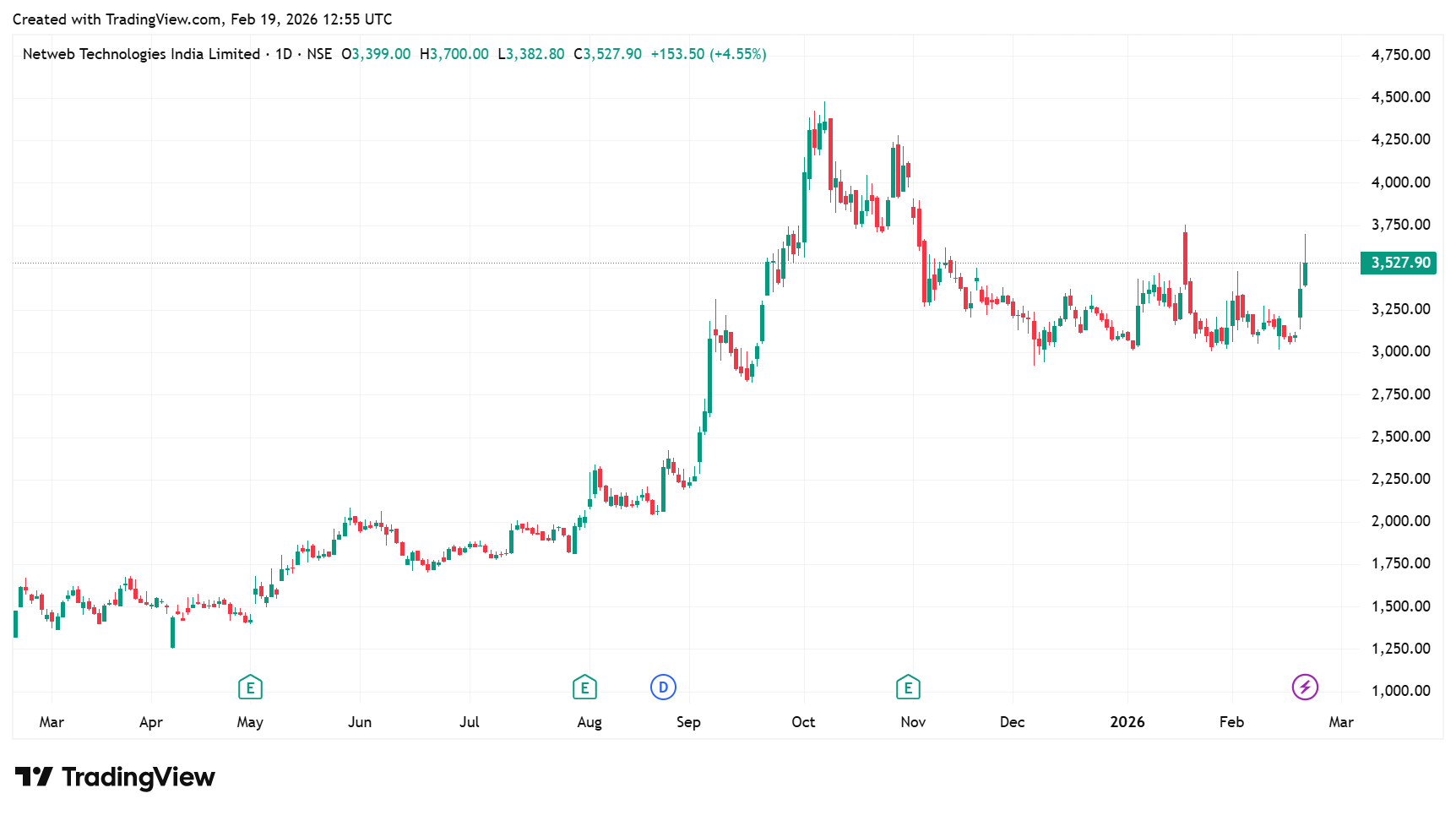
#1 Netweb Technologies: Scaling the NVIDIA Blackwell Architecture
Netweb is a leading Indian Original Equipment Manufacturer specializing in High-end Computing Solutions. It engages in in-house design and manufacturing of complex computing systems, providing a full-stack solution, including hardware, software, and integration.
The Full-Stack Manufacturing Advantage
Its business is primarily driven by three strategic growth pillars: AI systems, High-Performance Computing (HPC), Private Cloud, and Hyperconverged Infrastructure (HCI). The AI Systems segment is the primary growth driver, contributing 64.2% of revenue in Q3FY26. Netweb’s portfolio also includes Enterprise Storage, Data Centre Servers, and Software services.
GPU Integration & The Blackwell Ecosystem
Within AI systems, Netweb designs and manufactures advanced AI systems based on the latest GPU architectures. It works closely with technology partners such as NVIDIA, AMD, and Intel to integrate chips into their server designs. They have also introduced Skylus.ai, a unified solution for establishing a GPU-based AI infrastructure.
In the HPC domain, the company develops supercomputing systems that run complex algorithms and applications at scale. This involves bespoke hardware designs and unique middleware cluster suites. In HCI, it provides private cloud solutions that combine compute, storage, and networking capabilities.
The Supercomputer and Personal AI System
The management views the current surge in AI demand as just the “tip of the iceberg” and anticipates sustained growth across its business segments. To capitalise on the AI boom, on 18 February, 2026, Netweb unveiled one of its most advanced AI offerings, the Tyrone Camarero GB200 AI Supercomputer.
It is based on the NVIDIA Grace Blackwell. This product is built on the NVIDIA GB200 NVL4 platform. It also launched a petascale personal AI system, the Tyrone Camarero Spark. The company states the Spark is one of the world’s smallest AI supercomputers, based on the NVIDIA DGX Spark platform and powered by the NVIDIA GB10 Grace Blackwell Superchip.
Order Visibility & Q3 Financial Momentum
The company reiterates its guidance of a 30-40% CAGR for its organic business over the next 2-3 years. It holds a strategic order book of ₹1,733.6 crore, providing revenue visibility of over a year. The company also expects big opportunities from the Indian government’s AI mission.
Management states that large-scale procurement of sovereign infrastructure (i.e., the government purchasing GPUs/servers) has not yet begun, suggesting a future wave of demand. Netweb is working on the latest chip architectures, including NVIDIA’s Blackwell platform and upcoming chips from Intel and AMD, ensuring it remains at the forefront of technology.
From a financial perspective, total income rose by 141% year-on-year to ₹804.9 crore in Q3FY26, driven by order book execution. EBITDA rose 127% to ₹98 crore, while margins stood at 12.2%, slightly lower than the 12.9% in Q3FY25. Net Profit grew by 147% to ₹73.3 crore.
#2 Aurionpro Solutions: Reimagining Banking through ‘Software 2.0
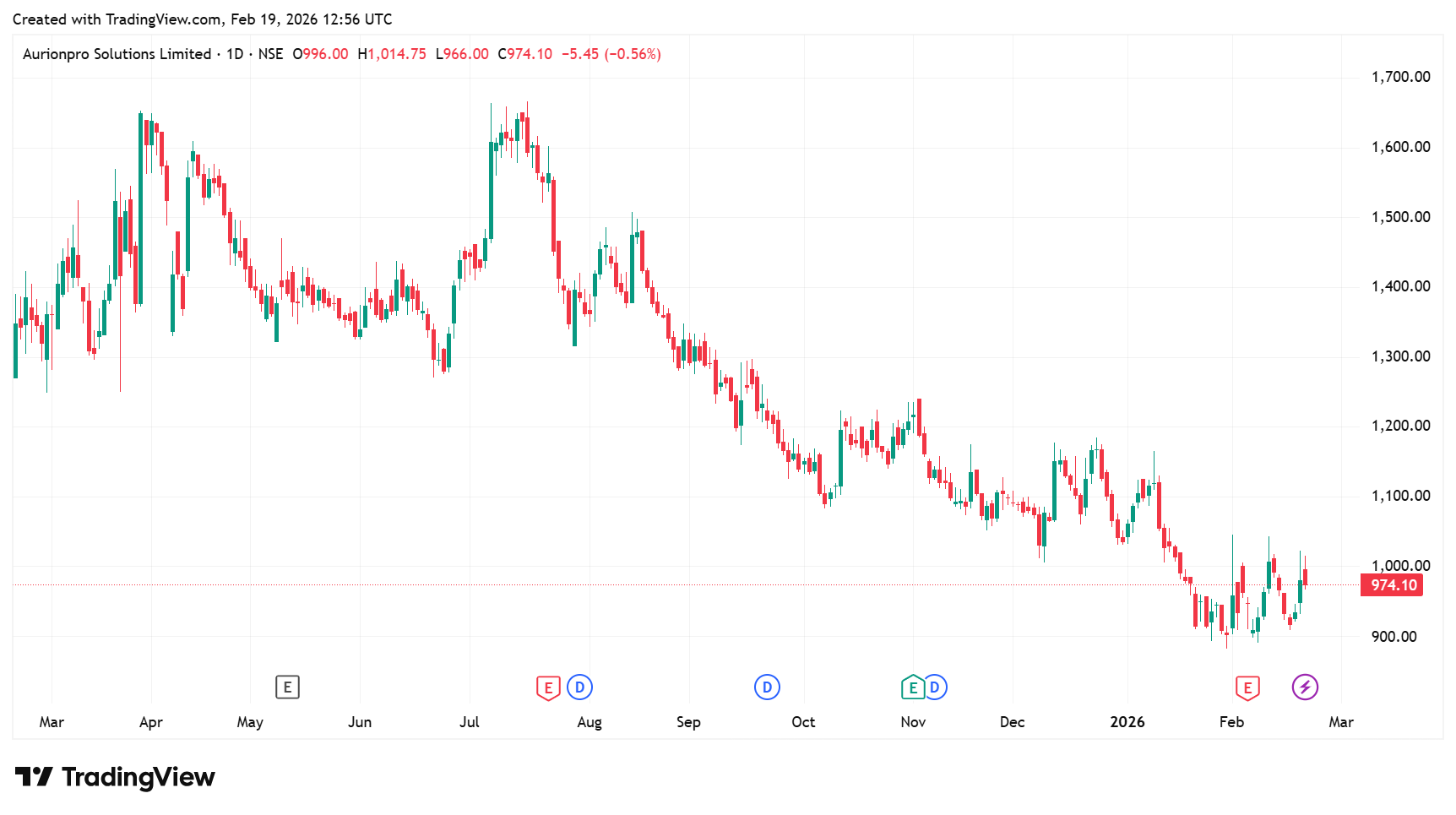
Aurionpro is traditionally a global technology company that provides IP-led products, platforms, and services. It primarily focuses on the Banking, Mobility, Payments, and Government sectors. The company positions itself as a platform-led provider of advanced technology solutions enabling enterprises to accelerate digital innovation.
The ‘Software 2.0’ Pivot: Agentic Banking and Lexsi Labs
Aurionpro is aggressively pivoting to become an “AI-native” organization, a strategy the management refers to as “Software 2.0.” This transition is not just about adding AI features; it fundamentally reimagines the software supply chain and how banking operations are executed.
It is developing software for Agentic Execution, in which AI agents (rather than humans) operate the system to execute complex banking processes. Management believes this shift expands their Total Addressable Market. While the global banking IT spend is estimated at around US$400 billion, the operations spend that agentic AI targets is estimated at US$3.5-4 trillion.
In fact, it recently launched AurionAI, a domain-led enterprise AI platform specifically tailored for the banking and financial services sector. It is designed to be secure, scalable, and production-ready for regulated institutions. Aurionpro has established a dedicated research arm, Lexsi Labs, to address “hard engineering problems” in AI that others have not addressed.
Operational Leverage & Revenue Efficiency
For Aurionpro, a key operational goal is to use AI tools to increase productivity, enabling revenue growth with a smaller increase in headcount. Management noted that while revenue grew 26%, headcount in software development has largely remained flat or decreased, driven by these efficiencies.
The company expects R&D spending to remain in the 9-10% range of revenue, reflecting a concentrated investment cycle to capture the AI opportunity. Additionally, the surge in AI usage is driving demand for the company’s data centre business.
Specifically, as AI moves from training to “inferencing” (mainstream usage), there is a massive need for near-shore compute capacity, which benefits Aurionpro’s design-and-build services for data centres. Management has maintained an ambition to deliver industry-leading growth.
The 65-66% Larger Pipeline
It aims to grow at about 30% over the next few years. They noted that the pipeline at this point in the year (FY26) is 65-66% larger than at the same time last year. Part of this growth can come from the data centre, which is expected to grow strongly. Management also targets converting roughly 60% of EBITDA to cash.
From a financial perspective, total income rose by 21% year-on-year to ₹371 crore in Q3FY26, driven by strong order book execution. EBITDA rose 18% to ₹75 crore, while margins stood at 20%, slightly lower than the 21% in Q3FY25. Net Profit declined by 8% to ₹44 crore, impacted by a one-time exceptional charge related to the new labour code.
#3 E2E Network: Building India’s Hyperscale Cloud Backbone
E2E Networks is primarily an AI-focused hyperscale cloud platform. The company operates its cloud infrastructure through data Centres, providing services such as accelerated Cloud GPUs and managed hosting solutions. Within data Centres, E2E includes cloud computing services to Indian data Centres in Noida, Chennai, and Mumbai.
India’s Hyperscale AI Backbone
Historically concentrated in the Delhi-NCR region, E2E Networks has significantly expanded its infrastructure. As of January 2026, the company maintains a total of 10 MW of Data Centre IT power capacity and has an operational GPU capacity of over 3,900 units. Its operations now span multiple data centres located in Delhi-NCR, Maharashtra, and Tamil Nadu.
The L&T Partnership: A Regional Edge
E2E has strengthened its presence in Chennai to enhance regional latency for enterprise and AI workloads. Through a strategic partnership with Larsen & Toubro, E2E is deploying GPU clusters at L&T’s data centre. In January 2026, the company secured a new contract with L&T for GPU services valued at ₹8.49 crore.
The Blackwell Rollout
The first batch of 1,024 NVIDIA Blackwell B200 GPUs arrived at the Chennai data centre on 9 January 2026, and is expected to go live before the end of Q4 FY26. This is expected to generate an Annualized Revenue Run-rate of approximately ₹245-250 crore upon full deployment. For this procurement, the company invested ₹600- 650 crore, partially funded by term loans.
The IndiaAI Mission
E2E has been awarded contracts worth ₹265 crore under the IndiaAI Mission, with phased deployment initiated in December 2025. Additionally, it completed the acquisition of Jarvis Labs in December to scale its global reach. With the integration of the new Blackwell units, E2E expects its total capacity to reach nearly 5,000+ GPUs by March 2026.
Scaling Revenue vs. Infrastructure Depreciation
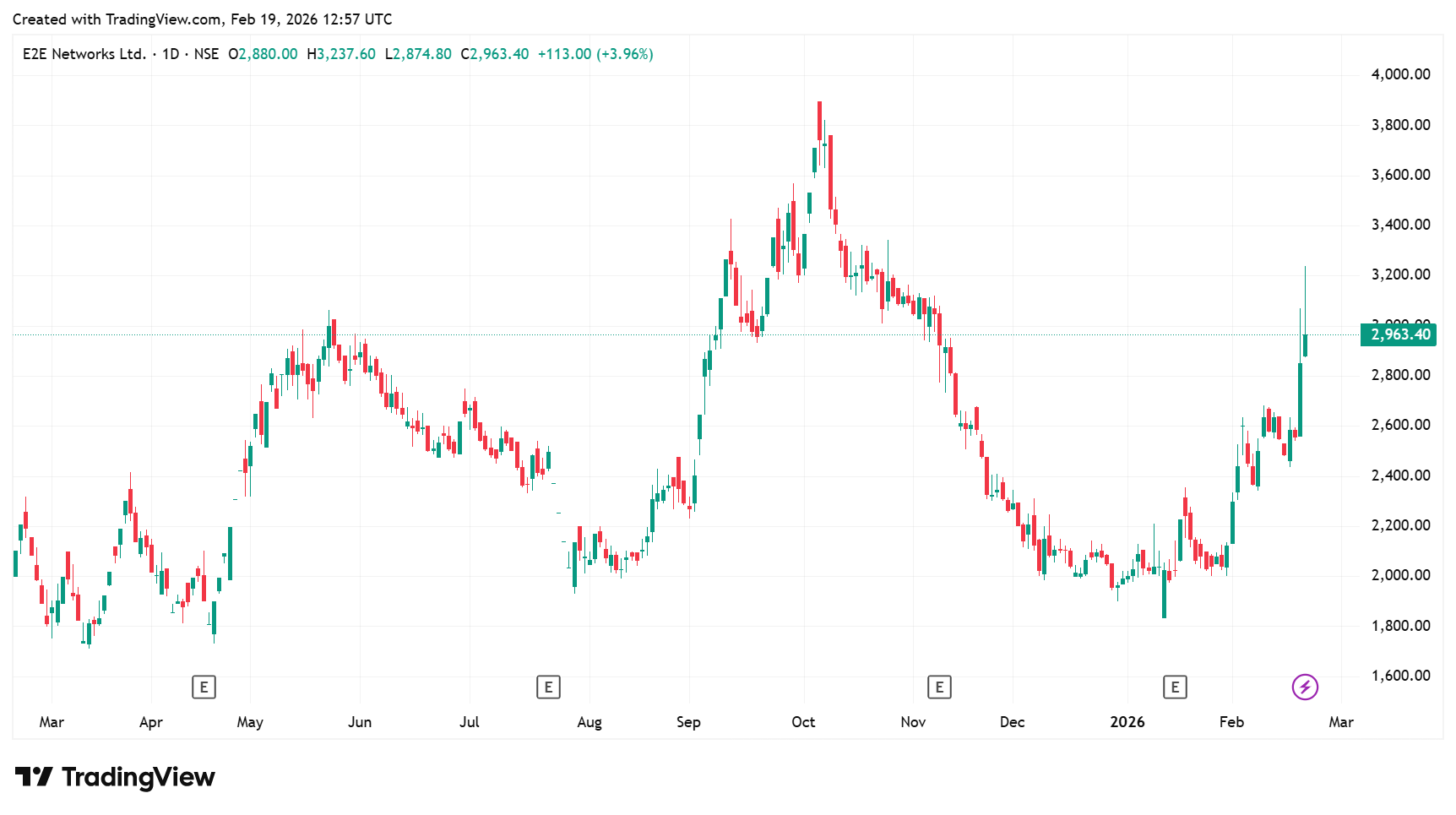
From a financial perspective, revenue surged 59.8% sequentially to ₹70 crore in Q3FY26. Consequently, EBITDA increased 120.2% to ₹39.6 crore, while margins expanded to 56.6%. Despite this, E2E reported a net loss of ₹5.7 crore (down from ₹13.5 crore in the previous quarter), mainly due to higher depreciation costs associated with new GPU facilities.
E2E reiterated its guidance for a monthly run rate (MRR) of ₹35-40 crore by March FY26, primarily driven by large orders (₹265 crore) from the IndiaAI mission. Long-term EBITDA guidance is set at around 70%, driven by operating leverage along with volume growth.
The exit MRR for the quarter ended December 2025 was ₹28 crore, up significantly from ₹16 crore in Q2FY26. After the IndiaAI mission orders (which ramp up in January 2026), the company is targeting to increase the utilisation of existing infrastructure to 80-90% in the next financial year, up from 60-65% in December 2025.
The Bottom Line
Netweb is a capital-light business and boasts a strong Return on Capital Employed (RoCE) and Return on Equity (RoE). E2E is currently in investment mode, depressing its return ratios. Netweb’s valuation is significantly higher, even when factoring in high growth potential.
Aurionpro is trading at a lower multiple than the historical median but in line with the industry. E2E multiples are at a discount to the median multiple but in line with the industry median. That said, India’s AI wave is creating distinct winners.
| Peer Comparison (X) | |||||
| Company | P/E | 5Y Median P/E | Industry P/E | RoCE (%) | RoE (%) |
| E2E Network | 34.2 | 45.9 | 30.9 | 11.2 | 10.9 |
| Netweb | 114.0 | 132.2 (2.5Y) | 26.8 | 32.4 | 23.9 |
| Aurionpro | 26.5 | 32.0 | 23.6 | 18.1 | 15.3 |
| source: screener.in | |||||
Netweb benefits from sovereign infrastructure build-out, Aurionpro is embedding AI into enterprise workflows, and E2E is building GPU capacity to meet rising demand. Each operates at a different stage of the value chain, with varied risk-reward profiles. It’s hard to predict who will win at this stage, but it’s worth adding them to your watchlist and keep them on radar.
Disclaimer:
Note: Throughout this article, we have relied on data from http://www.Screener.in and the company’s investor presentation. Only in cases where the data were not available have we used an alternate, widely used, and accepted source of information.
The purpose of this article is only to share interesting charts, data points, and thought-provoking opinions. It is NOT a recommendation. If you wish to consider an investment, you are strongly advised to consult your advisor. This article is strictly for educational purposes only.
About the Author: Madhvendra has been deeply immersed in the equity markets for over seven years, combining his passion for investing with his expertise in financial writing. With a knack for simplifying complex concepts, he enjoys sharing his honest perspectives on startups, listed Indian companies, and macroeconomic trends.
A dedicated reader and storyteller, Madhvendra thrives on uncovering insights that inspire his audience to deepen their understanding of the financial world.
Disclosure: The writer and his dependents do not hold the stocks discussed in this article.
The website managers, its employee(s), and contributors/writers/authors of articles have or may have an outstanding buy or sell position or holding in the securities, options on securities or other related investments of issuers and/or companies discussed therein. The articles’ content and data interpretation are solely the personal views of the contributors/ writers/authors. Investors must make their own investment decisions based on their specific objectives, resources, and only after consulting such independent advisors as may be necessary.