



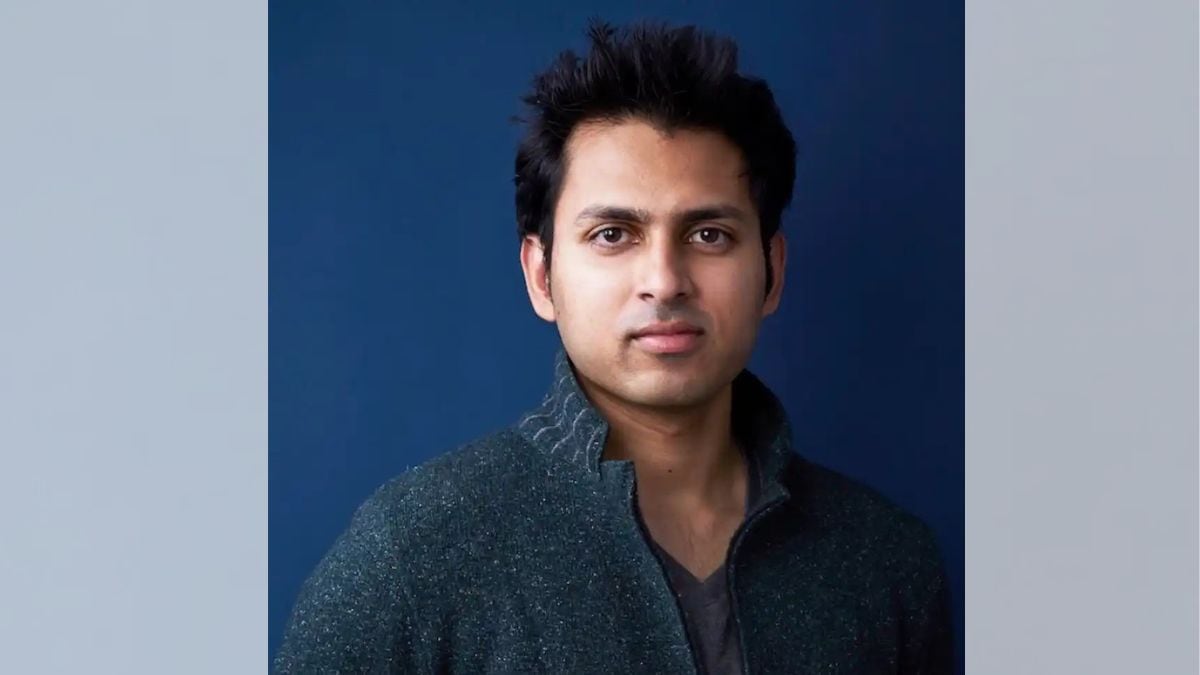
Soumith Chintala, the Indian-origin AI researcher and co-creator of PyTorch (one of the world’s most influential open-source deep learning frameworks) has been appointed as the new Chief Technology Officer (CTO) at Thinking Machines Lab, the ambitious AI startup founded by former OpenAI CTO Mira Murati. The announcement, made by Murati on X (formerly Twitter), highlights Chintala’s decade-plus contributions to the AI field and his role as a “major contributor” to the team.
The move to get Chintala onboard comes amid a leadership shakeup at Murati’s lab, following the departure of Barret Zoph, who left for OpenAI. Chintala’s elevation to CTO marks the latest chapter in a remarkable career that spans groundbreaking open-source innovations, leadership at Meta, and a passion for democratising AI.
Soumith Chintala: A peek into his early Life and education
Born and raised in Hyderabad, India, Chintala’s journey into the world of AI was far from straightforward. He has openly shared his struggles with mathematics during his school years, describing himself as “bad at math” in many interviews. Despite these hurdles, he pursued engineering at the Vellore Institute of Technology (VIT) in Vellore (often referred to as a “tier-2” college in India), where he earned his undergraduate degree between 2005 and 2009. This period laid the foundation for his interest in technology, though he faced rejections and setbacks early on.
Chintala later moved to the United States for graduate studies at New York University (NYU), where he delved deeper into AI, robotics, and computer vision. Some sources also mention time at the University of Texas at Austin, but his personal website confirms NYU as the key institution. At NYU, he collaborated on robotics projects and began contributing to open-source initiatives, setting the stage for his professional breakthroughs.
Career Milestones: Building PyTorch and leading at Meta
Chintala’s professional trajectory took off in 2014 when he joined Meta (then Facebook) as a software engineer at the Facebook AI Research (FAIR) lab. Over the next 11 years, he rose to become a VP/Fellow of Engineering, focusing on AI infrastructure, generative AI, and open-source tools.
His greatest legacy is co-founding PyTorch in 2016, alongside colleagues at Meta. What began as a passion project evolved into a dominant framework powering 90%+ of AI research and applications worldwide. PyTorch has been instrumental in advancements at companies like Tesla (for self-driving cars), AstraZeneca (drug discovery), Genentech (cancer research), and even NASA. Chintala led PyTorch for nearly eight years, handling everything from design and management to bug fixes and community growth.
Prior to PyTorch, he maintained Torch-7, a Lua-based deep learning library used by Google DeepMind, Twitter, and Meta, and contributed to EBLearn, a C++ framework with Yann LeCun and Pierre Sermanet. His research spans generative models (including key papers on GANs like LAPGAN, DCGAN, and Wasserstein GAN), object detection, human detection, AI for video games, and ML systems. Google Scholar lists his publications with thousands of citations.
Chintala’s current role as CTO at Thinking Machines
Chintala joined Thinking Machines Lab shortly after leaving Meta, initially as a major contributor. His promotion to CTO, as announced by Murati, highlights his expertise in AI infrastructure and research. The lab, focused on advanced AI development, benefits from his track record in scaling open-source projects and fostering innovation.
Beyond his CTO duties, Chintala dabbles in robotics at NYU, collaborating on projects like Robot Utility Models (90% zero-shot accuracy for tasks like door opening), On Bringing Robots Home (81% success across 109 tasks in NYC homes), Dexterity from Touch, CLIP-Fields, and Holo-Dex. He is building a household robot for chores and developing simulators for multi-modal AI models.
As an investor, Chintala backs AI and robotics ventures within his network, including Runway (video generation), 1X (humanoid robots), Osmo (AI for smell recognition and synthesis), Anthropic, Together.ai, and Lepton.