



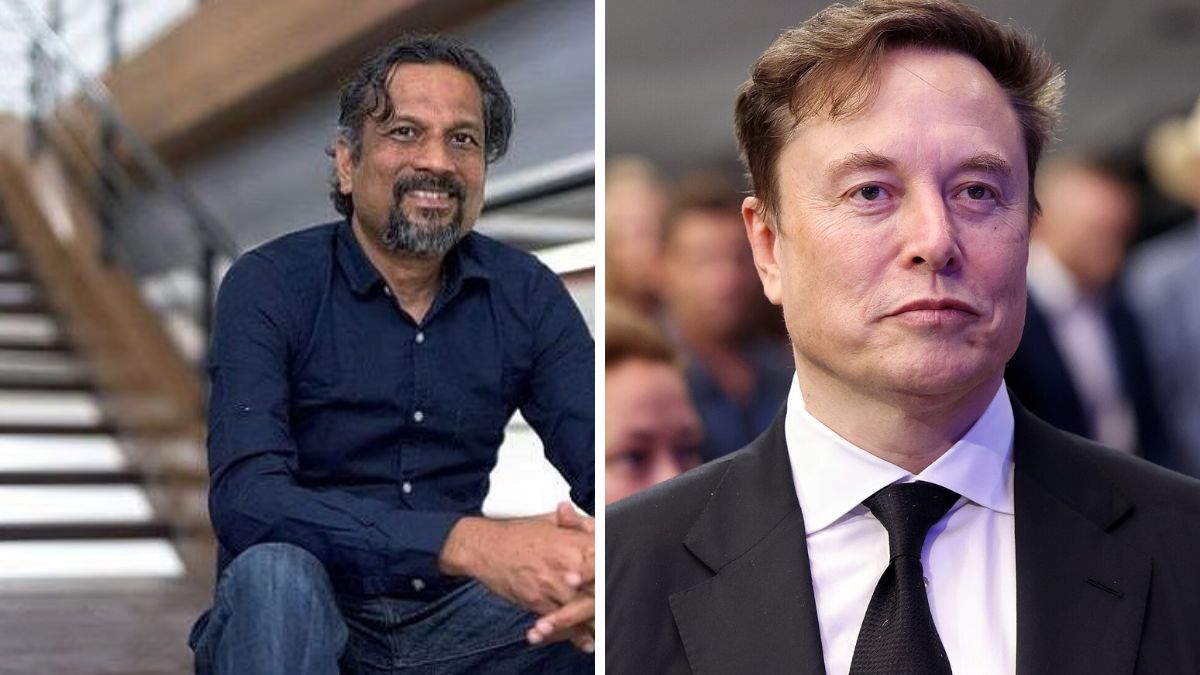
A debate over the future of work in the age of artificial intelligence has intensified after Zoho founder Sridhar Vembu publicly disagreed with Tesla CEO Elon Musk on how governments should respond to potential job losses caused by automation.
The discussion was sparked by Musk’s recent remarks advocating for a “Universal High Income” as a solution to large-scale unemployment driven by AI.
In his post, Musk wrote, “Universal HIGH INCOME via checks issued by the Federal government is the best way to deal with unemployment caused by AI. AI/robotics will produce goods & services far in excess of the increase in the money supply, so there will not be inflation.”
Vembu calls AI income model ‘dystopian’
Responding to this, Vembu offered a sharply contrasting view, arguing that such a framework assumes an extreme scenario where machines replace most human labour, leaving governments to sustain consumption through direct payments.
He explained that Musk’s idea rests on the belief that AI will generate massive output with minimal human involvement while maintaining stable prices. However, Vembu challenged this logic, especially the assumption that prices would not decline despite surplus production.
“Merely enforcing existing anti-monopoly laws would be sufficient for prices to drop,” Vembu noted, adding that even mechanisms like copyright — what he described as government-granted monopolies — could be reconsidered if needed.
Human roles will endure despite automation
Beyond the economic argument, Vembu stressed that fears of complete human redundancy are overstated. He pointed out that several professions rooted in human connection, empathy, and trust are unlikely to be replaced by machines.
He pointed to professions such as farming, teaching, nursing, and religious service as examples of work society may continue to value deeply, not just economically but socially. “We don’t care for robots to care for our babies or for the sick or be our priests,” he said, underscoring the enduring importance of human-centric roles.
The exchange highlights a broader and increasingly urgent global conversation: whether artificial intelligence will redefine work entirely or simply reshape it. While some, like Musk, foresee a future where income support becomes essential, others like Vembu argue that human purpose and economic systems will adapt without requiring such drastic interventions.