



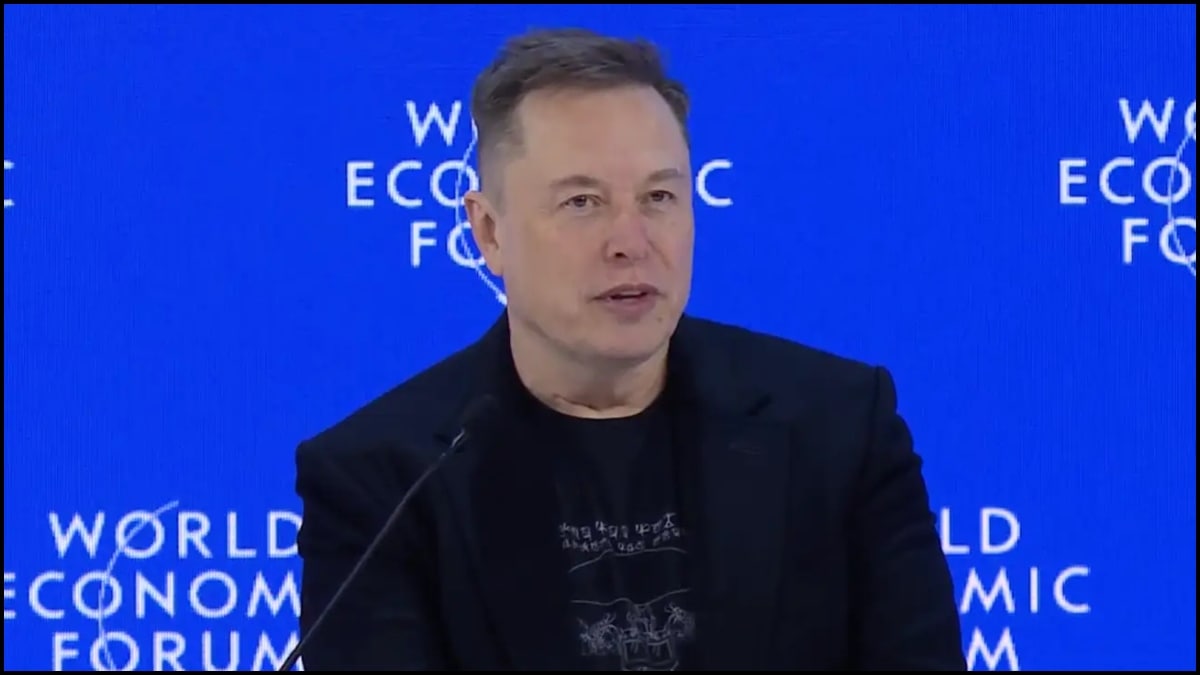
Elon Musk delivered a series of ambitious forecasts during a conversation with BlackRock CEO Larry Fink in his first-ever appearance at the World Economic Forum’s annual meeting. The Tesla, SpaceX, and xAI CEO predicted a future shaped by rapid advances in artificial intelligence, humanoid robotics, space travel, and human longevity.
Musk, who has been playing a crucial role in furthering the fields of generative AI and robotics with his companies, predicted that AI would surpass individual human intelligence by the end of 2026 or no later than 2027. “The rate at which AI is progressing, I think we have AI that is smarter than any human this year, and no later than next year.”
He went further, forecasting that by 2035, AI would exceed the combined intelligence of all humanity. He also claimed Tesla’s Optimus humanoid robot would be available for public sale by the end of 2027, eventually leading to billions of robots creating unprecedented economic abundance where “you won’t be able to think of something to ask the robot for at a certain point.”
Musk on AI, Robotaxis, and space travel timelines
At Davos 2026, Musk reiterated that Tesla robotaxis would become “very widespread by the end of this year” in the US, with planned expansions in Arizona, Florida, and Nevada. For SpaceX, he maintained that a fully reusable Starship rocket would be achieved by the end of 2026, reducing space travel costs by a factor of 100 and making orbital freight competitive with air cargo.
Musk also described aging as a “very solvable problem” whose root cause would prove “incredibly obvious” once discovered.
On a lighter note, Musk joked about extraterrestrial life, noting that SpaceX’s 9,000 satellites had never needed to maneuver around alien spacecraft, suggesting intelligent life may be extremely rare in the universe. “We have 9,000 satellites up there, and not once have we had to maneuver around an alien spaceship. We need to assume that life and consciousness are extremely rare and it might only be us,” said Musk.
Will Musk’s ambitious timelines become true?
Musk has been known to have ambitious targets within unrealistic timelines that eventually fail to take place. Be it the range of full self-driving capabilities of Tesla electric cars, the Mars missions, or the Starship milestones, Musk’s timelines have seldom come true.
However, in a world where all of Musk’s enterprises are facing some strong competition, it seems that Musk and his teams have to buckle up and get ready to push through the hardships with more effort and optimism.