



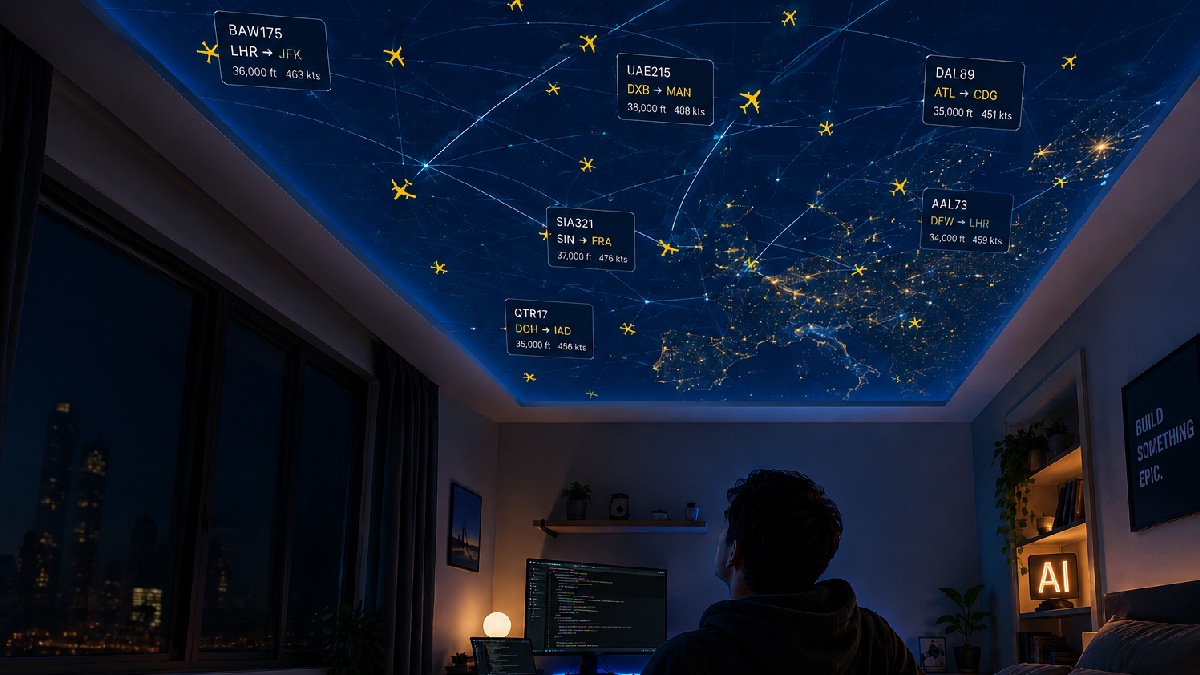
Can you use vibe coding to make something that can be deemed cool by plane spotters? One DIY enthusiast has shared one such example that the internet pleads to be commercialised and sold. The DIY creator has built a unique project, called SFO Ceiling Sky Projector, to track airplanes in ceiling projection in real time, flying over their roof – all thanks to some off-the-shelf parts and vibe coding.
The project, which seems like a commercially sold gadget at first, is entirely built at home, utilising a $30 RTL-SDR radio receiver, a projector, a Raspberry Pi computer and a vibe-coded software to make it all happen. While this may be strictly appealing to the community of plane spotters, there’s more to it than just a projection of virtual airplanes.
Vibe coding a dream project for plane spotters
We stumbled upon a project shared on Reddit, which shows what cheap computing bits and vibe coding can do. The creator lives under the takeoff path of San Francisco International Airport (SFO), and he decided to pull off something cool – turn their ceiling into a live, immersive sky map.
Using a cheap RTL-SDR radio receiver (a ubiquitous software-defined radio dongle), the setup decodes real-time ADS-B signals broadcast by aircraft. These contain data like position, altitude, speed, flight number, aircraft type, and destination data. A projector mounted to point at the ceiling shows virtual icons of the planes as they fly overhead in real time, complete with labels (e.g., “SWA3115, Boeing 737-8, DEN → OAK”).
When you hear a jet roar outside, its digital twin glides across the ceiling at the exact same moment, mimicking the flight path. But it doesn’t stop there. It goes further.
The software’s background is pure black, thus making the projector’s frame disappear so that only the aircraft icons and trails are visible.
The software, which is said to be vibe-coded with Anthropic Claude, also renders the actual sky for the user’s location and time, including Sun, Moon, bright stars, constellations, and live satellites. It can even render the International Space Station’s real-time tracking data to trace it in real time.
To make the project happen, the creator relied on a RTL-SDR dongle, a Raspberry Pi (or similar), and a suitable projector. The software ties it all together — decoding radio data, computing projections, handling graphics, and syncing with real-world astronomy data.
For those eager to replicate the same at their home, the project is fully open-sourced (MIT licensed) on his Github account.
Vibe coding allows non-software people to build easily
The project presents a lower barrier to entering the complex coding worlds. In this case, for example, the creator didn’t need to start by writing low-level radio decoding routines or graphics pipelines from scratch. They simply described what they wanted the software to do in natural language, and Claude handled the rest with ease.
Vibe coding also allows developers to improve upon the existing code. In this case, the developer could update the code to show emergency-declared planes flash in red, or improve the overall graphics quality.
Additionally, with off-the-shelf DIY parts like RTL-SDRs and Raspberry Pi, vibe coding allows makers to create unique projects with cheaper experimental hardware. In another case, for example, a Brazilian creator had vibe coded his obsolete smartwatch to use it as a gear-knob-mounted gear-shift indicator.