



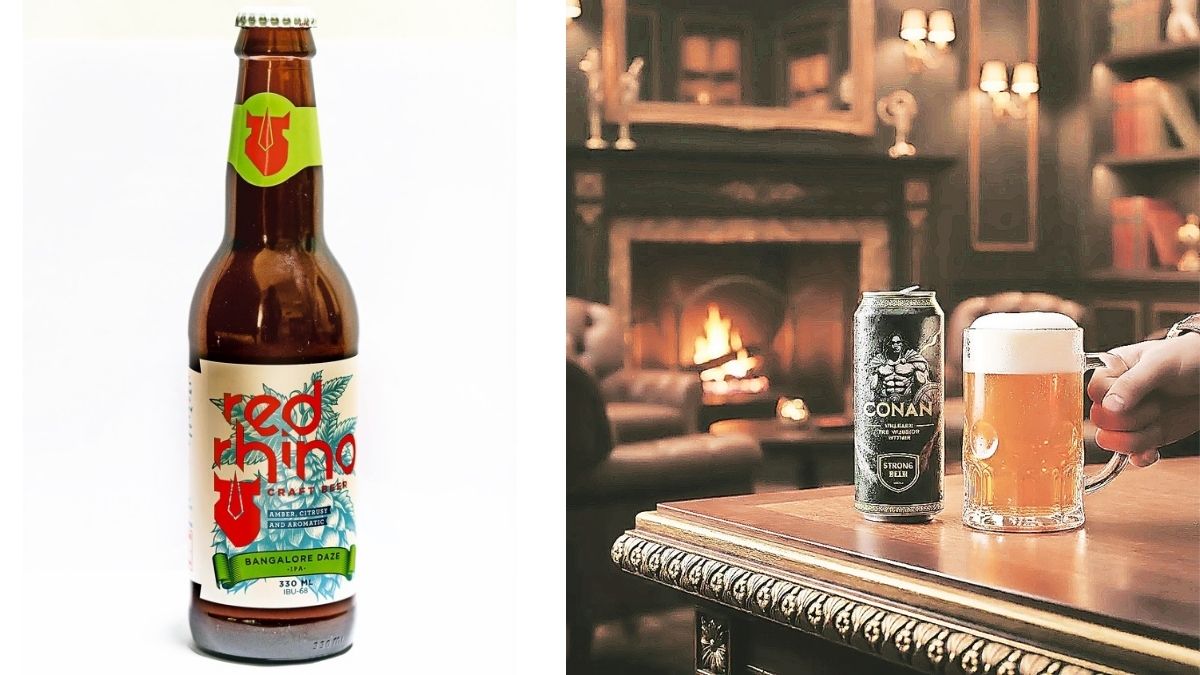
Move over, mainstream lager. Indian drinkers are increasingly taking to craft beer as they seek more aspirational experiences, variety, bolder tastes and aromas in a market that is projected to grow to $33.3 billion by 2033, from $4.7 billion in 2024, registering a CAGR of 23.4%.
Even though craft beer is still small in numbers, not more than 1% of the total beer market, which was valued at nearly $444.6 billion in 2024, “its significance lies not in volume, but in what it signals — innovation and experimentation that go on to rejuvenate and refresh the whole beer industry,” as per Vinod Giri, director general of the Brewers’ Association of India.
“Brewers are experimenting with citrus notes, fruit infusions, spices and lighter-bodied beers that are more suitable for India’s climate. Consumers are looking for beers that are refreshing yet flavourful, which is why styles like witbiers and crisp malt lagers are gaining popularity,” says Anurag Kedia, co-founder of Lone Wolf, a premium Indian beer brand.
The growth of craft beer in India is also being driven by a much more aware and curious consumer. “Today, people want to know what they are drinking, how it is made, and why it tastes the way it does. Travel exposure has played a big role, especially among urban consumers who have experienced fresh beer cultures abroad and now want similar quality and variety at home,” says Ashwin Nawani, COO of Red Rhino, a leading brewery in India’s craft beer segment that recently announced the launch of its bottled beer portfolio.
Demographic Shifts
The growth is also being driven by a fundamental shift in India’s socio-economic framework. Every year, India adds close to 23 million (roughly the equivalent of Australia’s population) to the legal drinking age group. Today, 70% of this cohort is willing to drink alcohol, up from 50% in 2015. “Even if only a portion of this cohort chooses to drink alcohol, that’s still millions of new consumers entering the market annually. For young adults, their first experience with alcohol is typically a beer. This cohort has travelled more both domestically and globally, are more curious, exposed more to global food and drink and are seeking the same diversity and quality back home,” says Narayan Manepally, CEO and co-founder of Geist Brewing, a homegrown craft beer brand.
The company experiments with smaller batches and new styles through its taprooms and ‘beer gardens’. “If a beer resonates with customers, we refine it further before a wider release. That process allows us to stay creative while still maintaining quality,” adds Manepally.
At the World Beer Awards 2025, homegrown craft beer brand Simba brought home a Silver for its Simba Wit and a Bronze for Simba Stout in the ‘India Country Winners — Taste’ category. The recognition not only places Simba in the global spotlight, but also provides validation to India’s growing craft beer movement.
Scaling Up
While the craft beer category in India holds tremendous potential, it also comes with its own set of challenges. The regulatory environment for alco-beverages, for instance, is complex and varies significantly across states, which can make distribution and expansion more complicated for emerging craft brands.
“Another challenge lies in maintaining freshness and quality, as craft beer requires a strong supply chain and cold storage infrastructure,” says Arvind Bajaj, founder of Conan Beer, a homegrown brand that is seeking to redefine India’s perception of strong beer with its Conan Strong offering.
Currently, Conan Strong is available in Delhi, where the company is targeting to reach 25,000 monthly sales in the coming fiscal. Its second variant, Conan Platinum, is going to be launched soon and is aimed at the “classical customer with upgraded malt who is looking for a premium product”, as per Bajaj.
Meanwhile, craft brewing requires careful attention to ingredients, process and consistency. “Balancing that level of craftsmanship while navigating regulatory and supply chain dynamics requires significant discipline. At the same time, these challenges also encourage brands to build stronger operational foundations,” says Abhinav Jindal, CEO and founder of BeeYoung, an Indian crafted strong beer brand owned by Kimaya Himalayan Beverages.
Currently, BeeYoung’s lineup includes a crafted strong beer, an international-style pilsner, and a tropic pilsner. In the Delhi market, where it is available in India, besides the UK, the brand sold over 3,94,000 cases in 2023-2024 alone.
According to Giri of the Brewers’ Association of India, the biggest challenge a craft beer faces is scaling up. “Beer is fundamentally a high-volume, low-margin product. The dilemma a craft beer faces is that in order to be commercially viable it needs to scale up, but if it scales up too much or too rapidly, it loses its ‘uniqueness’ which drove consumers to it in the first place,” he explains.
However, governments are now waking up and each year more states are adding different regulations for micro breweries in their excise policies, says Giri. “That’s a good sign because low-cost operations will feed into more entrepreneurs picking up the trade and more choices for consumers will mean more experimentation. That’s a good omen for the beer industry on the whole,” he adds.