



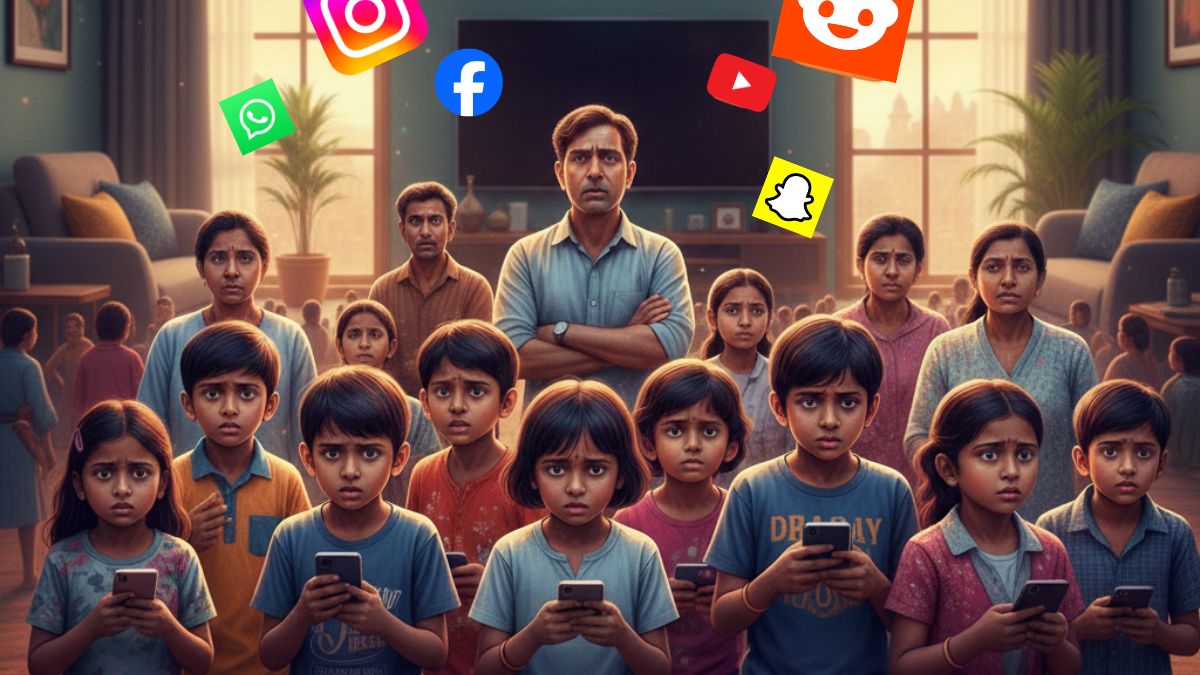
Social media ban: Delhi NCR was shaken earlier this month by the tragic deaths of three teenagers who allegedly died by suicide after developing an unhealthy attachment to an online Korean love game. The incident has intensified concerns about how deeply the digital world can shape young minds, especially when emotional vulnerability meets unregulated online content.
In the days that followed, grief quickly gave way to urgent debate, with parents, educators, and policymakers calling for stricter controls, and in some cases, a complete social media ban for minors. These demands mirror global developments, such as Australia’s recent move to restrict social media access for children under 16.
As India confronts this difficult moment, a pressing question has emerged: should the country introduce a similar social media ban for minors, and would such a measure truly protect young users or create new challenges?
The Data Behind the Distress: Why 23% of Indian Teens Face Anxiety
The concern is not unfounded. In India, social media is no longer just an app for entertainment. A survey by the National Institute of Mental Health and Neuro Sciences (NIMHANS) found that 23.33% of teenagers reported symptoms of anxiety and depression.
At the same time, United Nations data from 2024 showed that 90% of Indian children aged 14 to 16 have access to a smartphone at home, with 76% using it regularly for social media and recreational purposes. For many teens, the internet is not a separate space but an extension of their daily reality, shaping how they socialise, learn, and see themselves.
To understand whether a ban is the solution, or the answer lies elsewhere, Financial Express Online spoke to those at the heart of this digital shift: teenagers navigating online life, educators witnessing changing classrooms, and mental health experts observing its psychological impact.
While psychiatrists warn that constant exposure can overstimulate developing minds, many teenagers themselves admit to feeling both drawn to and drained by their screens. As India stands at a crossroads, the debate is no longer just about restricting access, but about understanding a generation growing up in a world where logging off is no longer simple.
The 10-Hour Screen Cycle: First-Hand Accounts from Gen Alpha
‘The more I use it, the more I feel dull’
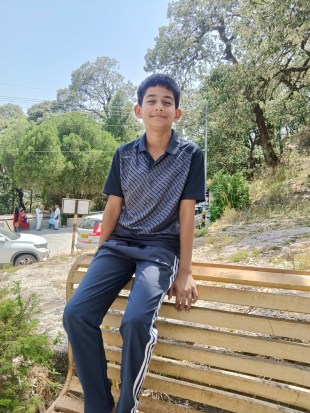
In an age where an entire generation practically lives off of social media and Gen-Z rakes up a screen time of over 10 hours a day, a twelve-year-old lent his valuable insight with Financial Express Online. Responding to the questions, he shared that a large percentage of his social media usage is consumed on YouTube for educational and recreational purposes.
Expressing that a ban on social media for teens under the age of 16 in India would leave him ‘a bit sad at first,’ he felt, “life without social media would be fun. You get to enjoy small moments of life and spend more time with parents and focus on sports,” sharing his love for sports, which often lets him escape the real world.
The 12-year-old admitted something many adults rarely hear from teens themselves: “The more I use it, the more dull I feel.” Recalling the COVID-19 pandemic, when he was not even a teenager, he was quick to notice that sports wasn’t really an option and all people would do is resort to screens, whether to work or play. “These things were used so much that children haven’t recovered till this day,” he remarked.
When asked if a complete ban was the best way to protect children, he shared, “Adults understand everything about their child except social media, but they hardly know about it. In my opinion supervision is best. When the parent knows what their child is watching it’s completely fine. But, the child should have a little bit of privacy. [sic]”
‘I use it a bit too much’
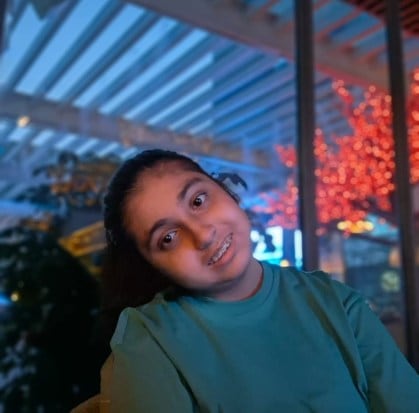
In another conversation, we gained insight into the life of a fourteen-year-old who uses YouTube ‘a bit too much,’ she confessed, acknowledging she understands the problem but can’t get rid of it. With regular parental checks and supervisions, our respondent affirmed that social media should be banned for teens under 16. However, she was as young as 6 when she was first introduced to social media.
At the same time, she replied, “No, I don’t use Instagram,” when asked about the apps she uses frequently. “It will distract me from studies, and cause addiction,” she expressed. In fact, her phone is regularly checked for screen-time, and remains under healthy supervision.
‘There should be no ban’
A Delhi-based student shared her experience with social media and shared how ‘YouTube is a must’. Strictly limiting their screen time to hours when she isn’t studying, the fourteen-year-old shared that she regularly uses platforms like Instagram, WhatsApp, and YouTube, and is an avid user of Shorts and Reels.
When asked whether social media affects her in daily life, she shared that it affects her academics sometimes. Expressing how a ban, if it comes in, will make her miss Instagram, and defended that there shouldn’t be a ban. However, she shared, “I understand the intention of protection, but I know my boundaries.” Adding further, she shared her parents, while may not be aware of parental controls on app, monitor her feed regularly, ensuring safety
(Aaryana Singh, 13)
‘Adults don’t understand how we use social media’
We also reached out to Aarna Shah, a bright student from Meerut who shared how as a sixteen-year-old social media apps like Instagram and Snapchat are the only ways to communicate socially, even for the smallest of questions from her friends. However, she shared that it was her mother who helped create an account, with clear supervision, as she used to use her account from her parents’ device. However, while she may be one of the few cases from her peer groups whose parents ensure supervision, Aarna expressed, “adults don’t understand how we use social media.” “They think all that we do on social media is all bad. They are scared, and think it is some kind of evil virus.” The awareness about cyberbullying and awareness Being the anomaly and not the norm, she even shared that sometimes she does feel judged and finds herself comparing to others on social media.
“Social media is a distraction,” Shah felt but she added, “A ban will not be good for children my age.” She explained how her and her peer group are heavily dependent on such platforms for socialising and entertainment.
(Responses from Aarna Shah, 16)
Financial Express Online spoke to the teenagers with due consent from their parents and/or guardians.
What social media does to a teenage mind – Psychiatrist weighs in
Speaking to Financial Express Online, Dr. Sameer Malhotra, Principal Director, Department of Mental Health and Behavioural Sciences at Max Super Speciality Hospital Saket, explained how social media really affects teens. Overexposure to social media, he explained, could be overstimulating for a teenage mind, “which is learning how to control attention and impulses as well as regulate emotion,” he added.
Commonly called ‘doomscrolling’ Malhotra identified this pattern as harmful, as it could impact the sleep quality and exposure to blue light. He added that social media brings a “never-ending comparison and constantly looking for validation.” through likes damages self-esteem and foster self-doubt, the crucial milestones in the development of a teenage mind.
In fact he shared, “We’re seeing young people coming through with anxiety, low self-esteem, body image issues, sleep problems and distress about things like cyberbullying.” These cases, however, have risen over the past 5 years, he elaborated.
“The significance of social media being exposed too often, plays a large part for many reasons,” the mental health professional explained. He shared how content on social media could be “seen as a trigger or amplifying factor of any difficulties children experience, especially for vulnerable and at risk adolescents.”
‘Discipline isn’t the problem – distraction is’
Sarika Arora, Principal, Ramjas Public School Day Boarding, told us that social media has fundamentally changed how students engage with learning, not by making them defiant, but by making them more distracted, restless, and emotionally vulnerable. She emphasised that the biggest shift in classrooms today is reduced patience and sustained attention, with students increasingly drawn to constant stimulation.
While she acknowledges that social media is not the sole cause of academic or mental health struggles, she says excessive use contributes to poor concentration, sleep disruption, anxiety, and self-doubt driven by online comparison.
“Students who spend a lot of time on social media often struggle with concentration, irregular sleep, and unfinished work, which eventually affects academics,” the educator shared. She also cautioned that a blanket national ban may be difficult to enforce and could create friction rather than solutions. “Instead of easing school management, it may turn teachers into monitors. Clear rules, awareness, and responsible use tend to work better than outright bans,” she explained.

At the same time, she commented on how cyberbullying has become a silent problem. “Online distraction is widespread, and signs of overdependence on phones are increasingly noticeable, even if students don’t see it as a problem themselves,” Sarika Arora told Financial Express Online. Schools, she says, should prioritise awareness and guidance, stepping in when digital behaviour begins affecting learning or well-being.
Who are the real stakeholders?
While it is true that a ban will largely affect the teenagers, the creator economy in India is slowly becoming the biggest market segment. In conversation with Formula 1 creator and actor Aleesha Arora, Financial Express Online discovered that she takes the responsibility of her audience’s mental health seriously.
“Fans often form strong emotional connections, and for teenagers especially, that kind of negativity can feel deeply personal. I believe it’s important to model respectful, balanced discussion, even when opinions differ,” she shared.
There are instances when influencers tend to share moments from their personal lives online. While they may preach about mental health for content, there are several pieces of content that show them indulging in activities like drinking alcohol and sharing their experiences ‘for the plot’, which becomes a sensitive topic for teens viewing their content.
A ban, at the same time, would have a significant impact on their audiences. “It would definitely change the influencer economy, since a large part of it today is driven by reach and virality, and younger users do contribute significantly to that. Removing that segment would naturally force both creators and brands to shift their priorities, from chasing numbers to focusing on intent, relevance, and quality,” shared Aleesha.

“That said, there are real trade-offs. Limiting access for younger users could reduce early exposure to interests such as sports, media, or creative industries, areas many teenagers currently discover through social platforms. For creators, particularly those operating in niche spaces, this could mean slower growth and fewer early opportunities,” she added.
To ban or not to ban
The creator also believes that social media platforms are not doing enough to protect young users today. “While most platforms have introduced baseline safety features such as content warnings or labels for potentially disturbing material, these measures are largely generic and designed to apply to all users equally,” she explained and rallied to take better age appropriate action.
However, Aleesha also felt that a complete ban is the right thing to do. “Social media can be an educational, creative, and genuinely inspiring space for young people when used responsibly. However, access should be far more structured than it currently is,” she remarked. “Rather than default, unrestricted exposure, there needs to be guided access with clearer boundaries, age-appropriate design, and stronger accountability from platforms and creators alike,” the creator told Financial Express Online.
(Aleesha Arora is a lifestyle influencer on Instagram with over 88,000 followers. She is also an actor who has worked alongside Shah Rukh Khan)
In another account, Shreeum Rakheja, a lifestyle influencer with over 1.3 lakh followers on Instagram across three different pages, shared her thoughts with Financial Express Online.
‘They hold the responsibility of the eyeballs on them seriously,” shared Shreeum, with a growing presence on social media. She acknowledged that creators, like herself, hold responsibility with their words and must speak mindfully, given the impressionable minds of teens. “I never want, at least teenagers or people who are still impressionable, to be left with the bad taste in their mouth about who they are,” she told Financial Express Online.
“I’ve been a consumer of content long before I ever became a creator. So I understand the implications that content can have on people, like I do feel like social media is a very, very powerful tool, then it can change lives. But I do think that it can also destroy lives and really affect mental health,” she said further.
Expressing further how content is not just something you leave behind, statements, images, and opinions tend to make an impression. “It’s not just going to be you interacting with the screen and that’s it. Like there are repercussions to your existence on the internet,” Rakheja added.
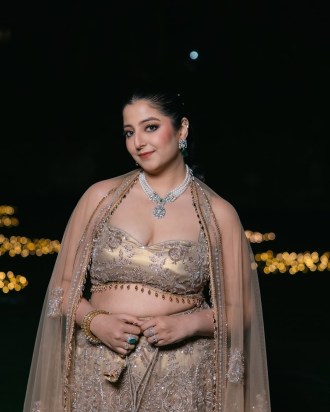
The creator then further added that a ban, while it is necessary, need not be restrictive to change the creator space entirely. “I do think that the ban is necessary. I don’t think that it’s something that should be thought of as hindering…If nothing else, there should be stricter laws to what kind of content is being projected on the phones of teenagers,” she opined, adding that who a teenager watches can potentially change the course of their life.
Rakheja ended by saying, “I just feel like whether or not the ban happens, whether or not these platforms are doing anything to protect the generation of tomorrow, I do think as creators, some responsibility lies on us as well…I feel like having some moral compass would be fantastic.”
Namrita Kour, an entertainment creator, told us that she feels a strong sense of responsibility toward her young audience, noting that many followers fall in the 18–24 age bracket — a phase she describes as formative and emotionally vulnerable. Having “recently turned 25,” she says she understands how habits built during this time can last.
On the question of banning under-16 users, Kour believes such a move would “definitely impact the influencer economy,” since creators often build long-term loyalty by connecting with audiences early. At the same time, she acknowledges a potential upside: shielding younger teens from trolling and harmful comparison could support healthier mental habits.
Redesign vs. Restriction: The Sociological Verdict
Pointing out the ubiquity of social media, sociology experts unanimously questioned the purpose behind the ban. While they acknowledged the need for some remedies, they rejected the notion of restricted access.
Speaking to Financial Express Online, Rituparna Patgiri, Assistant Professor of Sociology, Department of Humanities and Social Sciences, at IIT Guwahati, shared, “It [social media] is also leading to a lot of mental health issues, where teenagers constantly compare themselves with others. And as human beings, we are social, but when the whole world can comment on what we should and should not do, it is tough to process.”
At the same time, Dr Pratichi Majumdar, Assistant Professor of Sociology at Indraprastha College for Women, Delhi University, shared the shift from ‘virtual reality’ to ‘real virtuality’. She questioned how the ban would be the same as asking the vulnerable to not roam around on streets, given their unsafe nature.
Instead, she rallied to make it a safer space, placing the onus on the decision makers to create a better place for minors, especially teenagers below 16, one of the more active users of social media apps.
With a deep understanding into digital sociology, Majumdar further shared how a restriction might also raise questions about censorship and control. She further emphasised on the ubiquity of social media as a lifestyle, more than just an application in today’s times. “We must design a system which discourages mistreatment,” of the young mind, she opined.
Citing an example of the same, Patgiri echoed the expression and suggested,”There can be regulations on the kind of content that is created..as China has introduced regulations on who can produce content around health and law, because these are sensitive topics.”
Should India ban social media for teens?
Mental health expert Dr Malhotra opined that while it is hard to clearly segregate social media as good or bad for teens, he recommends that “the platforms can be made less toxic, if they’re properly designed and moderated.” He shared how social media “can provide connection, learning and creative expression, but unchecked or excessive use raises the risk of anxiety, comparison, cyberbullying and diminished real-life connection.”
A complete ban on social media would help “cut down on screen overload,” improve focus, and “ alleviate performance pressure ,both of which may lead to less teen anxiety,” opined Dr Sameer Malhotra. However, the lack of alternatives would lead to further alienation, while the teenage peers are still online, “Any limitation should be combined with encouraging healthy offline social and recreational pursuits,” he advised.
Generalising an age will help objectify the guidelines, but not consider psychological factors like “emotional readiness,self-regulation, self-esteem stability, ability to manage criticism.” Eliciting different responses from each person, access to social media should also depend on “maturity levels,” explained Malhotra. He further concluded, “It is imperative to evaluate a child’s emotional readiness before allowing independent access to social media, even if they are above the minimum age of 13 to 14 years old,” to be able to sign up for the platforms.
There are several popularly used platforms which have parental controls and child-friendly modes, but aren’t talked about enough today – be it through dialogue or advertisements. For a large part of early 2025, Meta ran a campaign about teen safety, advertising end-to-end encryption and other features. However, it is largely a commercial practice that is dominated by the number of users and the time they spend on the app.
As India debates whether to follow Australia’s historic move, the real question may not be whether teens should be banned from social media, but whether platforms, policymakers, and society are prepared to redesign the digital world they’ve already built a comfortable money-maker around.