



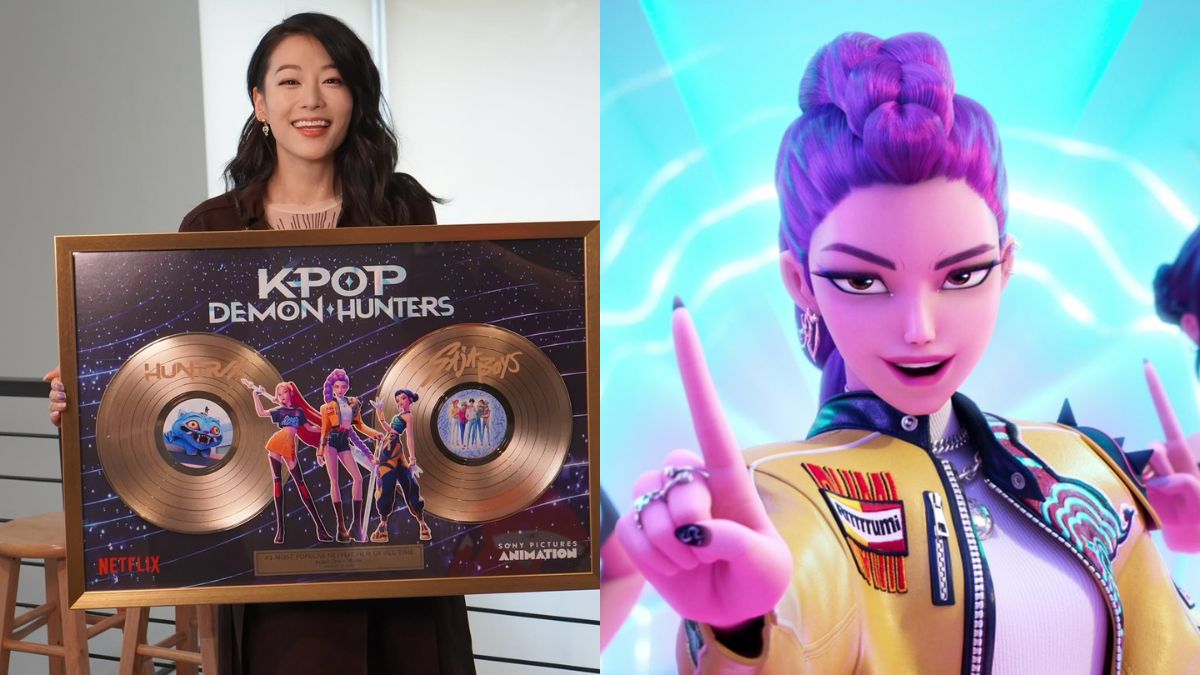
Streaming giant Netflix has just had a very successful year with constantly sky-rocketing profits and revenue collection and it may partly be due to their chart-topping animated original: Kpop demon hunters. The film was widely regarded as ground breaking in many ways, bagging the distinction of being the most-watched original title in Netflix history with 325 million views, surpassing even Glass Onion: A Knives Out Mystery (2022) with its star-studded cast.
Released on June 20, the movie was not only acclaimed widely, but declared a cultural phenomenon by several established publications like Time Magazine, Tatler Asia, BBC, Vox among others. It also featured an original soundtrack, off which the song ‘Golden’ continues to reign over the #2 spot on the US Billboard charts even currently and if that wasn’t enough – it has also received a nod from the most prestigious musical institution in the world, The Recording Academy, in the form of a GRAMMY nomination for ‘Song of the Year.’
Now as the cast makes rounds of the press circuit, they are getting candid in front of the cameras. Actress Arden Cho, who many will recognize from the YA supernatural series Teen Wolf, and who plays Rumi on K-pop Demon Hunters opened up to BBC about her struggle for acceptance as a child of Korean immigrants in a primarily white American society.
“I hated a lot of myself and I wanted to be someone else.”
For Arden Cho, who was born to Korean immigrant parents in Amarillo, Texas, this is not a novel sentiment. In 2014, the actress stated in an interview to Mochi Magazine that she often felt like an outsider due to growing up in areas with fewer ethnic minorities. As a child she had been bullied and injured after being physically attacked.
Racist experiences such as these can deeply impact individuals for life, affecting one’s self image, worth and confidence and the actress affirmed this in her BBC interview. “I hated that I looked Asian, that I didn’t have blue eyes and blonde hair, because that’s what was beautiful at the time,” She said as she described her childhood in Texas for the BBC World Service for the Global Women series.
“Being born in America, feeling American but having people treat me like I’m not, trying to figure out my identity as an Asian-American, as a Korean-American, as a woman. I can honestly say that at different points in my life, I hated a lot of myself and I wanted to be someone else.” In the movie, her character Rumi struggles to come to terms with her identity as part human and part demon and Arden Cho resonated with her story heavily; her life after all seemed to mirror that of her character’s.
Kpop Demon Hunter’s wildly crazy success, however, has acted as a healing balm for the actor, who stated that it was refreshing to be able to take pride in her own culture. To many young Asian-Americans, Cho has become a role model – a prominent face for representation in an industry where visibility has long been limited.
“I feel like K-Pop really, truly, has paved the way. K-beauty has had such a big impact on Korea being loved. But I feel like this movie is the one that tipped it over the edge of, everybody wants to go to Korea, now.”
About K-pop Demon Hunters
K-pop Demon Hunters is perhaps the first film of its kind. With a multi-genre approach, the movie manages to be a supernatural animated fantasy which takes inspiration from Korean culture, particularly: mythology, demonology and K-pop.
The film follows a fictional K-pop girl group that secretly moonlights as demon hunters, battling evil forces while maintaining their glamorous idol personas. Voiced by Arden Cho (Rumi), May Hong (Mira), and Ji-young Yoo (Zoey), the trio leads a heavy-hitting ensemble that includes Ahn Hyo-seop, Yunjin Kim, Daniel Dae Kim, Ken Jeong, and Lee Byung-hun.
Directed by Maggie Kang and Chris Appelhans and produced by Sony Pictures Animation, the movie premiered on Netflix on June 20, 2025. With a runtime of 100 minutes and a production budget exceeding $100 million, it quickly became a global sensation. Additionally, it topped Netflix charts in 33 countries – entering the Top 10 in 93 nations. Despite a modest box office return of $25 million which was due to its limited release, its streaming success and critical acclaim have cemented it as one of the standout animated releases of the year.