



India remains a top global defence importer, while China, with a defence budget three times larger than India’s, imports only a fraction. To counter this asymmetry, self-reliance and indigenisation of defence technology becomes a strategic necessity for the country. While the private sector plays a crucial role, already contributing 21% to total defence production, so that 65% of defence equipment is now manufactured domestically, of late, deeptech startups are emerging as the new strategic assets in the technological sovereignty mission. They are developing indigenous drones, AI-based surveillance, and electronic warfare systems, to reduce import dependency.
Take the case of EON Space Labs. Traditionally, high-performance earth observation(EO)/infrared (IR) optics and payloads have been imported, creating long-term dependency in surveillance and reconnaissance domains. EON has addressed this gap by developing in-house capabilities spanning optical design, simulation, precision manufacturing, system integration, and validation.
IIT-M incubated EON Space Labs bets on end-to-end ‘tech sovereignty’
Incubated at IIT Madras, EON Space Labs specialises in designing and manufacturing indigenous electro-optical imaging payloads for small satellites and UAVs, enabling Indian missions to collect, process, and secure critical data without reliance on imported subsystems. “For us, technological sovereignty goes beyond local procurement; it is about achieving complete control over the entire value chain,” feels Punit Badeka, the co-founder. “True autonomy requires ownership of sensors, core components, system architecture, and the resulting data. Our approach aims to ensure that critical national missions are not dependent on external suppliers for essential technologies.”
Regarding EO/IR payloads designed for satellites, EON has strengthened national self-reliance for its MIRA space telescope, which is an electro-optical payload for earth observation which was part of the recent ISRO’s PSLV-C62 mission. “MIRA is among India’s lightest and most compact space telescopes, fully designed, developed, and integrated by an Indian startup, demonstrating India’s growing capability to independently create advanced space optics and scientific instruments,” Badeka stressed.
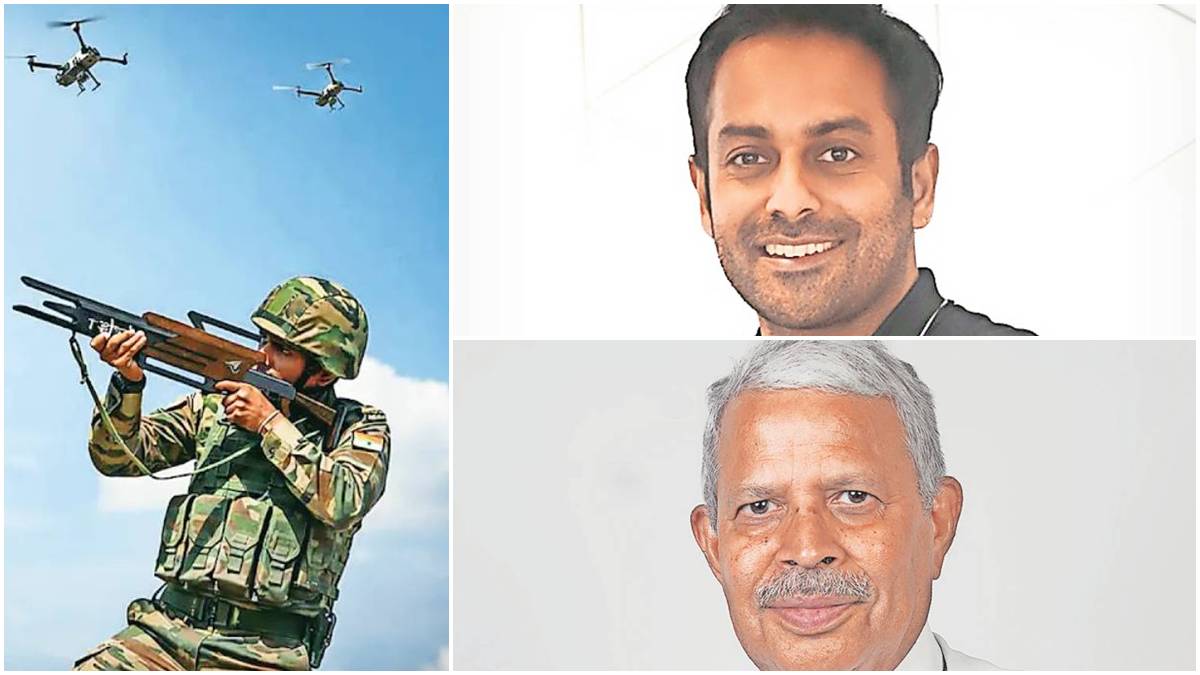
IG Defence has secured orders from the Indian Army and the Indian Navy for its homegrown counter-drone system, the IG T-Shul Pulse. This is a handheld, electronic-warfare-based anti-drone jammer designed to disrupt and neutralise hostile drones in operational environments. Lightweight and quick to deploy, the system is intended for frontline troops, perimeter security, and the protection of military bases and critical strategic assets. It has an effective jamming range of 2 km.
Made-in-India defence systems get boost; firm patents tactical UAS
“Systems designed and manufactured in India, aligned with operational requirements, strengthen both responsiveness and long-term self-reliance in defence capabilities,” said Maj Gen RC Padhi, senior vice-president, IG Defence. The company has also been granted a patent for its fixed-wing tactical unmanned aerial system (UAS). The platform brings together precision strike, surveillance and terminal engagement in one versatile unmanned system.
As electronic warfare becomes a defining feature of modern battlefields, India’s defence UAV ecosystem is rapidly evolving to meet new operational challenges. ZOLT, the indigenous tactical unmanned aerial vehicle (UAV) by ideaForge Technology, is among the platforms contributing to this transformation. Recently showcased at the 77th Republic Day Parade, this is a multi-role tactical UAV designed for long-range intelligence, surveillance and reconnaissance missions and precision payload delivery. It delivers robust electronic counter-countermeasures (ECCM) capabilities, including GNSS denied autonomy and resilience to communication jamming.
“ZOLT can seamlessly adapt to a variety of modern missions ranging from counter-insurgency and border surveillance to tactical strike operations,” said Ankit Mehta, CEO and co-founder, ideaForge Technology. Its VTOL versatility enables take-off and landing in challenging terrain while maintaining fixed-wing endurance. ideaForge has recently received a procurement order worth ₹75 crore from the Indian Army for this tactical UAV.
According to Badeka, self-reliance in defence technology is today a long-term resiliency requirement to mitigate against external shocks and evolving geopolitical volatility. “We actively collaborate with domestic suppliers, research institutions, and skilled engineers, contributing to the development of a robust indigenous aerospace and defence ecosystem,” he added.
QUOTES
Punit Badeka: Self-reliance in defence technology is today a long-term resiliency requirement to mitigate against external shocks and evolving geopolitical volatility
Maj Gen RC Padhi: Handheld, electronic-warfare-based solutions provide frontline units with the ability to respond swiftly and independently to low-cost, asymmetric drone threats
Ankit Mehta: The battlefield is increasingly defined by multimodal data, autonomous drones, and compressed decision timelines.