More than four years after the Centre launched its flagship Production Linked Incentive (PLI) scheme to build a domestic battery manufacturing ecosystem, progress on the ground remains sharply behind stated ambitions, with just 2.8 per cent of the targeted capacity commissioned so far.
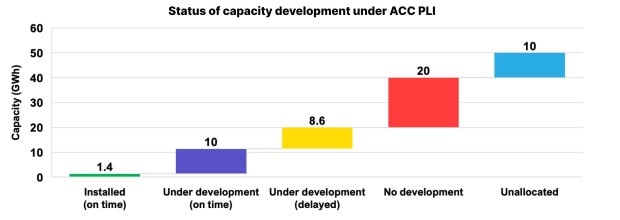
The Advanced Chemistry Cell (ACC) PLI scheme, notified in October 2021 with an outlay of ₹18,100 crore, aimed to establish 50 GWh of battery cell manufacturing capacity in India by 2025 and reduce near-total dependence on imported lithium-ion cells. However, as of October 2025, only 1.4 GWh of capacity has been commissioned within the stipulated timeline — entirely by Ola Electric — according to a new assessment by JMK Research and the Institute for Energy Economics and Financial Analysis (IEEFA).
Despite strong initial industry interest and multiple auction rounds, the report finds a widening gap between policy intent and execution, raising questions over the design and sequencing of India’s battery manufacturing push.
Capacity targets missed, incentives yet to flow
Of the 50 GWh originally planned under the ACC PLI scheme, 40 GWh has been allocated so far across two auction rounds. The first auction in March 2022 saw the full 50 GWh being awarded, but Hyundai Global Motors subsequently withdrew from its 20 GWh allocation, prompting a second auction in September 2024. That round resulted in only 10 GWh being awarded, leaving 10 GWh still untendered.
Even among awarded capacities, timelines have slipped. Reliance Energy is the only beneficiary that has indicated it will commission its second-round allocation of 10 GWh on time. Ola Electric, which had been awarded 20 GWh, now plans to commission only 5 GWh by March 2026 and has scaled back further expansion to FY2029, effectively diluting the scale envisaged under the scheme.
As of October 2025, no incentives have been disbursed under the scheme against a targeted incentive outgo of ₹2,900 crore, the report said.
Investment and jobs far below expectations
The under-delivery on capacity has also translated into weaker outcomes on investment and employment, two of the scheme’s key objectives.
Against an estimated target of 1.03 million jobs, the ACC PLI scheme has generated only 1,118 jobs so far — just 0.12 per cent of the target. Investment commitments have reached around ₹2,870 crore, accounting for 25.6 per cent of the targeted ₹11,250 crore, according to the report.
“Although strong policy support led to substantial investment announcements and capacity plans outside the ACC PLI scheme, on-ground progress remained sluggish,” said Prabhakar Sharma, senior consultant at JMK Research and co-author of the report.
The Centre has imposed penalties of 0.1 per cent of the performance security for each day of delay in commissioning capacity, but the report notes that these measures have not been sufficient to overcome deeper structural challenges.
Bottlenecks: value addition rules, supply chains, visas
The assessment points to a combination of policy and implementation hurdles that have slowed execution. Chief among them are stringent domestic value addition (DVA) requirements, an aggressive two-year installation timeline, and delays in visa approvals for Chinese technical specialists required to install and commission specialised battery manufacturing equipment.
India’s continued reliance on imported battery cells — still close to 100 per cent — underscores how far the scheme remains from achieving its original objective of import substitution.
The report also flags shortcomings in the scheme’s evaluation framework. While Exide Industries and Amara Raja were among the few bidders with prior battery manufacturing experience, neither qualified for allocations. Instead, greater weightage to DVA commitments, proposed capacity and subsidy benchmarks favoured new entrants with limited operating experience.
Call for complementary policies on minerals and components
To unlock the full potential of the ACC PLI scheme, the report argues for a broader, ecosystem-level approach rather than a narrow focus on cell manufacturing alone.
“Going forward, improving the effectiveness of ACC PLI will require a holistic, multi-pronged strategy,” the report notes, including robust cell testing and certification infrastructure, scaling up equipment manufacturing and recycling, and developing skilled domestic talent.
A dedicated policy for critical minerals — covering both sourcing and refining — is also seen as essential, alongside a separate scheme for cell components. Tariff measures such as basic customs duty and anti-dumping duties may be required to support domestic manufacturers during the initial scale-up phase.
“It is equally important to assess how India can attract global battery players to establish manufacturing facilities in the country,” said Vibhuti Garg, Director – South Asia, IEEFA. “Bringing established global players into the ecosystem would strengthen capabilities, accelerate technology transfer, and help steer the industry in the right direction.”
As India’s clean energy ambitions hinge increasingly on grid-scale storage to support renewables and electric mobility, the report concludes that closing the gap between policy ambition and execution under the ACC PLI scheme is now a matter of urgency rather than aspiration.
Graphic credit: IEEFA-JMK Research