



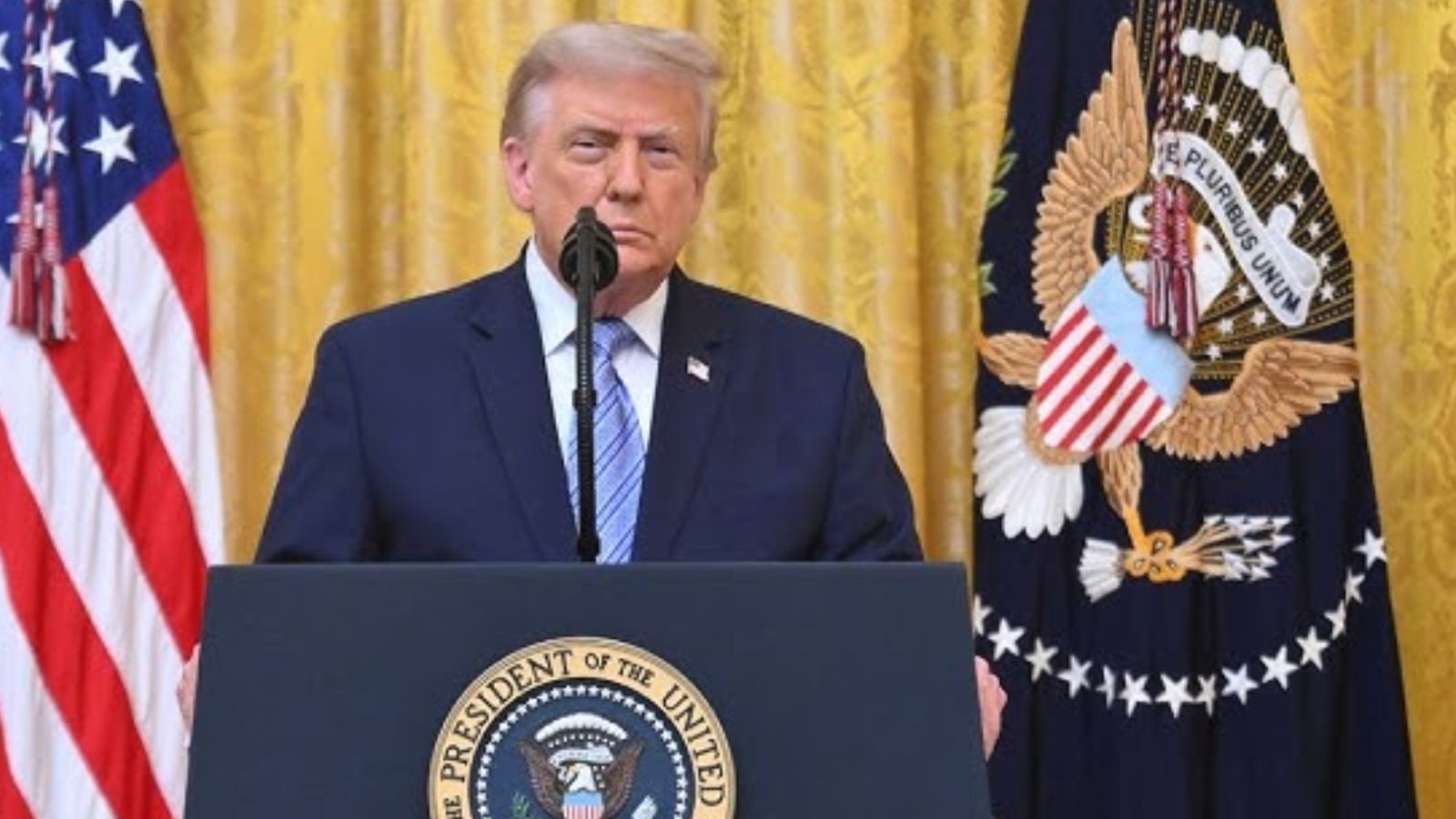
US President Donald Trump has asked Republican lawmakers to expand a proposed Russia sanctions bill so that it also covers Iran. The proposal comes at a time when tensions between the US and Iran have intensified, raising fresh questions about how the bill could affect global trade and energy markets.
Trump says Iran should be included
In a post on Truth Social on Sunday, Trump said the Russia sanctions bill should also include Iran. He said this was something the bill’s original author, the late Senator Lindsey Graham, had always wanted. Trump praised Graham’s idea and said making this change was “important.”
“Republicans should add Iran to the Russian Sanctions Bill. That’s what Lindsey wanted to do, and it was going to happen. Important!!!” Trump said in a post on Truth Social.
Trump’s remarks came just days after a fragile ceasefire involving Iran collapsed. The recent deaths of US service members in Jordan and Iraq have also pushed Washington to take a tougher stand against Tehran.
Earlier, Trump had said he did not mind Iran stepping away from a US-Iran understanding, but stressed that preventing Iran from developing a nuclear weapon remains the US government’s top priority.
If Iran is added, what changes for India
India’s oil trade with Iran has gone through many ups and downs over the years.
Before the US reimposed sanctions during Donald Trump’s first term, Iran was one of India’s biggest crude oil suppliers. In 2018, it even briefly overtook Saudi Arabia to become India’s second-largest source of crude oil.
Things changed after the US brought back sanctions on Iran in November 2018. India was among eight countries that received a temporary waiver, allowing it to continue buying around 300,000-325,000 barrels per day. However, that exemption ended in May 2019. To avoid US secondary sanctions, Indian state-run refiners completely stopped buying Iranian oil.
For almost seven years, imports from Iran remained close to zero.
That changed in 2026.
As tensions in the Middle East disrupted shipping through the Strait of Hormuz and created uncertainty in global oil supplies, India temporarily resumed importing Iranian crude in April 2026. However, these purchases have been repeatedly suspended or delayed due to ongoing geopolitical uncertainty and frequent policy changes.
Trump’s proposal to include Iran in the Russia sanctions bill could create a further challenge for India.
If Iran is added to the bill and buyers of Iranian oil face the same tariffs or secondary sanctions planned for buyers of Russian crude, India could once again be forced to make a difficult choice between continuing to import Iranian oil and protecting its access to the US market.
Adding Iran to the legislation would also link the bill to the growing military tensions between the US and Iran. If the conflict becomes wider or lasts longer, it could disrupt shipping through the Strait of Hormuz, one of the world’s busiest oil routes.
What is the Russia Sanctions Bill?
The bill, now widely known as the Senator Lindsey O. Graham Sanctioning Russia Act, was first introduced in April 2025 by Senator Lindsey Graham.
Its main aim was to reduce the money Russia earns from oil and gas sales, which help fund its war in Ukraine. The proposal seeks to punish countries that continue buying Russian energy.
The bill remained on hold for more than a year while the Trump administration tried to negotiate an end to the Ukraine war with Russian President Vladimir Putin.
It gained traction in July 2026 after Graham announced that the White House had agreed to move the legislation forward. Just days later, Graham died suddenly on July 11.
Since then, more than 60 senators from both Republican and Democratic parties have supported an updated version of the bill, bringing it close to a Senate vote for the first time.
What has changed in the new version?
The revised bill is different from its earlier version.
It no longer calls for a blanket 500% tariff on every country buying Russian energy. Instead, it allows tariffs of up to 100% on the five biggest buyers of Russian crude oil and natural gas.
The bill also allows similar tariffs on countries accused of helping Russia avoid existing sanctions.
In addition, it includes two more measures. One targets the “shadow fleet” of tankers that transport sanctioned Russian oil. The other, called the STOP Russia-China Act, focuses on China’s support for Russia’s defence industry.
There are also exemptions. Countries whose Russian natural gas imports account for less than 15% of Russia’s total gas exports, and which are actively reducing those imports, will not face penalties. This exception is widely seen as protecting allies such as France and Japan.
The bill also gives the US president the power to temporarily waive sanctions if he tells Congress that doing so is in America’s national interest.
Why India could be affected
India and China are by far the two biggest buyers of Russian crude oil. Together, they account for around 70% of Russia’s energy exports. India’s purchases of Russian oil increased sharply after Russia invaded Ukraine in 2022. Before the war, Russian oil made up less than 1% of India’s crude imports. By early and mid-2026, that figure had risen to around 40-47%.
Indian refiners turned more towards Russian oil after supply routes from Iran near the Strait of Hormuz became uncertain. Because of this, India is expected to fall under the category of the five biggest buyers that the bill targets.
If that happens, Indian exports to the US could face tariffs of up to 100%.
This would come on top of the 25% tariff Trump imposed on Indian goods in 2025 over India’s purchases of Russian oil and defence equipment, as well as another additional 25% penalty announced later.
Industries such as pharmaceuticals, textiles and IT services, which earn a large share of India’s export revenue from the US market, could be among the hardest hit.
New Delhi has repeatedly maintained that its energy purchases are based on economic needs and energy security, not political alliances.
The bill’s waiver provision could still offer India some relief if the US president decides that exempting India is in America’s national interest, although there is no guarantee that this will happen.