



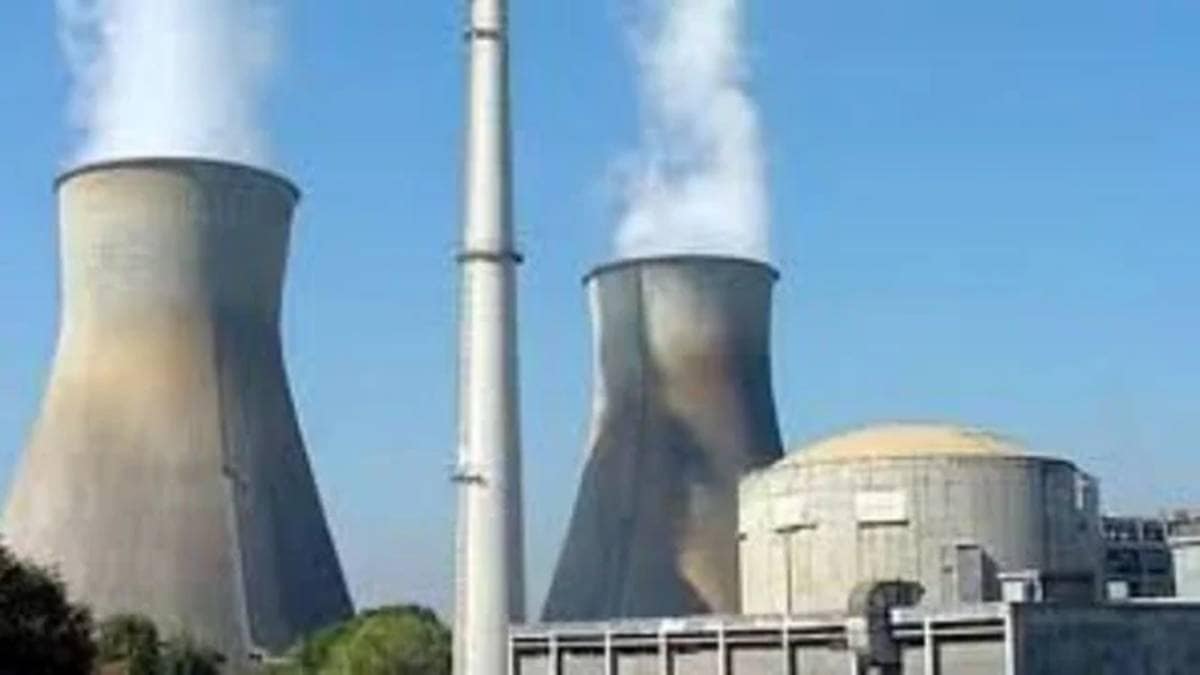
The Kalpakkam Prototype Fast Breeder Reactor attained its first criticality earlier this week. Banasree Purkayastha looks at what this means for India’s nuclear power generation programme and how soon the reactor can be expected to feed electricity to the country’s power grid
l The importance of first criticality
ON APRIL 6, the indigenous 500 MWe (mega watt electrical) Prototype Fast Breeder Reactor (PFBR) at Kalpakkam, Tamil Nadu, successfully attained first criticality. Criticality is the point at which a sustained and controlled nuclear fission chain reaction begins. At this stage, neutrons produced by fission equal those lost through absorption and leakage, resulting in a stable power output. It marks the transition from the construction phase to the operational phase and is the essential first step towards generating heat and, ultimately, electricity.
Attaining criticality is thus a key milestone before full power generation for PFBR and formally signals the start of the second stage of India’s three-stage nuclear power programme. In this stage, plutonium produced in pressurised heavy water reactors (PHWR) is used in fast breeder reactors (FBR), paving the way for the third stage — thorium-based reactors. This technological capability thus enhances the utilisation of nuclear fuel resources and enables India to extract far greater energy from its limited uranium reserves while also preparing for large-scale use of its thorium reserves in the future.
l How this fits into India’s 3-stage nuclear power programme
FAST BREEDER TECHNOLOGY forms the vital bridge between the existing PHWRs and the future deployment of thorium-based reactors. India’s nuclear power programme is based on a sequential strategy: PHWRs, followed by FBRs and finally, thorium reactors. PHWRs rely on uranium fuel while FBRs use plutonium as fuel and are designed to produce more fissile material than they consume by converting uranium-238 into plutonium-239 and, eventually, enable the production of uranium-233 from thorium-232.
India has around 500,000 tonne of thorium reserves. It is found in coastal and inland placer sands on the beaches of Kerala, Tamil Nadu, Odisha, Andhra Pradesh, Maharashtra and Gujarat, and in the inland riverine sands of Jharkhand and West Bengal. As India continues to expand its clean energy portfolio, FBRs will play a crucial role in delivering reliable, low-carbon, base-load power with higher thermal efficiency.
l Types of nuclear reactors in India
ALONG WITH FBRs, there are other kinds of reactors. In pressurised water reactors (PWRs), ordinary water under high pressure is used as both coolant and moderator. Two such Russian-designed reactors are operational at Kudankulam in Tamil Nadu, with four more units under construction. Pressurised heavy water reactors (PHWR) use natural uranium as fuel and heavy water as coolant and moderator. In boiling water reactors (BWRs), water boils inside the reactor core to produce steam that drives turbines. Two BWR units are operational at the Tarapur Atomic Power Station in Maharashtra.
l What about small modular reactors?
SMALL MODULAR REACTORS (SMR) have a power capacity of up to 300 MW(e) per unit and harness nuclear fission to generate heat to produce energy. These can be factory-built and assembled on site. While 18 out of India’s 25 reactors are technically ‘small’ as they produce less than 300 MW of electricity, since they have been conventionally built, they are not modular.
Bhabha Atomic Research Centre ARC has initiated design and development works on 200 MWe Bharat SMR and 55 MWe SMR. At least five indigenously designed SMRs are to be operational by 2033. The Nuclear Energy Mission has allocated Rs 20,000 crore towards the design, development, and deployment of SMRs.
Finally there are advanced reactors that use alternative coolants like helium or molten salts but these are still at the research or conceptual stage in India.
l How early can commercial operations start at Kalpakkam?
THE KALPAKKAM REACTOR being a prototype FBR, commercial operations are still several months or even years away. A series of performance tests and safety validations will be conducted and only after the Atomic Energy Regulatory Board gives the green signal will the plant undergo staged power ascent, and then finally generate electricity to feed the southern grid. Successful operation of the PFBR will lead to the construction of six 600 MWe FBRs at Kalpakkam and other sites. Already, two units— FBR 1 and FBR 2 — are planned at the Kalpakkam complex, as per an expert committee report of the Vivekananda International Foundation. Once the Kalpakkam PFBR is fully operational, India will become the second country in the world after Russia to operate a commercial FBR. This also brings India closer to its goal of achieving net zero emissions by 2070.
l India’s nuclear power landscape
INDIA’S CURRENT NUCLEAR capacity is 8.78 GW. With indigenous 700 MW reactors and 1,000 MW reactors being developed via international cooperation, the installed capacity is projected to reach 22.38 GW by 2031–32. Nuclear power has consistently accounted for around 3% of India’s total electricity generation. In 2024–25, its share stood at 3.1% with nuclear power plants generating 56,681 million units of electricity. The Nuclear Energy Mission aims to achieve 100 GW of nuclear power generation capacity by 2047.