



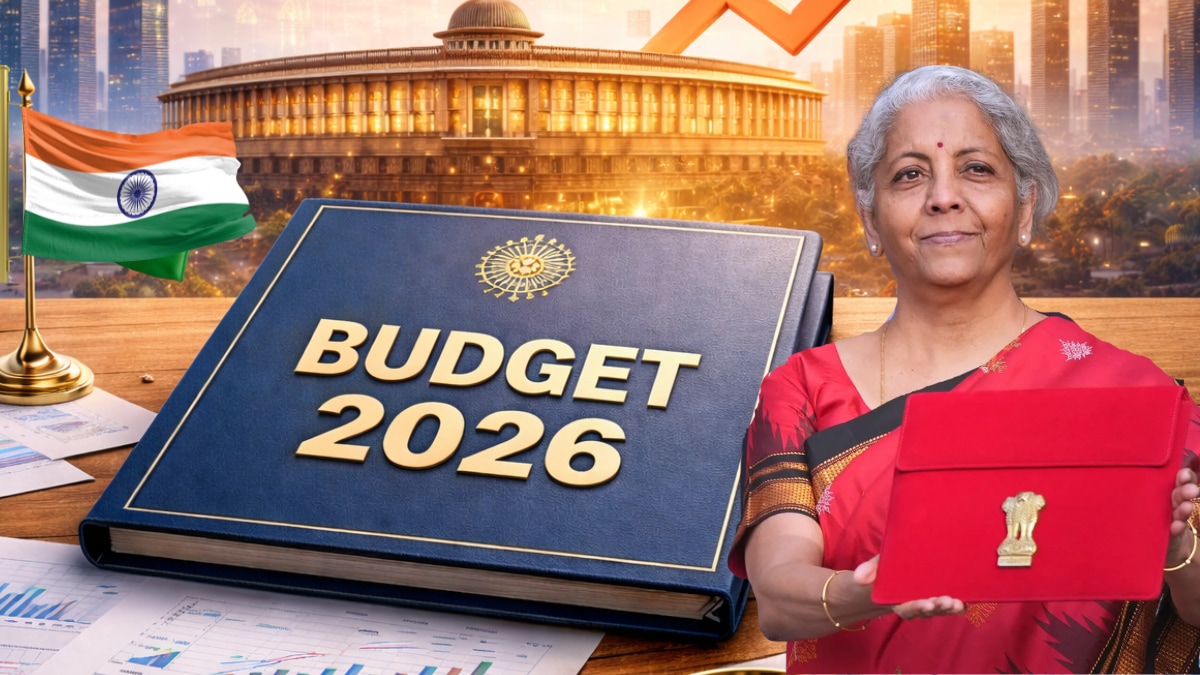
Union Budget 2026 Expectations Highlights: The final countdown for the Union Budget 2026 has begun. The Economic Survey was tabled in the Parliament yesterday and it presented a comprehensive review of the nation’s economy over the past financial year. From revising the definituon of government companies to boost divestment to flagging concerns about a 10-20% chance of a ‘systemic shock’, the suvey presented a comprehensive review and key factors to watch out for.
Now, all the focus is on Finance Minister Nirmala Sitharaman’s key announcements.
Capex to rise 13% YoY
Anand Rathi believes that FY27 Budget is expected to stick to the existing reform path with no major shocks.
Anand Rathi expects capital expenditure to rise approximately 13% YoY to Rs 12.6 trillion; capex-to-GDP maintained at 3.2%.
Economic Survey highlights
Economic Survey estimates GDP growth for FY27 in the range of 6.8–7.2%. Real GDP growth for FY26 is projected at 7.4%, while GVA growth is estimated at 7.3%. The Survey proposes “disciplined swadeshi” — a three-tier strategy to build critical capabilities, cut costs, strengthen advanced manufacturing, and move from self-reliance to strategic indispensability.
Budget expectations 2026 LIVE updates:Real estate sector expects affordability measures
Ramji Subramaniam, Managing Director, Sowparnika Projects, says the real estate sector remains a strong pillar of India’s growth story and hopes the upcoming Union Budget will introduce progressive measures to improve affordability, liquidity, and long-term demand.
“One of the key interventions that we urge the government to consider is extending the 1% GST benefit for affordable housing to homes priced up to INR 65-75 lakh, from the current INR 45 lakh threshold. With land prices in cities rising by 50-75% in recent years and construction costs escalating due to higher raw material prices and a persistent shortage of skilled labour, such a move would reflect current market realities. It would offer relief to first-time homebuyers while allowing developers to focus on making housing accessible for all. We also hope the government considers revising Section 80EEA. “Subramaniam added.
“ Additionally, rationalisation of GST for under-construction projects would help offset rising input costs and improve project viability. The right policy support can help the sector to continue generating employment, drive infrastructure-backed growth, and support sustainable urban development. Such measures will strengthen investor confidence and accelerate the sector’s contribution to the Indian economy.” he added.
Budget expectations 2026 LIVE updates:New airports and capacity expansion likely
Kinjal Shah, Senior Vice President & Co-Group Head, Corporate Sector Ratings, ICRA, says that the budget 2026 is expected to reiterate the focus on improving regional connectivity through the Regional Connectivity Scheme (RCS) or Ude Desh ka Aam Nagrik (UDAN).
“The Budget is also likely to focus on setting up new airports and expanding the existing airport capacities at some key airports to help address the current airport infrastructure constraints faced by the airlines and to improve connectivity with the underserved/unserved destinations to boost tourism.” Shah added.
She elaborates that the development of new tourist attractions, promotion of medical tourism and streamlining of e-visa facilities, which will boost international tourism in India, are also expected to remain the key focus areas.”
ICRA expects the Railways’ budgetary allocation for FY2026–27 to see a range-bound increase, in line with the trend of the past two years. The allocation has grown by about 5% year-on-year in both FY25 and FY26 (Budget Estimate), reaching ₹2.65 lakh crore, including extra-budgetary resources (EBR) of ₹10,000 crore.
With railway electrification nearing completion, the focus is expected to shift towards easing congestion through capacity expansion. This will include the development of new routes, gauge conversion, track doubling, and the expansion of dedicated freight corridors. Alongside this, infrastructure modernisation—such as rolling stock upgrades, station redevelopment, and safety improvements—is likely to remain a key priority, according to ICRA Vice President and Co-Group Head Suprio Banerjee.
Banerjee added that within the broader capacity expansion push, economic corridors are expected to take centre stage. He also said faster rollout of Kavach 4.0 and advanced signalling systems across the railway network will play a major role in shaping both budget priorities and execution plans.
Budget expectations 2026 LIVE updates: Deloitte outlines priorities for trade resilience
Deloitte India said the FY27 Budget should look at steps such as extending export credit and concessional financing to MSMEs, along with allocating funds for the exploration of critical minerals to strengthen trade resilience and limit external risks.
Deloitte Economist Rumki Majumdar said increasing global protectionism and ad hoc actions — including tariff increases, changes in rules of origin and non-tariff barriers — are heightening uncertainty for Indian exporters.
Budget expectations 2026 LIVE updates: Bank reform push in Budget?
The Centre may propose the Banking Governance Bill during the Union Budget presentation on February 1, 2026, in a move aimed at enabling public sector banks to independently finance large infrastructure and industrial projects.
Budget expectations 2026 LIVE updates: Budget must boost digital compliance as cross-border trade expands
Amid expectations of deeper economic integration and rising cross-border transactions following the proposed India–EU free trade agreement, experts say the Union Budget will need to place greater emphasis on digital compliance and forensic preparedness to manage emerging risks.
“With the India–EU free trade agreement expected to accelerate cross-border trade and capital flows, the upcoming Budget will need to strengthen digital compliance capacity across tax and customs systems. Higher transaction volumes increase exposure to invoice manipulation, transfer pricing abuse, shell entities and refund irregularities, making analytics-driven risk detection and integrated data trails essential rather than optional. Forensic and compliance professionals will increasingly rely on automated anomaly screening, faster digital evidence validation and tighter documentation controls to manage this complexity,” Omkar Borkar, Association of Certified Fraud Examiners, National Forensic Science University – Student Chapter said.
Budget expectations 2026 LIVE updates: Crisil recomneds higher tourism budget
Pushan Sharma, Director, Crisil Intelligence, said that the global tourism industry, which was significantly impacted by the Covid-19 pandemic, returned to near normalcy in 2024. Worldwide, international tourist arrivals stood at 1.46 billion in 2024, which is 99.6% of the pre-pandemic, or 2019, level of 1.47 billion.
"However, even in 2025, India’s tourism sector is yet to reach those levels; foreign tourist arrivals in 9MCY2025 stood at 81% of 9MCY2019.Two reasons for this. One, if Bangladesh and China are excluded, foreign tourist arrivals to India were up 1.6% in 2024 over 2019. Second, the budget for overseas promotion and publicity for fiscal 2026 was set at just Rs 3 crore versus Rs 415 crore in fiscal 2019. Moreover, Rs137 crore was budgeted for domestic publicity and promotion for fiscal 2026. " Sharma said.
He added that the increasing budgeted spends for overseas publicity back to fiscal 2019 levels would help improve arrivals and the share of tourism in India’s GDP as well, because jobs associated with tourism will also rise from 13.3% of total employment as of H1FY26.
Budget expectations 2026 LIVE updates: Crisil recomends policy support for fertilizers
Pushan Sharma, Director-Crisil Intelligence, says that rationalising fertiliser use is crucial for the sustainable growth of agriculture.
In 2023, urea application in the country averaged ~182 kilogram per hectare (kg/ha), higher than the global average of ~116 kg/ha but far below China’s ~335 kg/ha. There were significant regional disparities, too.
He said that the government is encouraging balanced nutrient management through the Pradhan Mantri Programme for Restoration, Awareness Generation, Nourishment, and Amelioration of Mother Earth (PM-PRANAM) scheme, which incentivises reduced use of chemical fertilisers, and the Market Development Assistance (MDA) scheme, which promotes organic inputs. However, these schemes require sharper focus and fund allocation.
"Policies that support organic fertilisers, such as MDA and the Galvanising Organic Bio-Agro Resources Dhan (GOBARdhan) schemes, accounted for only 0.1 % of the total fertiliser budget in fiscal 2026. Allocations to these schemes must be substantially increased to achieve sustainable agriculture without sacrificing yields." he added
Budget expectations 2026 LIVE updates: Crisil Intelligence highlights the importance of climate-change for agriculture sector
Pushan Sharma, Director of Crisil Intelligence highlighted the importance of funding the National Innovations in Climate Resilient Agriculture project in the upcoming budget.
He added that climate-change has materially impacted agricultural production in India, pointing that temperature increase can reduce crop yield and lead to significant losses in the country's annual GDP.
He also emphasized on expanding the Pradhan Mantri Krishi Sinchayee Yojana (PMKSY) scheme, including Per Drop More Crop (PDMC) and Har Khet ko Pani (HKKP). Pointing that , HKKP received only ~4% of the fiscal 2026 budget of the Department of Water Resources, River Development and Ganga Rejuvenation.
"Scaling up these initiatives is critical to strengthen micro irrigation, water harvesting and last-mile delivery, thereby building climate resilience and sustaining agricultural growth," Sharma said.
Budget expectations 2026 LIVE updates: LS Digital says policy push needed around data compliance
Industry experts have added that the Union Budget 2026 should push for clearer policies over domestic digital growth. Commenting on the same, Anand Bhadkamkar, Group CFO, LS Digital, said,
"As businesses integrate AI, MarTech, and AdTech into their core operations, the clarity and direction provided by the Union Budget become critical for sustained digital growth."
He added that Indian digital businesses need clearer policy signals, especially around compliance automation, data governance, and incentives that encourage domestic technology adoption.
"This will be key to translating policy intent into real, long-term investments and ensuring India remains competitive in the global digital economy.” Bhadkamkar said.
Budget expectations 2026 LIVE updates: Crisil Intelligence on Market price stabilisation
Pushan Sharma, Director, Crisil Intelligence, said that Market price stabilisation hinges on mechanisms such as the minimum support price, the Market Intervention Scheme and the Price Deficiency Payment Scheme, which are aimed at providing targeted income support and price certainty to farmers while maintaining market efficiency and allowing demand-supply dynamics to operate freely.
“However, uptake of these schemes has been lower than expected. utilisation for price support schemes under the Pradhan Mantri Annadata Aay Sanrakshan Abhiyan (PM AASHA) initiative was only ~64 % in fiscal 2022 and 89 % in fiscal 2023. Moreover, these schemes received only 5-6% of the Department of Agriculture and Farmers' Welfare's total budget in fiscal 2026.” Sharma said.
“Therefore, to enhance price stabilisation under PM AASHA, the Union Budget may consider increasing the allocation for this umbrella scheme and combining it with a streamlined onboarding process, time-bound direct benefit transfer settlements, and state incentives or conditional grants to improve utilisation,” he added.
Budget expectations 2026 LIVE updates: ICRA flags tariff stress, seeks export support for textile sector
“The year 2025 was a challenging one for the domestic textile industry. US tariff issues affected the entire value chain, particularly impacting apparel and home textile segments. As competition from neighbouring countries intensified and global retailers are prepared to place new orders for the upcoming season, early resolution of tariff negotiations is crucial,” Srikumar Krishnamurthy, Senior Vice President & Co-Group Head, Corporate Ratings, ICRA, said.
“In this backdrop, the Budget is expected to prioritize policy measures that safeguard the exporters in the form of temporary support schemes, favourable financing terms on bank loans, etc. Proposals around support for MSMEs, job security, skill development initiatives, and addressing supply chain issues shall aid the sector,” he added.
Budget expectations 2026 LIVE updates: Economic survey urges ‘Strategic Sobriety’ as rising incomes drive higher imports
“India must run a marathon and sprint simultaneously, or run a marathon as if it were a sprint.”
The Economic Survey, tabled yesterday, cautions that as incomes rise, India’s import bill will also increase, regardless of the progress made on indigenisation. To manage this structural reality, it says the country must generate stronger investor interest and higher foreign-currency export earnings to ensure external balances remain sustainable.
The Survey argues that economic policy should prioritise supply stability, creation of strategic resource buffers, and diversification of trade routes and payment systems. It describes the appropriate policy stance for 2026 as one of “strategic sobriety” rather than defensive pessimism.
It adds that a more uncertain global environment will require India to simultaneously maximise domestic growth and strengthen its capacity to absorb external shocks, with greater emphasis on liquidity, redundancy, and financial and supply-side buffers.
Budget expectations 2026 LIVE updates: ICRA says retailers seek disposable income boost, policy clarity
“Steps to improve personal disposable income to spur consumer sentiments and consumption remain the key expectation of the Indian retailers from the upcoming Budget,” Kinjal Shah, Senior Vice President & Co-Group Head, Corporate Sector Ratings, ICRA, said.
“Additionally, entities are hopeful that the Budget will provide long-awaited clarity on implementation of National Retail Policy, which focuses on ease of doing business by rationalising the licensing processes, enhancing the credit inflow, particularly to MSMEs and improving supply chain infrastructure,” she added.
“Further, implementation of national e-commerce policy, which streamlines regulations and improves transparency across e-commerce platforms would be critical to boost investor confidence,” she noted.
Budget expectations 2026 LIVE updates: ICRA says retailers seek disposable income boost, policy clarity
“Steps to improve personal disposable income to spur consumer sentiments and consumption remain the key expectation of the Indian retailers from the upcoming Budget,” Kinjal Shah, Senior Vice President & Co-Group Head, Corporate Sector Ratings, ICRA, said.
“Additionally, entities are hopeful that the Budget will provide long-awaited clarity on implementation of National Retail Policy, which focuses on ease of doing business by rationalising the licensing processes, enhancing the credit inflow, particularly to MSMEs and improving supply chain infrastructure,” she added.
“Further, implementation of national e-commerce policy, which streamlines regulations and improves transparency across e-commerce platforms would be critical to boost investor confidence,” she noted.
Budget expectations 2026 LIVE updates: GCC ecosystem employs 2.16 million, driving high-skill job creation
India now hosts over 1,800 Global Capability Centres, employing around 2.16 million professionals in largely formal, high-skilled and stable roles.
Beyond direct hiring, GCCs are generating indirect jobs across real estate, infrastructure, transport, retail, healthcare and education through multiplier effects.
They are also investing heavily in reskilling across digital, analytics, AI, finance and risk functions, operating as large private-sector training platforms.
The expansion of GCCs into Tier-2 and Tier-3 cities is further broadening the talent base and easing metro pressure, with several state governments rolling out dedicated policies and infrastructure support to attract new centres.
Read More: How Global Capability Centres are quietly powering India’s next growth cycle
Budget expectations 2026 LIVE updates: GCCs contribute $68 billion to GVA, seen as key growth lever
Global Capability Centres (GCCs) are emerging as a major pillar of India’s growth story, moving well beyond their earlier back-office role. They currently contribute about $68 billion in direct gross value added, or roughly 1.6–1.8% of GDP.
A recent report by the Confederation of Indian Industry projects this direct contribution could rise to $150–200 billion as centres expand and shift toward higher-value, IP-led work.
Including indirect and induced effects, the total economic impact could reach $470–600 billion by 2030.
Read More: How Global Capability Centres are quietly powering India’s next growth cycle
Budget expectations 2026 LIVE updates: Services surplus and new FTAs cushion India’s trade deficit, says survey
The Economic Survey highlighted that services exports remain the backbone of India’s trade resilience, rising 6.5% to $304 billion in April–December 2025, driven by global capability centres and professional services.
While imports increased 4.9% to $730.8 billion, the $96.6 billion trade deficit stayed manageable due to the services surplus. The report also flagged aggressive trade diplomacy, with multiple FTAs and CEPAs concluded or advanced with partners including the UK, Oman, EU and EFTA bloc.
Foreign exchange reserves stood at $701.4 billion in January 2026, giving nearly eleven months of import cover and strengthening external stability.
Read More: $634 billion exports, 8 trade deals: India’s global trade story so far in FY26
Budget expectations 2026 LIVE updates: Shriram Wealth’s Naval Kagalwala sees steady fiscal glide path with Capex push intact
“Despite higher fiscal deficit levels so far this year due to stronger capital expenditure and softer tax collections, the government is likely to stay on track to meet its 4.4% deficit target, supported by robust non-tax revenues and controlled spending,” Naval Kagalwala, COO & Head of Products at Shriram Wealth, said.
He added that FY27 will likely see only gradual consolidation, continued infrastructure capex, limited personal tax changes, and elevated borrowing, with markets closely watching growth, consumption, and export-support measures.
“From an Equity market perspective, participants will be watching for measures to support growth – whether those would be directed towards higher capex (which has long term multiplier effects) or measures to boost consumption or a combination of both,” he added.
Budget expectations 2026 LIVE updates: Economic Survey says India’s exports stay resilient despite US tariff pressures
India’s external sector has held up better than expected despite steep US tariffs, global slowdown and trade disruptions, the Economic Survey 2025-26 noted.
Total exports reached a record $825.3 billion in FY25, with momentum continuing into FY26 as first-half exports touched $418.5 billion. Between April and December 2025, exports rose 4.3% year-on-year to $634.3 billion.
Merchandise exports grew modestly, but electronics shipments jumped over 35%, helped by PLI-led manufacturing gains. The Survey said diversified trade ties and strong services earnings have helped cushion volatility and maintain export stability through a difficult global trade cycle.
Read More: $634 billion exports, 8 trade deals: India’s global trade story so far in FY26
Deloitte India said that the FY27 Budget should consider measures such as supporting MSMEs through export credit and concessional financing, as well as funding exploration of critical minerals to enhance trade resilience and reduce external vulnerabilities.
Deloitte Economist Rumki Majumdar said that rising global protectionism and ad hoc measures, such as tariff hikes, changes to rules of origin, and non-tariff barriers, are adding to the uncertainty for Indian exporters
Budget expectations 2026 LIVE updates: Anand Mahindra lauds Economic Survey for seeing cities as growth engine
Anand Mahindra lauded the Economic Survey for placing Indian cities at the centre of the growth narrative, saying it marks a major shift from treating urban areas as administrative challenges to recognising them as economic engines.
“Cities that prioritise liveability, meaning clean air, walkability, safety, affordable housing, efficient mobility, green spaces, and access to culture and opportunity, are the cities that will attract and retain talent and sustain creativity,” Mahindra said via post on X.
“If this thinking carries meaningfully into budgeting and institutional reform, it could mark a long-overdue shift: from managing cities as problems to building them as platforms for India’s growth,” he added.
Budget expectations 2026 LIVE updates: Systemic shock could hit hard, Survey warns
The Economic Survey highlights a 10–20% risk of a systemic shock cascade, where financial, tech, and geopolitical stresses interact.
While India’s fundamentals are strong, spillovers could tighten liquidity, trigger capital flight, and rival the 2008 crisis in impact if multiple shocks coincide.
Read More: Economic Survey warns of fragile global order in 2026 – Three risk scenarios explained
Budget expectations 2026 LIVE updates: PhysicsWallah’s Prateek Maheshwari urges lower GST on education and outcome-based spending
"My expectation for the budget is to make education affordable and accountable. I want to see a reduction in the GST on educational services. The current 18% rate is a burden. Lowering this is essential to make quality learning accessible to every family," Prateek Maheshwari, Co-Founder, PhysicsWallah, said.
Furthermore, he said that a shift to outcome-based budget allocation would be transformational for the country as it moves the focus from spending to impact.
"We shouldn't just fund infrastructure but results, such as improved learning outcomes and increased employability. When we link budget to performance, we ensure that every rupee spent directly empowers our youth and builds a skilled nation," he added.
Budget expectations 2026 LIVE updates: Economic Survey flags rising global risks ahead of Budget 2026
The Economic Survey 2025-26 warns of escalating global uncertainty. Geopolitical tension, financial vulnerabilities, and leveraged tech investments are making shocks more likely.
Even minor disturbances could trigger outsized effects, requiring active government intervention to stabilise markets. Probability of a fragile “managed disorder” scenario: 40–45%.
Read More: Economic Survey warns of fragile global order in 2026 – Three risk scenarios explained
Budget expectations 2026 LIVE updates: Analysts see medium-term market resilience despite Budget week nervousness
Dr VK Vijayakumar of Geojit notes global uncertainties and rising crude as headwinds, but expects tailwinds from the Economic Survey GDP projections (6.8–7.2%) and 10% nominal growth.
FPI outflows are declining, and India’s export diversification and upcoming India-EU trade deal could support earnings growth of 15–17% in FY27.
Read More: Why are markets cautious before FM Sitharaman’s Budget 2026 – 4 key reasons to know
Budget expectations 2026 LIVE updates: Sensex falls nearly 500 points ahead of Budget 2026
Indian markets opened on a weak note ahead of Budget Day. Sensex slipped ~500 points, with Nifty below 25,300.
Selling pressure is led by caution over policy announcements, metals, IT and financials, while foreign investors have sold equities worth over Rs 43,000 crore this January. FMCG, healthcare, and consumer durables showed resilience.
Read More: Why are markets cautious before FM Sitharaman’s Budget 2026 – 4 key reasons to know
Budget expectations 2026 LIVE updates: GST 2.0 simplifies rates, life & health insurance now tax-exempt
The Survey details GST reforms: moving to a two-rate system, standard 18%, merit 5%, with sector-specific relief on cars, medicines, farm machinery, and daily essentials.
Notably, life and health insurance policies are now GST-exempt, making premiums more affordable and supporting greater insurance penetration across households.
Budget expectations 2026 LIVE updates: No Income Tax up to Rs 12 Lakh, Standard Deduction boosts middle-class relief
The Economic Survey 2025-26 highlights a major shift in India’s direct taxes: individuals earning up to Rs 12 lakh pay no personal income tax, while salaried taxpayers get a Standard Deduction of Rs 75,000, pushing the effective threshold to Rs 12.75 lakh.
This move eases the tax burden, boosts household spending, and strengthens the middle class ahead of Budget 2026-27.
Budget expectations 2026 LIVE updates: ICRA estimates a 5% YoY growth in railways allocation
ICRA anticipates a range-bound increase in Railways’ budgetary allocation for FY2026–27, given the trend seen over the past two years, about 5% YoY growth in FY25 and FY26BE to reach Rs. 2.65 lakh crore, including EBR of Rs. 10,000 crore.
“With electrification nearly complete, focus will remain on decongestion through capacity augmentation—new routes, gauge conversion, track doubling, and dedicated freight corridors. Infrastructure modernisation, including rolling stock upgrades and station redevelopment, alongside safety enhancements, will remain critical.”, Suprio Banerjee, Vice President & Co-Group Head, ICRA said.
He added that within capacity expansion, economic corridors, coupled with accelerated deployment of Kavach 4.0 and advanced signalling across the network, are expected to dominate both budgetary priorities and execution strategies.”