



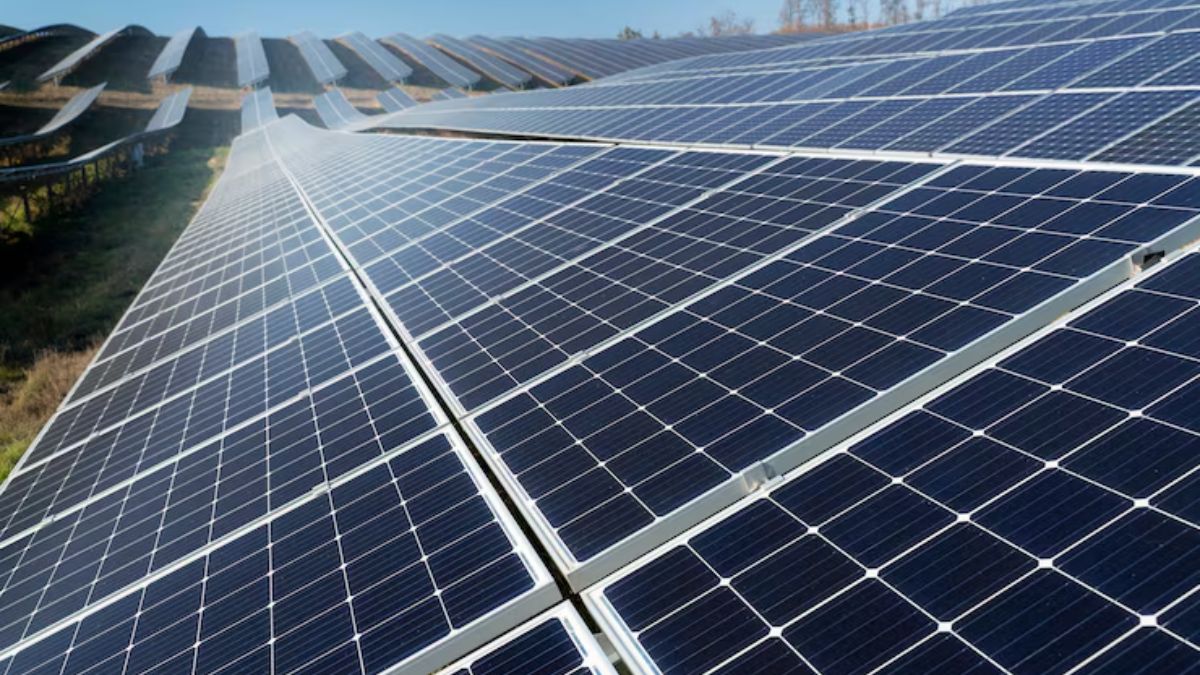
Village-level solar systems could reduce rural electricity costs by as much as 53% compared with the average power purchase cost of state utilities, even as battery storage raises costs and requires location-specific planning, according to a new study by the International Institute for Sustainable Development and Idam Infrastructure Advisory.
In Maharashtra’s Hiware Bazar, a proposed 980-kW ground-mounted solar project was estimated to deliver electricity at ₹3.06 per unit with subsidy, around 47% below Maharashtra State Electricity Distribution Company’s average power purchase cost of ₹5.8 per unit. Even without subsidy, the cost was estimated at ₹4.09 per unit, nearly 30% lower than the utility benchmark.
The cost gap was wider in Assam’s Bamun Sualkuchi. A 1,318-kW grid-connected system, with 70% ground-mounted and 30% rooftop solar, was estimated to produce electricity at ₹4.03 per unit with subsidy, about 53% below Assam Power Distribution Company’s purchase cost of ₹8.5 per unit. Without subsidy, solar power would cost ₹6.01 per unit, still about 29% lower.
“DRE can offer affordable and reliable electricity in rural India, often below state procurement costs across very different rural contexts. In most cases, it can remain competitive even without subsidies,” said Sunil Mani, policy adviser at IISD.
The economics changed when batteries were added. In Hiware Bazar, a 350-kW/1,400-kWh four-hour battery raised the blended cost to ₹5.44 per unit, only marginally below the state’s purchase cost. The battery reduced the number of days with net exports to the grid from 93 to 60, but average surplus exports still stood at around 1,378 kWh per day on the remaining days.
A larger 500-kW/2,000-kWh battery reduced peak demand by more than 80%, but seasonal agricultural consumption limited its utilisation.
In Bamun Sualkuchi, where 84% of electricity consumption comes from domestic users, including home-based weaving units, a 500-kW/2,000-kWh battery pushed the subsidised cost to ₹9.8 per unit, above the state benchmark. A smaller 400-kW/1,600-kWh battery lowered the cost to ₹8.3 per unit, just below the utility’s purchase cost.
“To scale rural DRE, India must move from isolated projects to system-level planning, starting with Village Energy Plans that reflect local demand, integrate DRE with distribution companies, and plan early for storage and surplus power management,” said Ashwitha Tunga, policy analyst at IISD.
The findings come as India targets 500 GW of non-fossil capacity by 2030. Total installed power capacity stood at about 542 GW as of May 31, 2026, including nearly 283 GW of renewable capacity, excluding large hydro. Distributed renewable systems account for around 55 GW, or 24% of renewable capacity.
Distribution companies are required to source nearly 5% of their electricity from distributed renewable energy by 2030, equivalent to about 63 GW. The report said scaling deployment would require Village Energy Plans covering demand, storage, grid readiness, financing, surplus management and long-term maintenance.
“If India wants DRE to contribute meaningfully to its clean-energy and net-zero ambitions, it must move beyond uniform deployment and adopt village-level energy planning,” said Rajiv Shukla, executive director at Idam Infrastructure Advisory.