



By Colonel Baljinder Singh Retd
“You do not have to worry about burning bridges, if you are building your own.” -Kerry Wagner
Commercially, the US -India engagement in the defence sector over the last two decades has paused at USD 20 billion, dominated mainly by government to government and Foreign Military Sales (FMS) exchanges. Historically, it is a case of missed opportunities for the US more than India, as both countries did not form a strategic and mutually beneficial long-term relationship that also covers security cooperation.
The US needed to understand India’s security concerns with two enemy countries on the Western and Eastern borders, with whom India has fought three major wars and had many skirmishes to date. Indian outreach for support during these wars had not only gone unabated, but also exposed US self-serving strategic interests at that time. Another occasion for the US showing its support was the requirement of ‘Missile Umbrella Cover,’ which the Indian government was scouting for its borders. The US overlooked this when it had the opportunity to sell its missile system to India, only later to threaten India with CAATSA sanctions on India’s purchase of the Russian S-400 missile system.
Also Read: India and Romania ink the first ever Defence Cooperation Agreement; focus on Indo-Pacific and more
The US must conduct a reality check when discussing the ease of business with India. It conveniently forgets the red-tape bureaucratic regime it supports when sharing technology or selling high-tech equipment to countries other than NATO. The export controls, the ITARs, and other USG policies and regulations are an endless web that is difficult to get out of, leading to no substantial progress as far as the US – India defence relations are concerned. A case in point is the lack of product co-development despite the policy framework of DTTI since 2016. The US needs to walk the talk and convert these opportunities into something substantial.
However, things are changing as the US tries to shore India as a long-lost friend. Towards this end, the meeting of NSAs of both countries on January 31 this year set the tone for events. Firstly, a White House Fact Sheet was released where both countries agreed to resolve issues related to regulatory barriers and business and talent mobility in both countries through a standing mechanism under iCET.
Secondly, the US presence in the follow-up Indian Aero Show on February 23 this year was by far the largest compared to others and its presence earlier, with the DSCA driving the US agenda. The presence of F-16, F-18/A, fighters, C-17, and C-130J transporters aside, the maiden flight of F-35 in the Bangalore skies was the icing on the cake as the Indian Forces are drawn to this unique technology. The fact that a few days earlier, India’s entire relief package for the Turkey earthquake was moved overnight on American transporters, the C-130Js, signalled the shift in Indian dependency on Russian equipment and its mental move towards the US and other countries.
Also Read: India shares Japan’s vision for free, open, rules-based Indo-Pacific: Rajnath Singh
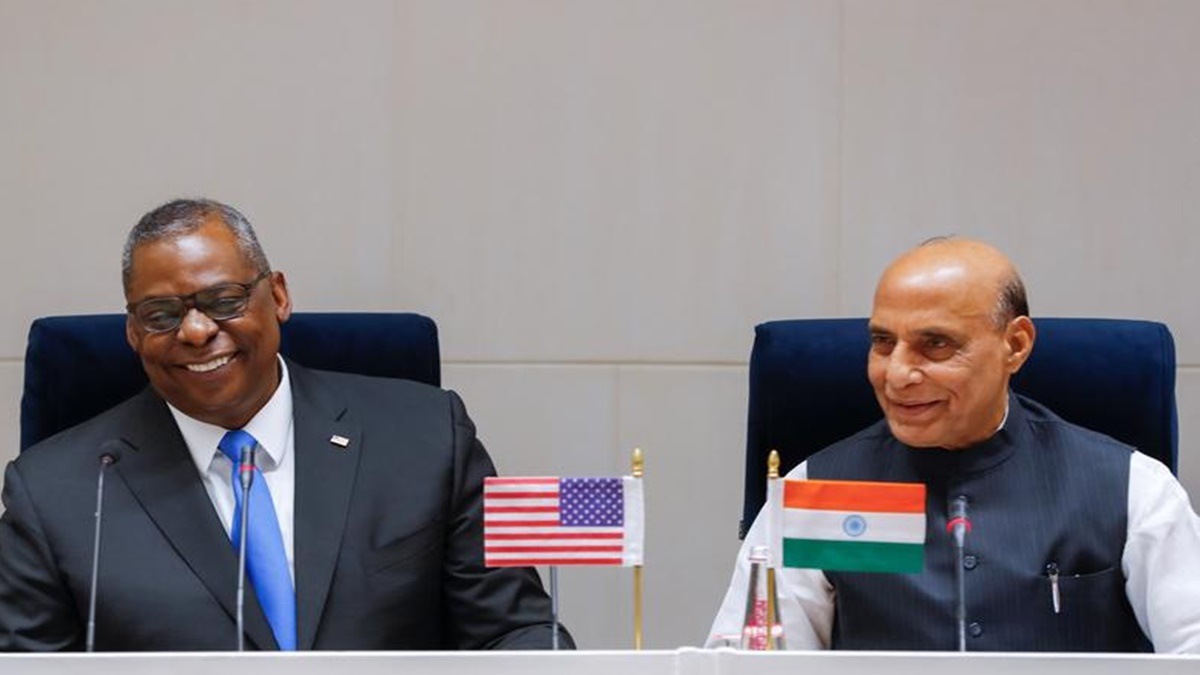
Thirdly, the bonhomie seen during US Commerce Secretary Gina Raimondo’s visit to India in March where she proactively participated in the Holi festivities with the Indian Defence Minister Rajnath Singh and other Indian cabinet ministers, is a testament to the ‘strategic and cordial’ relationship currently in play. This was followed by signing the US-India Strategic Trade Partnership to work on deregulating ‘Export Controls’ and Indo -US Commercial Dialogue to stabilize semiconductor supply chains. This shows clarity of intent between the two countries, as both seem ready to iron out the impediments in the deeper engagement and cooperation of the technology transfer.
The recent shift in geopolitics alignment indicates the friend-shoring exercise at the highest level. Chinese President Xi’s prowess to strike a deal between the Saudis and the Iranians is no less than a feather in the cap, making the US reflect upon its stand in relations with these countries. A mirror image of the role the US played in the signing of the Abraham Accords between Israel and UAE. Xi’s visit to Russia has also clearly indicated to the world that China could back Russia if the war in Ukraine is prolonged and there is an infinitive possibility of war never ending with a Russian loss.
With China’s growing influence in the Indo-Pacific region and geopolitically, it is in the interest of the US to have a militarily strong and reliable partner in this region to thwart the ill intentions of China. It would be a pillar of stability and strength for the US in the Indo-Pacific, Japan, South Korea, and Australia. The US must realize that India must develop as a manufacturing hub. India today contributes only 2 percent of global manufacturing, which needs to be proportional to its potential in size, HR, and natural resources available. This US-assisted development would be in sync with India’s ambition of being a USD 5 trillion economy in 2025 and a USD 30 trillion economy by 2050.
India today is very actively involved with the US on many geopolitical platforms like the quad, I2U2, IPEF, etc. The relationship is on an upward trajectory with the recently announced initiatives in critical and emerging technologies(iCET), the Strategic Trade Agreement, and the Commercial Dialogue. The potential transfer of GE Engine technology to India a litmus test for this partnership. If the US could successfully navigate this puzzle, it would have friend-shored India for the future.
The author is Director Aerospace and Defence of US-India Strategic Partnership Forum (USISPF).
Disclaimer: Views expressed are personal and do not reflect the official position or policy of Financial Express Online. Reproducing this content without permission is prohibited.