



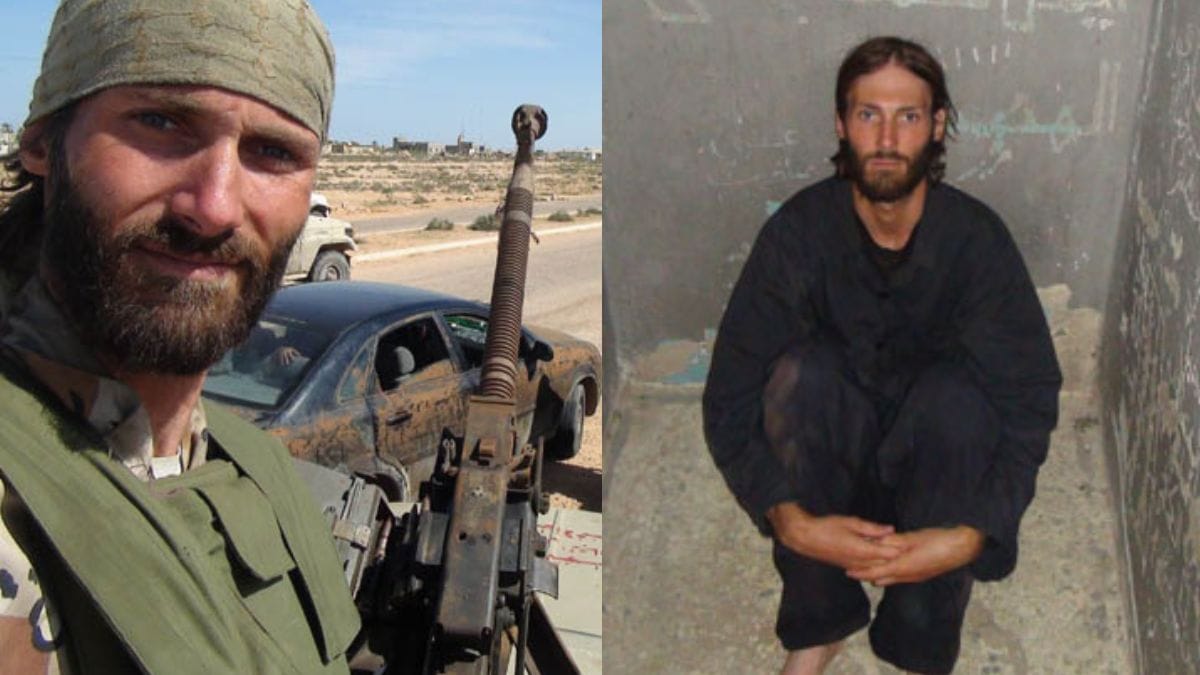
American national Matthew VanDyke was among multiple individuals arrested by India’s National Investigation Agency (NIA) this past week in connection with suspected drone warfare training and cross-border movement. Six Ukrainian citizens were also apprehended in coordinated operations in Indian cities like Kolkata, Delhi, and Lucknow.
Official documents circulating online show that the Indian agency filed a case under Section 18 of the Unlawful Activities (Prevention) Act, 1967, which deals with conspiracy, support, abetment, or incitement to carry out a terrorist act. Consequently, a court in the national capital, Delhi, on Monday transferred all seven to NIA custody until March 27.
VanDyke was originally arrested at Kolkata airport at 9 pm on March 13, 2026 (IST). Of the six Ukrainian nationals, three were arrested at Lucknow airport and the other three at Delhi Airport that same day. Authorities have since identified the six Ukrainians in the same case as Hurba Petro, Slyviak Taras, Ivan Sukmanovskyi, Stefankiv Marian, Honcharuk Maksim, and Kaminskyi Viktor, according to the NIA’s official docs.
The US and Ukrainian authorities have also responded to the arrests of these individuals. Although the US Embassy in India said it was “aware of the situation,” it steered clear of sharing any details due to privacy issues regarding US citizens. Ukraine’s foreign ministry, on the other hand, has urged the immediate release of the Ukrainian nationals in addition to seeking consular access.
Ukraine’s Ambassador to India, Oleksandr Polishchuk, met Sibi George, Secretary (West) in the Ministry of External Affairs. Ukraine has also submitted an official note related to the issue.
Charges against Matthew VanDyke
As per the NIA’s court papers cited across reports, VanDyke and the other Ukrainians “entered India on tourist visa on separate dates and flew to Guwahati and thereafter, they travelled to Mizoram without requisite documents – Restricted Area Permit (RAP)/Protected Area Permit (PAP) and entered Myanmar illegally and they were to collect a pre-scheduled training for Myanmar-based ethnic armed groups (EAGs), known to support terror organisations/gangs operating in India in the domain of drone warfare, drone operations, assembly and jamming technology, etc targeting the Myanmar Junta.”
The Indian agency further noted that it was looking for eight more Ukrainians, who, in addition to the already arrested six, entered India on tourist visas illegally. In its submission to the court, the NIA said that the American man and the Ukrainians had even admitted during questioning that they had trained the armed groups more than once.
On this 15th anniversary of the Libyan Revolution:
— Matthew VanDyke (@Matt_VanDyke) February 17, 2026
I’m writing this while on a mission with other rebels in another part of the world (can’t say where for security reasons).
The revolution continues worldwide until authoritarianism is only found in history books.#Libya #Feb17 pic.twitter.com/uqamkKVM5Q
An unidentified NIA office also told the Hindustan Times, “The EAGs they were training and supplying with weapons and other terrorist hardware are known to be supporting some banned Indian Insurgent Groups (IIGs), which affects the national security and interest of India. We are trying to unearth the entire conspiracy, and a hunt is on for others.”
The group of seven people has been accused of illegally bringing large drone shipments from Europe into Myanmar through India so that those groups could use them.
After the seven accused were originally taken into custody on Friday, they were produced before a duty magistrate on Saturday, according to The Print. Thereafter, they were sent to custody for three days, which was ultimately followed by another round of court hearings on Monday. They currently remain in NIA custody till March 27.
Senior advocate Pramod Kumar Dubey represented all seven suspects believed to be linked to “anti-India” plots. He branded their arrests as illegal, claiming that NIA didn’t comply with the Vienna Convention’s rules, The Print reported. The legal representative also argued that the case against Matthew and the Ukrainian nationals stood on flimsy ground.
Who is Matthew VanDyke?
As per the NIA’s submission, the American national’s full name is Matthew Aaron VanDyke. His social media presence appears to indicate his involvement in global conflict zones. He describes himself as an “international security analyst and founder of Sons of Liberty International, veteran of wars, producer and subject of the documentary film “Point and Shoot” about the war in Libya, and award-winning director of the film “Not Anymore: A Story of Revolution” about the war in Syria” on YouTube.
Meanwhile, his Facebook intro says he is an “American freedom fighter who fought in the 2011 Libyan war. Now fights ISIS.” On the flip side, his X bio claims he “Fought in Libya + Ukraine. Run covert ops in Venezuela.”
Regardless of how he identifies himself across SNS platforms, one common identifier marked throughout all of them is Sons of Liberty International (SOLI), which he described as “the first non-profit organisation that provides free military training, advising, and supplies to communities fighting against terrorists, insurgents, and oppressive regimes,” on his LinkedIn profile.
US reports further detail that Matthew, who hails from Baltimore, prominently gained international attention after joining the front lines of the Libyan revolution. At the time, he even went missing in Libya for months, but ultimately returned to the US in 2011. It was eventually revealed that he was captured and held in prison during that time.
Having grown what some may view as a multi-faceted resume, VanDyke has also previously been identified as a journalist by multiple US news outlets.
His LinkedIn profile confirms he studied political science at the University of Maryland, Baltimore County. After that, he secured a master’s degree in security studies with a concentration in the Middle East in 2004 from Georgetown University in Washington.
VanDyke once even reached out to The Baltimore Examiner newspaper. Having ceased operations in the early 2000’s, the paper ultimately published two of his stories, the Associated Press reported nearly two decades ago. The brief 2009 stint helped him get embedded with the US military in Iraq.