



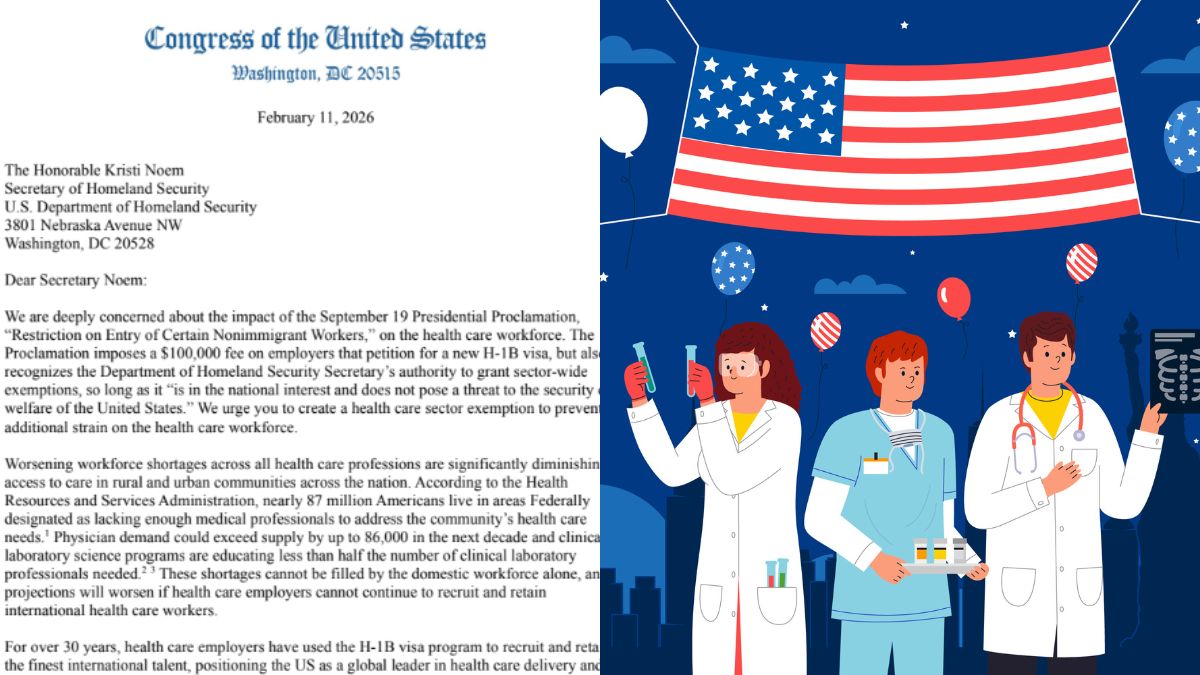
100 members of the US Congress penned a letter to Homeland Security Secretary Kristi Noem, urging the DHS to grant the US health care sector an exemption from the $100,000 fee on new H-1B visas. Led by New York Representatives Yvette D Clarke and Michael Lawler, the grand pool of American lawmakers highlighted that this sector particularly relies significantly on the nonimmigrant ‘specialty occupation’ visa category to hire staff members.
The “Bicameral Letter” (involving both US Chambers) pushing for relief from the $100,000 fee for H-1B health care sector comes days after Florida’s Representative Greg Steube joined the ranks of several other Republicans seeking to terminate the H-1B visa program in the US. On his part, he introduced the Ending Exploitative Imported Labor Exemptions Act or EXILE Act, which would amend Section 214(g)(1)(A) of the Immigration and Nationality Act (8 USC 1184) by ending the H-1B visa program.
US lawmakers demand H-1B fee relief for health care sector
“Worsening workforce shortages across all health care professions are significantly diminishing access to care in rural and urban communities across the nation. According to the Health Resources and Services Administration, nearly 87 million Americans live in areas Federally designated as lacking enough medical professionals to address the community’s health care needs,” the lawmakers stated in the letter to Noem.
They foregrounded health care employers have especially used the H-1B visa program for over 30 year to “recruit and retain the finest international talent, positioning the US as a global leader in health care delivery and innovation.”
The US lawmakers pushing for the H-1B visa fee relief shed light on how severely the Donald Trump administration’s sweeping blow would impact the health care team by highlighting that many staffers, including highly skilled physicians, advanced practice professionals, clinical laboratory workers, and researchers come to the US from across the world.
And so, it was crucial for US health care organisations to be able to hire staff in the “most cost-effective manner” so that financial resources could be dedicated to recruiting as many caregivers as possible for the benefit of the communities, the lawmakers added. The huge group of US politicians also pointed out that rural hospital and urban safety net hospitals would ultimately be most acutely impacted by the effects of the $100,000 H-1B visa.
“These hospitals rely heavily on the H-1B visa to maintain adequate staffing and offer comprehensive services in high-need areas,” the letter added. “21 million Americans live in areas where foreign-trained physicians account for at least half of all practicing physicians,” it stated, alluding to the October 3, 2025, National Advocacy Update on the American Medical Association (AMA) website.
Lawmakers also asserted that the imposition of a $100,000 fee for new H-1B petitions, as per Trump’s September 2025 Proclamation, would exacerbate US hospitals’ existing staffing problems. They noted that it would even push underfunded hospitals over the edge, making matters from them on the financial side. Amplifying even more challenges, they said that the hefty visa fee would leave “critically needed open positions” unfilled.
Ken Raske of the President, Greater New York Hospital Association, also argued that New York hospitals have severely counted on the H-1B visa program to “deliver world-class health care, train the next generation of physicians, and conduct cutting-edge research,” as per the press release issued by Clark’s office this week.
Bea Grause, RN, JD, President of the Healthcare Association of New York State, also called the H-1B visa program a “critical lifeline to health care organisations,” owing to its support in easing workforce shortages.
Who all signed the anti H-1B visa fee letter to Kristi Noem
The 100 members of US Congress involved in the effort are: Yvette D. Clarke, Michael Lawler, Kirsten Gillibrand, Becca Balint, Nanette Barragán, Wesley Bell, Ami Bera, Donald Beyer, Brendan Boyle, Shontel Brown, André Carson, Joaquin Castro, Sheila Cherfilus-McCormick, Judy Chu, Gilbert Cisneros, Emanuel Cleaver, Steve Cohen, Herbert Conaway, Jasmine Crockett, Danny Davis, Donald Davis, Madeleine Dean, Suzan DelBene, Christopher Deluzio, Maxine Dexter, Debbie Dingell, Lloyd Doggett, Veronica Escobar, Adriano Espaillat, Shomari Figures, Brian Fitzpatrick, Bill Foster, Valerie Foushee, Laura Friedman, Sylvia Garcia, Laura Gillen, Daniel Goldman, Vicente Gonzalez, Maggie Goodlander, Josh Gottheimer, Chrissy Houlahan, Henry Johnson, Julie Johnson, Thomas Kean, Robin Kelly, Timothy Kennedy, Raja Krishnamoorthi, George Latimer, Teresa Leger Fernandez, Ted Lieu, Zoe Lofgren, Stephen Lynch, Seth Magaziner, John Mannion, Doris Matsui, Lucy McBath, Jennifer McClellan, Betty McCollum, James McGovern, LaMonica McIver, Gregory Meeks, Robert Menendez, Grace Meng, Kweisi Mfume, Joseph Morelle, Kelly Morrison, Seth Moulton, James Moylan, Frank Mrvan, Jerrold Nadler, Eleanor Norton, Alexandria Ocasio-Cortez, Jimmy Panetta, Chris Pappas, Nellie Pou, Josh Riley, Patrick Ryan, Linda Sánchez, Mary Gay Scanlon, Janice Schakowsky, Bradley Schneider, Hillary Scholten, Terri Sewell, Melanie Stansbury, Suhas Subramanyam, Thomas Suozzi, Eric Swalwell, Emilia Sykes, Shri Thanedar, Bennie Thompson, Mike Thompson, Dina Titus, Paul Tonko, Ritchie Torres, Lori Trahan, Jefferson Van Drew, Marc Veasey, Nydia Velázquez, James Walkinshaw, Nikema Williams.
Meanwhile, the letter also found support of the following US organisations: American Hospital Association (AHA), Association of American Medical Colleges (AAMC), Greater New York Hospital Association (GNYHA), Hospital Association of New York State (HANYS), American Psychiatric Association (APA), NYC Health + Hospitals, America’s Essential Hospitals (AEH), California Medical Association (CMA), Advocates for Community Health (ACH), Association of Clinicians for the Underserved (ACU), American Academy of Neurology, American College of Obstetricians & Gynecologists (ACOG), Miles for Migraine, American Gastroenterological Association, Association for Advancing Physician and Provider Recruitment (AAPPR), Hope for HIE, American College of Radiology (ACR), American Geriatrics Society, MLD Foundation, Society of Teachers of Family Medicine (STFM), Association of Department of Family Medicine, American Society for Clinical Pathology (ASCP), Society of Hospital Medicine (SHM), The Society of Thoracic Surgeons, American College of Surgeons (ACS), National Society for Histotechnology, American Academy of Family Physicians (AAFP), American Society for Cytopathology, American Academy of Otolaryngology-Head and Neck Surgery (AAO-HNS), American Society of Hematology (ASH), American Academy of Pediatrics (AAP), NAPCRG, American Society for Clinical Pathology’s Board of Certification, Infectious Diseases Society of America, HIV Medicine Association, Commission on Laboratory Accreditation (COLA), Philippine Association of Medical Technologist-USA, Inc. (PAMET-USA, Inc.), Association of Academic Leaders of Neurology, American Society for Radiation Oncology (ASTRO), American Clinical Laboratory Association (ACLA)