



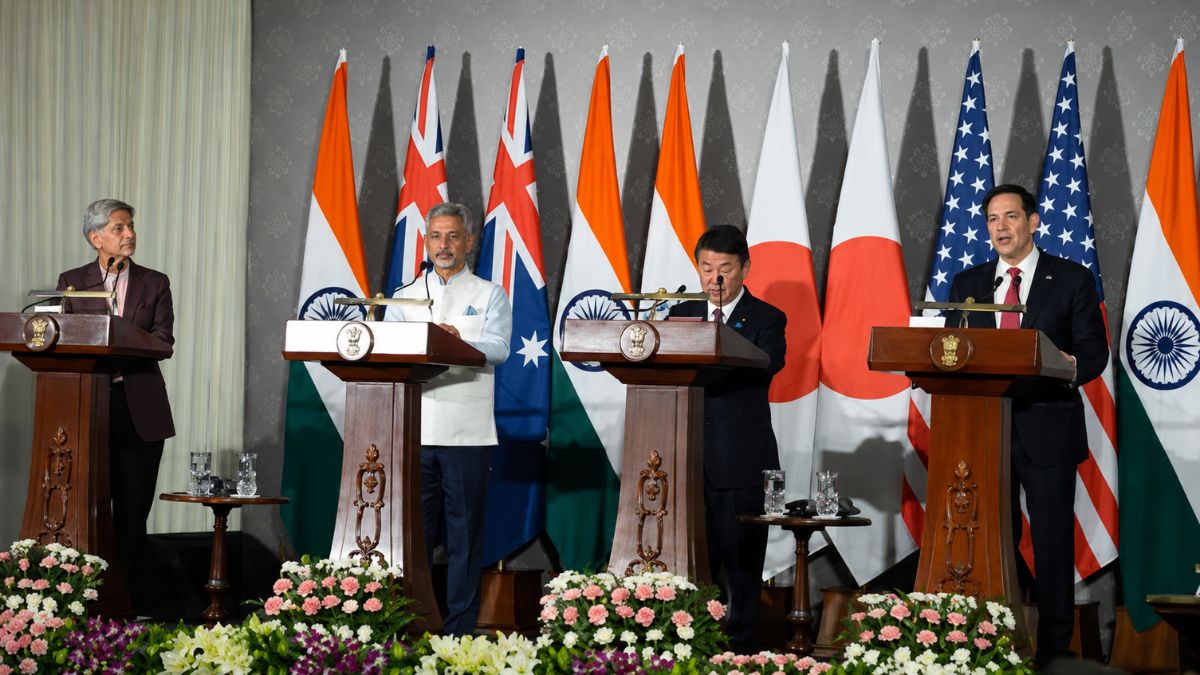
The informal strategic alliance of US, India, Japan and Australia on Tuesday announced its intention to mobilise $ 20 billion through government and private sector for development of secure critical mineral supply chains.
The meeting of the foreign minister of Quadrilateral Security Dialogue or Quad partners launched the Critical Minerals Initiative that plans to use economic policy tools and coordinated investment to accelerate the development of diversified and fair critical mineral markets.
The funds that quad intends to mobilise will be used to strengthen critical minerals supply chains, including in mining, processing, and recycling. Projects that are located in Quad partner countries, operated by companies headquartered in Quad partner countries, or supplying Quad markets, that address critical mineral supply chain gaps will be supported.
“The idea is to mobilise public and private sector support and deepen cooperation in various areas, including regulatory practices, investment facilitation, recycling technologies and resilient supply chains essential for advanced manufacturing and emerging technologies,”
Additional Secretary (Americas Division – USA & Canada), Ministry of External Affairs Nagaraj Naidu Kakanur said.
On the sidelines of the Quad conference, India and the US have signed a bilateral critical minerals framework to engage in international efforts to protect sensitive supply chains from coercive market practices and reduce our collective vulnerability to single-source monopolies.
Both these moves come in response to China’s use of its complete dominance of refining capacity of critical minerals used in electronics, aerospace, defence, semi conductors, solar cells, battery manufacturing and other emerging sectors for diplomatic leverage. In most of the key rare minerals the share of China is more than 90%.
After the tariff wars were inaugurated by the Trump administration, China has used this dominance to bring the US to the negotiating table. China has progressively tightened global supplies via strict licensing requirements. New regulations require foreign entities to obtain explicit licenses from Beijing if they export “parts, components, or assemblies” that contain Chinese-sourced rare earth materials or utilize Chinese proprietary processing technology.
Quad partners also launched the first ever Indo-Pacific Maritime Surveillance Collaboration (IPMSC) initiative and an initiative on Indo-Pacific Energy Security to help strengthen regional energy resilience. Quad countries will work, in coordination with the Government of Fiji, to advance port infrastructure and associated activities in the country.
The Quad also emphasized the need to protect undersea cable networks from risks, including threats and sabotage, through closer coordination and information sharing.
Quad partners have provided tangible support to ensure that all Pacific Island Forum countries are connected via undersea cables by 2026. “We will continue to explore opportunities to support future undersea cable connections in the region to further provide trusted redundancy,” the joint statement said.