



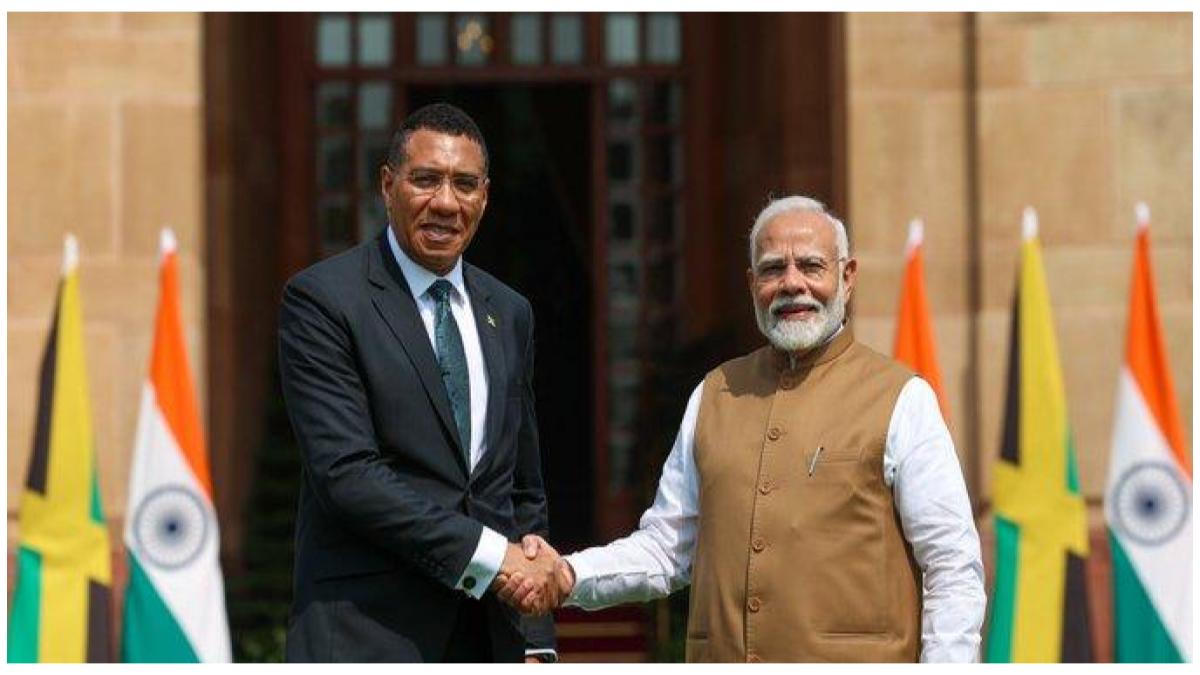
In a groundbreaking moment for India-Jamaica relations, Prime Minister Andrew Holness arrived in India for his first-ever official visit, marking the first bilateral visit by a Jamaican Prime Minister to the country. The visit, which began on September 30, 2024, is set to strengthen ties between the two nations, expanding cooperation in multiple sectors, including technology, energy, education, and security.
Deepening Historical Ties and Shared Heritage
During a joint press statement at Hyderabad House in New Delhi, Prime Minister Narendra Modi highlighted the deep historical connections between India and Jamaica, noting that their relations are built on shared history, culture, and values. “I welcome Jamaica PM Holness and his delegation… Prime Minister Holness has been a long-standing friend of India. I am confident that his visit will give new energy to our bilateral relations as well as our engagement with the entire Caribbean region,” Modi said.
Modi highlighted the importance of the Indian diaspora in Jamaica, with nearly 70,000 people of Indian origin calling the island nation their home. “The people who went to Jamaica from India about 180 years ago laid a strong foundation for our ‘People to People’ ties. The nearly 70,000 people of Indian origin who consider Jamaica as their home are a living example of our cultural heritage,” he added.
Key Areas of Cooperation
Both leaders discussed enhancing cooperation across various sectors. The visiting leader expressed Jamaica’s interest in learning from India’s advancements in STEM (science, technology, engineering, and mathematics), education, and digitalization. “India positions itself as the knowledge capital of the world… We recognise the remarkable strides made by your government in STEM education and digitalisation. We look forward to learning from India as a beacon of technological advancement,” Holness stated.
The two leaders also underscored the role of sports in cementing the bond between their nations. PM Modi announced that the road in front of the Jamaica High Commission in New Delhi would be named ‘Jamaica Marg,’ signifying the strong ties between the countries. Modi quipped that the future growth of India-Jamaica relations would be “faster than Usain Bolt.”
Holness also pointed to the importance of collaborating on national security and border control, noting India’s expertise in technology-driven security solutions. “We see India, a global leader in technology-driven security solutions, as a natural ally,” he said, acknowledging India’s role in improving Jamaica’s national security framework.
Boosting Energy Cooperation and Climate Resilience
Energy cooperation was another key focus of the bilateral talks. Both countries share a common goal to diversify their energy mix by 2030. “Our shared interests, premised on our respective national targets to diversify our energy mix by 2030, provide a platform for deeper cooperation in this sphere,” Holness remarked. In line with this goal, Jamaica announced its intention to join the Global Biofuels Alliance, a key initiative of the Indian government aimed at promoting the use of biofuels as an alternative energy source.
Climate change and disaster resilience were also high on the agenda. Holness expressed Jamaica’s pride in being invited by India to be a founding member of both the Infrastructure for Resilient Island States (IRIS) and the Coalition for Disaster Resilient Infrastructure (CDRI). These initiatives align with Jamaica’s commitment to addressing the challenges posed by climate change.
Prime Minister Modi’s Commitment to Jamaica
India has long been a reliable partner in Jamaica’s development journey, and PM Modi reaffirmed this commitment during the joint press conference. “India has always been a reliable and committed development partner in Jamaica’s development journey. The Four Cs characterize our relations: Culture, Cricket, Commonwealth, and CARICOM (Caribbean Community),” Modi said. He also highlighted India’s role in building Jamaica’s human resource capacity through various scholarship programs, such as ITEC and ICCR.
In terms of trade, both leaders agreed on the importance of boosting bilateral trade and investment. “Trade and investment between India and Jamaica are growing. Through ITEC and ICCR scholarships, we have contributed to the skills development and capacity building of the people of Jamaica,” Modi added.
Strengthening Ties in the Caribbean
This visit is not just a bilateral milestone but a step towards expanding India’s engagement with the entire Caribbean region. Modi pointed out that India’s relationship with Jamaica is key to its broader CARICOM engagement, as both nations share a commitment to democracy, freedom, and development.
PM Holness was equally optimistic, describing the visit as a chance to explore new avenues for cooperation. “This visit is a great opportunity to deepen our relations with India. We have already seen the immense potential in sectors like technology and energy, and I look forward to working with Prime Minister Modi to realize these possibilities,” he said.