



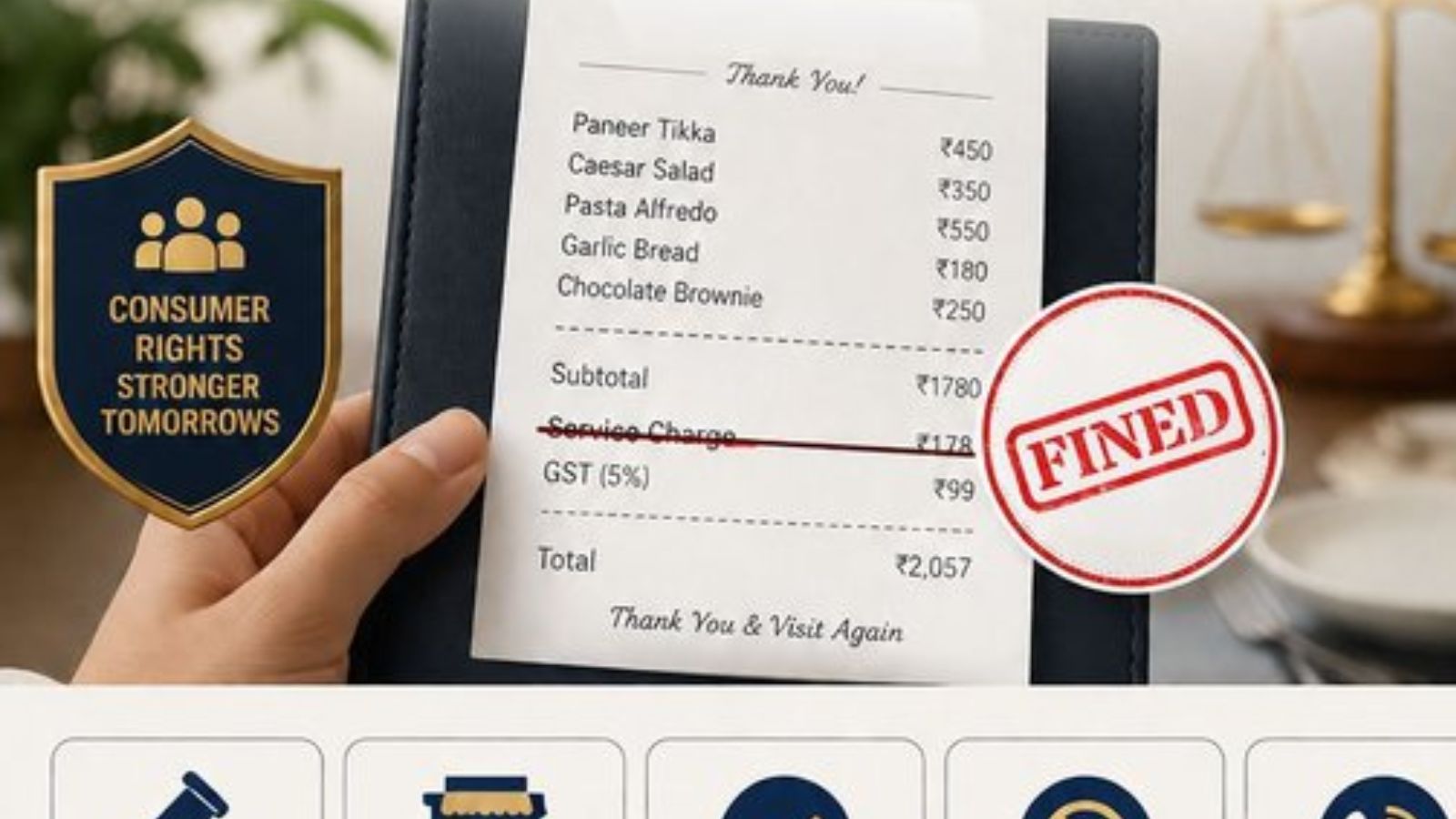
Hotels and restaurants cannot add a service charge to your bill without telling you, and they also cannot force you to pay it. The Central Consumer Protection Authority (CCPA) has now taken action against 41 restaurants across India for allegedly violating consumer rights by automatically adding a service charge to customers’ bills.
In a press release issued by the Ministry of Consumer Affairs, Food and Public Distribution on July 19, the government said the CCPA started the action on its own after receiving several complaints through the National Consumer Helpline (NCH).
Many customers shared copies of their bills showing that a service charge had been added automatically, even though they had never agreed to pay it.
The Central Consumer Protection Authority (CCPA) has initiated suo motu action against 41 restaurants for levying service charge by default, based on complaints received through the National Consumer Helpline (NCH).
— Pralhad Joshi (@JoshiPralhad) July 19, 2026
Reaffirming that service charge is voluntary and entirely at… pic.twitter.com/bESSxvTX4U
Why did the CCPA step in?
The CCPA said its investigation found that these restaurants had violated the “Guidelines to prevent unfair trade practices and protection of consumer interest with regard to levy of service charge in hotels and restaurants.”
According to the authority, “such practice amounts to an unfair trade practice under Section 2(47) of the Consumer Protection Act, 2019.”
The consumer watchdog said its action is meant to protect people from being forced to pay charges that are optional.
The move also comes after the Delhi High Court‘s judgment on March 28, 2025, which upheld the validity of the CCPA’s service charge guidelines.
The court observed that “mandatory collection of service charge is contrary to law” and made it clear that restaurants must follow these guidelines. It also said that the CCPA is free to enforce them according to the law.
What are your rights as a customer?
The CCPA had issued these service charge guidelines on July 4, 2022, clearly explaining what restaurants and hotels can and cannot do.
The guidelines say that no hotel or restaurant can automatically add a service charge to a food bill. They also cannot collect the same charge under any other name.
Restaurants cannot force customers to pay a service charge. They must clearly tell customers that paying it is completely voluntary, optional and entirely up to them.
If a customer decides not to pay the service charge, the restaurant cannot deny entry or refuse to serve them.
The guidelines also state that the service charge should not be included in the food bill, and Goods and Services Tax (GST) cannot be charged on that amount.
Chaayos fined ₹50,000, told to change billing system
In one of the cases, the CCPA imposed a ₹50,000 penalty on Sunshine Teahouse Pvt. Ltd., which operates Chaayos. The company has also been directed to refund the service charge collected from the customer.
Apart from the refund, the CCPA ordered Chaayos to change its software-generated billing system across all its outlets so that service charges, or any similar charges, are not added automatically to customers’ bills in the future.
The authority also directed the company to make sure that all future bills follow the consumer protection guidelines.
The CCPA has also passed final orders against Fiesta Barbeque Nation, China Gate Restaurant Pvt. Ltd., L’Opera French Bakery Pvt. Ltd., FOO Ahmedabad Restaurant, Cafe Blue Bottle, and Zorro – The Luxury Night Club.
Proceedings against the remaining restaurants are still underway.
The CCPA said it will continue to monitor complaints related to service charges and take action against restaurants that violate the Consumer Protection Act, 2019, and the service charge guidelines.
Financial Express has reached out to Chaayos for a response
How can consumers report violations?
The CCPA has urged consumers to report restaurants that add a service charge by default. Complaints can be filed through the National Consumer Helpline by calling the toll-free number 1915 or by using the NCH online platform.