



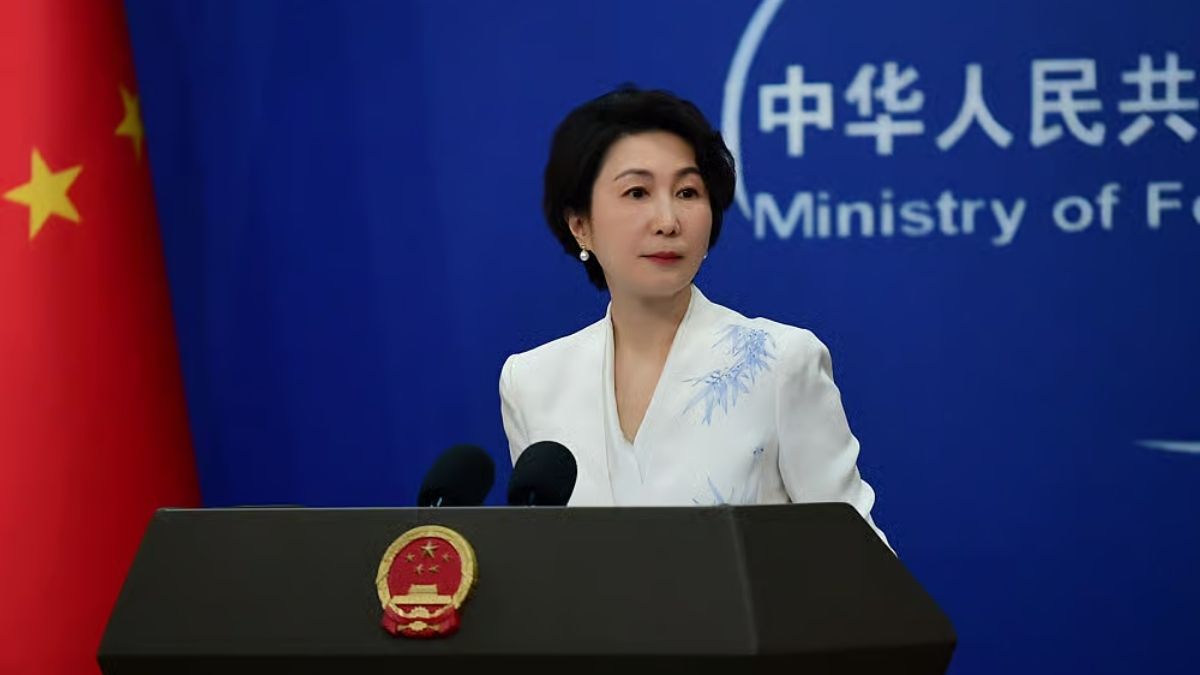
China has firmly rejected India’s claim over the Shaksgam Valley in Jammu and Kashmir. Speaking on Monday, Chinese Foreign Ministry spokesperson Mao Ning said the area belongs to China, ANI reported. In a media briefing, Mao Ning dismissed India’s concerns, saying China’s construction and infrastructure work there is “beyond reproach.”
China rejects India’s claim, cites Pakistan deal
During the briefing, Mao Ning was asked about India’s position. The question raised concern, stating: “Shaksgam Valley is an Indian territory and India has never recognised the China-Pakistan boundary agreement signed in 1963 and has consistently maintained that the agreement is illegal and invalid. Critics also say that China is trying to seek to validate its hold on the area with investments. What’s China’s comment and response to this?”
Mao Ning responded: “The territory you mentioned belongs to China. It’s fully justified for China to conduct infrastructure construction on its own territory.”
She added that China and Pakistan had already settled the matter decades ago. According to her, the two countries signed a boundary agreement in the 1960s and clearly marked their borders. Mao said this agreement was a lawful decision taken by two independent and sovereign nations.
Referring to a report by the Global Times, Mao Ning said the China-Pakistan Economic Corridor is meant to help people living in the region. She described CPEC as an economic project designed to boost local development and improve livelihoods.
Mao also made it clear that both the China-Pakistan boundary agreement and the CPEC do not change China’s stance on Kashmir. She said China’s position on the issue remains exactly the same as before. “The China-Pakistan boundary agreement and CPEC do not affect China’s position on the Kashmir issue, and the position remains unchanged.”
India’s response over the Shaksgam Valley dispute
The Shaksgam Valley lies in a sensitive yet very disputed region. It borders China’s Xinjiang province to the north, Pakistan-occupied Jammu and Kashmir (POJK) to the south and west, and the Siachen Glacier area to the east. Because of its location, the valley has long been a point of disagreement between India, China, and Pakistan.
India had earlier rejected China’s infrastructure work in the Shaksgam Valley. On January 9, New Delhi called China’s activities through the CPEC “illegal and invalid” and said the valley is an inseparable part of India.
At a weekly press briefing, Ministry of External Affairs spokesperson Randhir Jaiswal said India has never accepted the 1963 China-Pakistan boundary agreement or the CPEC project.
He said, “Shaksgam Valley is an Indian territory. We have never recognised the so-called China-Pakistan boundary agreement of 1963. We have consistently maintained that the agreement is illegal and invalid. We do not recognise the so-called China-Pakistan Economic Corridor either, which passes through Indian territory, which is under forcible and illegal occupation of Pakistan.”
Jaiswal also repeated India’s position that Jammu and Kashmir and Ladakh are integral parts of the country. He said India has raised objections with China many times and will continue to protect its interests.
He added, “The entire UTs of J&K and Ladakh are an integral and inalienable part of India. This has been clearly conveyed to the Chinese and Pakistani authorities several times. We have consistently protested with the Chinese side for its attempts to alter the ground reality in the Shaksgam Valley. We further reserve the right to take necessary measures to safeguard our interests.”