



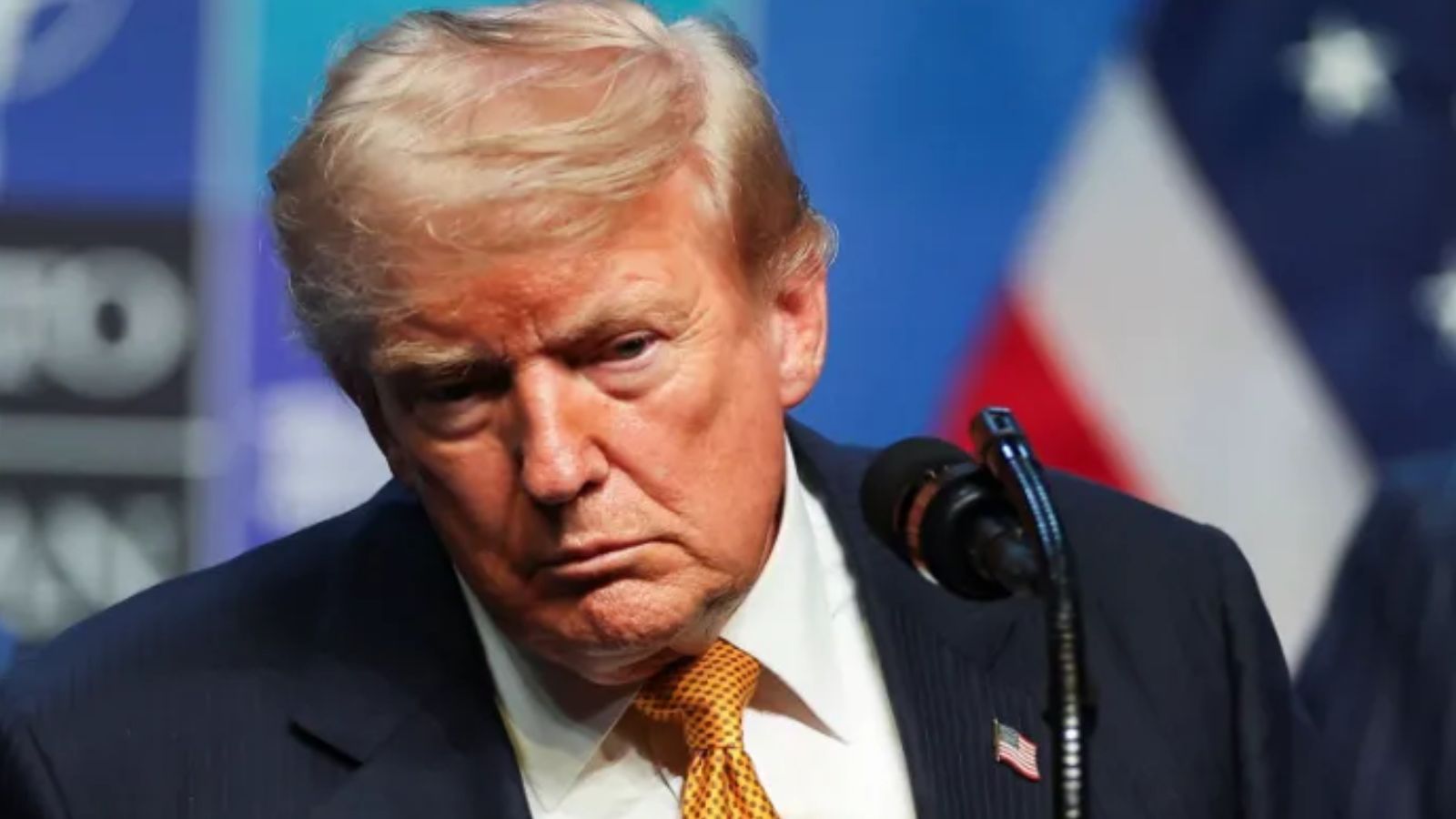
Trump on Monday said the United States will act as the “guardian” of the Strait of Hormuz, one of the world’s most important oil shipping routes. But this time, he says America should not do it for free.
Instead, Trump wants wealthy Gulf countries to pay the US for protecting ships passing through the strategic waterway. His comments came as the US launched fresh strikes on Iran, further raising tensions in the region.
Trump says Gulf countries should pay
Speaking from the Oval Office and later on social media, Trump announced a major change in US policy. He said the US would restore a naval blockade on Iranian ports while allowing other countries to continue using the Strait of Hormuz. In return, those using the route would have to pay for the security provided by the US.
Trump proposed a 20% reimbursement on the value of cargo being shipped through the strait to cover America’s security costs.
He specifically named Saudi Arabia, Qatar, the United Arab Emirates, Kuwait and Bahrain, saying these wealthy Gulf nations should contribute because they benefit the most from the waterway remaining open.
“Yeah, I want to be reimbursed because we’re protecting a very rich portion of the world, we’re spending money, and so what we’ve done is we are going to be reimbursed for protection,” Trump said. He added, “We guarded the strait for 50 years, and we never got paid for it.”
A more transactional US policy
Although Gulf nations depend heavily on the Strait of Hormuz for oil exports, they are reportedly uncomfortable with Trump’s proposal. Experts say charging ships to pass through international waters could go against international maritime rules and may create tensions with US allies. Some diplomats have reportedly shown no support for the idea.
The Strait of Hormuz connects the Persian Gulf with the Gulf of Oman and is the main route used by oil exporters such as Saudi Arabia, Iraq, the UAE, Kuwait and Iran.
Around 20% of the world’s oil trade passes through this narrow waterway. Any disruption there quickly affects global energy markets. Recent attacks on tankers have already increased shipping insurance costs and pushed oil prices higher.
Trump officially tells Congress fighting has resumed
Trump’s comments came hours after Trump formally informed Congress that military operations against Iran have restarted.
His decision came despite growing pressure from lawmakers, who have asked him either to end the conflict or seek Congress’ approval before continuing military action.
In a letter sent to Congress on Friday and made public on Monday, Trump said US forces had resumed strikes on July 7, 2026, targeting missile launch sites, air defence systems, military maritime assets, military infrastructure and command-and-control facilities inside Iran.
The Trump administration said the strikes were launched after Iran violated a fragile ceasefire and carried out attacks in the region, including strikes on commercial tankers. On the other hand, Iran has rejected Trump’s proposal and strongly opposed any attempt by the US to control or charge for passage through the Strait of Hormuz. Tehran has made it clear that it does not accept foreign oversight of the waterway.
Oil prices jump to one-month high
Oil prices climbed about 2% on Tuesday, reaching their highest level in nearly a month, as fresh fighting between the United States and Iran raised concerns over global energy supplies through the Strait of Hormuz. Brent crude futures rose $1.68, or 2%, to $84.98 a barrel by 0051 GMT.
US West Texas Intermediate (WTI) crude also gained $1.65, or 2.1%, to $79.79 a barrel. The rally follows Monday’s sharp surge, when Brent crude jumped 9.6%, its biggest single-day rise since May 2020, according to Reuters.
Oil prices are now at their highest level since the US and Iran signed a memorandum of understanding on June 17 that was meant to end the war.
Trump says ceasefire ‘doesn’t mean much’
Trump appeared to downplay the importance of the ceasefire that his administration had earlier described as a “historic breakthrough.” In a radio interview, he said such agreements were never very meaningful.
“They don’t mean much,” Trump said, referring to the memorandum of understanding that formed the basis of the ceasefire. He later claimed the agreement had simply been “sort of a test” for Iran.
“These people are crazy,” Trump said. “We had a deal where we won everything, and they basically break the deal. You know, they make deals; to them, deals are made to be broken. They are extremely unreliable people.”
Along with restarting military operations, Trump announced that the US would once again enforce a naval blockade around Iranian ports.
He also declared that ships passing through the Strait of Hormuz would have to pay the United States for security.
Trump blames Iran for years of failed negotiations
Trump also used the opportunity to criticise Iran’s leadership and accused Tehran of delaying negotiations for decades. Speaking about recent talks, he said the two sides had almost reached an agreement before Iran backed away.
“We had a deal with them (Iran) 2 days ago, and then they said, ‘Oh, we can’t make that deal. We have to negotiate it further.’ And this is what they’ve done for 47 years,” Trump said.
He added, “The difference is nobody negotiated like I do… Frankly, it’s 47 years they’ve been ripping off everybody and really hurt again, killing thousands of people.”
Trump also referred to Iran’s handling of anti-government protests, claiming the country “killed 52,000 protesters.”
Trump defends killing of Soleimani
The US President also spoke about the 2020 killing of Iranian General Qasem Soleimani, who headed Iran’s Quds Force. Trump defended the decision, saying Soleimani was planning attacks against US forces.
“Soleimani killed many people… He was a person that was an evil genius. He was looking to take out a lot of our military installations in Iraq and Iran. And I got him before he got us,” Trump said.
“We have to do what we’re doing.”