



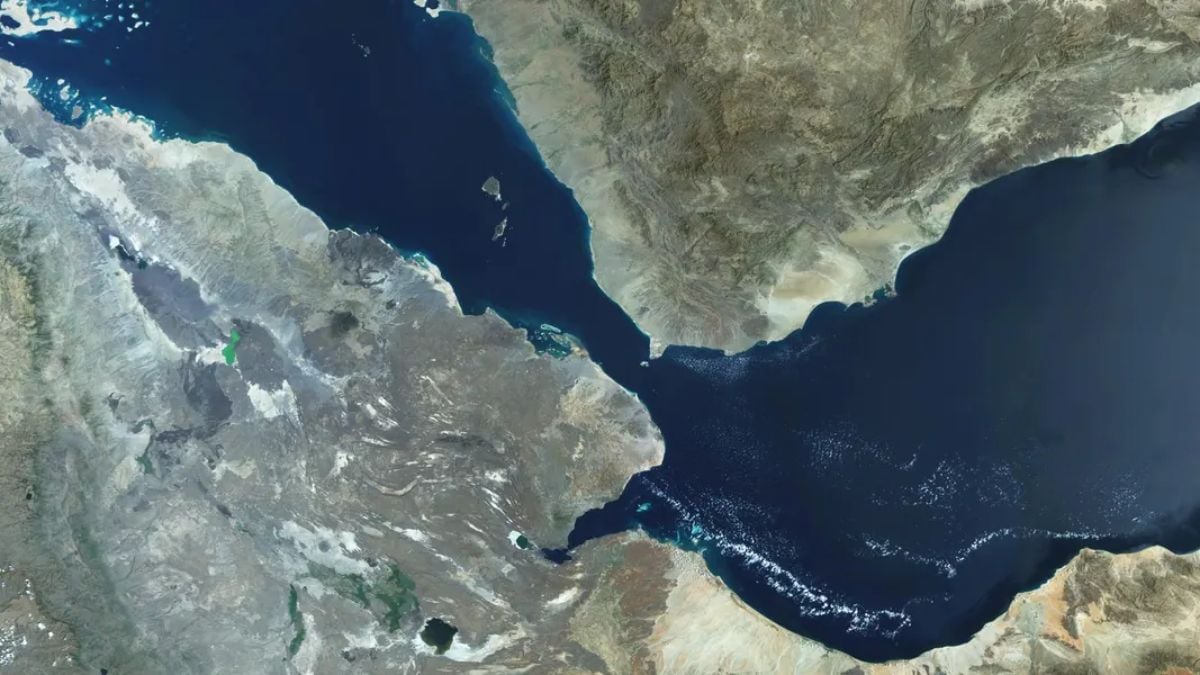
As tensions around the Strait continue to rise, attention is shifting to another chokepoint, the Bab al-Mandeb. After talks with Iran collapsed in Pakistan, US President Donald Trump made a move that could change the course of the conflict. He said the US military would blockade the Strait of Hormuz, a narrow but critical route for global oil.
However, Iran has hinted that if the US moves ahead with blocking Hormuz, it could respond by turning to the Bab al-Mandeb. Known as the “Gate of Tears,” this narrow stretch connects the Red Sea to the Gulf of Aden. Around 12% of the world’s oil passes through it, making it a key route between Asia and Europe. Any disruption here could quickly ripple across global trade.
Iran’s message: disruption can happen ‘with a single move’
Ali Akbar Velayati, a senior aide to Iran’s Supreme Leader, said the “Resistance front” now views the Bab al-Mandeb the same way it sees the Strait of Hormuz.” He warned: if the White House repeats what he called past “foolish mistakes,” it could disrupt global energy flows and trade with a single move.
The Bab al-Mandeb is not just another shipping lane. It’s one of the world’s busiest trade routes, linking Asia to Europe. If that gets hit at the same time as Hormuz, the impact could be massive, not just on oil, but on global trade as a whole.
Mona Yacoubian, director and senior adviser at the Middle East Program, speaking to Fox News Digital, said the situation could widen quickly if the US goes ahead with its plan. “If the US proceeds with its plan to blockade the strait, Iran’s escalation strategy could dictate that it ensures Gulf countries can’t export, either.” She added, “This could translate to further attacks on Gulf energy infrastructure or even deploying the Houthis to blockade the Bab al-Mandeb.”
How Iran could respond
Experts, according to Fox News, say Iran may not act alone. Mona Yacoubian, a senior adviser at the Centre for Strategic and International Studies, said Tehran could turn to its allies in the region, especially the Houthis in Yemen. “If the US proceeds with its plan to blockade the strait, Iran’s escalation strategy could dictate that it ensures Gulf countries can’t export, either,” she told Fox News.
She explained that this could mean attacks on energy infrastructure in Gulf countries or even attempts to block Bab al-Mandeb itself using Houthi forces. “This could translate to further attacks on Gulf energy infrastructure or even deploying the Houthis to blockade the Bab al-Mandeb,” she added.
Growing threat in the Red Sea
The risk around Bab al-Mandeb is not new, but it is growing. Back in March, the US had already warned ships in the Red Sea about possible attacks by the Houthis. According to a maritime advisory, the threats are wide-ranging. “Potential hostile actions include one-way unmanned aerial vehicle (UAV) attacks; unmanned surface vehicle (USV) attacks; unmanned underwater vehicle (UUV) attacks; ballistic and cruise missile attacks; small arms fire from small boats; explosive boat attacks; and illegal boardings, detentions, and/or seizures,” the advisory said.
US blockade plan moves ahead
Meanwhile, Washington is pushing forward with its own plan. US Central Command has said the naval blockade will begin Monday. It will apply to ships of all countries that are entering or leaving Iranian ports, including those along the Arabian Gulf and the Gulf of Oman.
Just hours after negotiations broke down, Trump said the Navy would begin the blockade. He added that US forces would “seek and interdict” ships that had paid Iran to pass through the strait and would start clearing sea mines from the area.
He also issued a blunt warning: any Iranian forces targeting US troops or commercial ships would be “BLOWN TO HELL.” On paper, the US has the power to pull this off. “It’s certainly well within the capacity of the forces that are there to mount a blockade,” Bryan Clark, a former naval officer, told WSJ.
But he also pointed to the real challenge. “Now, if Iran starts shooting at them or shooting at people that are operating these systems, then obviously it gets more difficult… You have to protect them with ships.” In other words, starting a blockade is one thing. Holding it in a tense, hostile environment is another.
On the other hand, even after weeks of strikes, Iran is far from out of options. The country’s Revolutionary Guard still has a large number of fast attack boats, more than 60% of them are believed to be intact. These small, quick vessels are often used to control parts of the strait.
That means US ships will not just be dealing with open waters, but with constant, close-range threats, from drones, mines and small boats.