



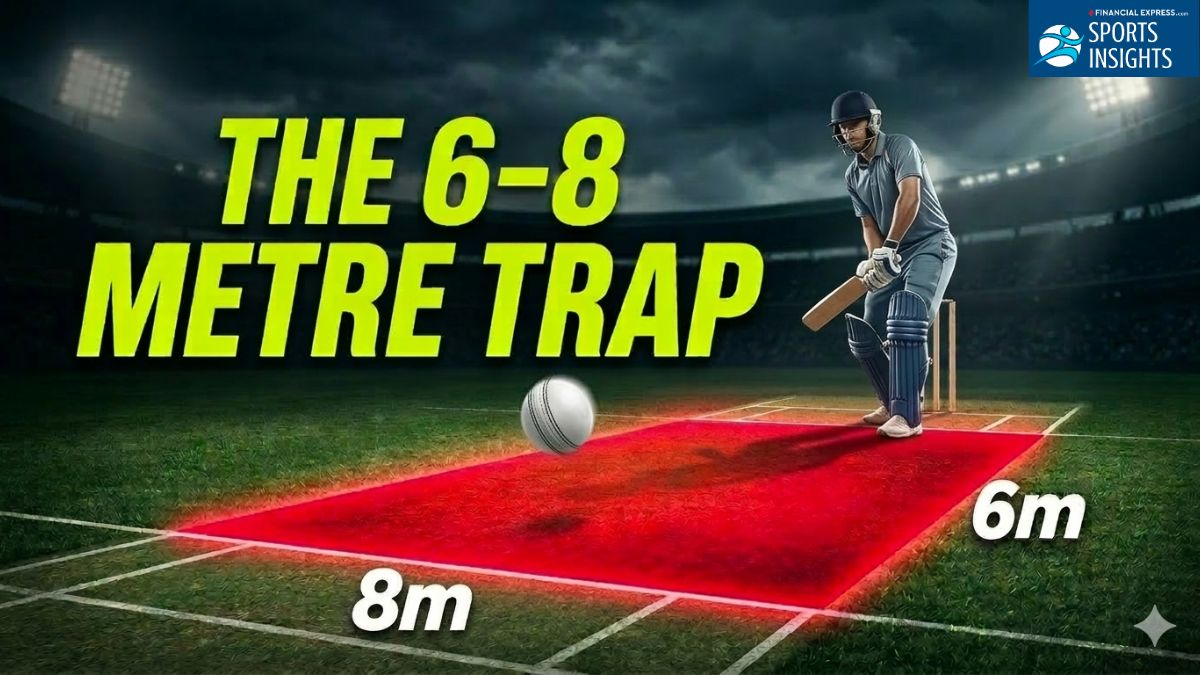
The stadium lights hum. The bowler starts his run-up. The batter sets himself deep in the crease, bat tapping, eyes locked. And then it happens.
The ball pitches somewhere between six and eight metres from the stumps. Not full enough to drive. Not short enough to pull. Just… there. Hanging in that cruel middle ground where physics meets panic.
This is the hard length. And it is eating T20 cricket alive.
What exactly is this beast?
For years we talked about the “good length” like it was one thing. Pitch it up, they said. Make them play. But T20 changed the rules. In Test cricket, that same length tempts the edge. In T20, it invites something worse: confusion.
| Length | Distance (m) | What the Batter Does | The Result |
| Yorker | 0 – 2 | Digs it out | Great if you hit it; a six if you miss. |
| Full | 2 – 6 | Drives it | Easy boundaries. |
| Hard Length | 6 – 8 | Freezes | Panic, mistimed hits, caught in the circle. |
| Short | 8 – 10 | Pulls/Cuts | High risk for both. |
The 6-8 metre zone sits at the edge of a batter’s reach. Commit forward and the ball might bounce over your bat. Stay back and it might skid into your pads. Either way, you are late. You are hurried. You are human.
Anrich Nortje knows this. In the 2024 World Cup at Nassau County, he bowled four overs for seven runs and took four wickets. Seven runs. Nortje made world-class batters look like they had never held a bat before. Kusal Mendis. Angelo Mathews. Big names. Small answers.
The ball kept landing in that six-metre corridor. Hitting the deck at 150 clicks. Bouncing steep. Giving the batter maybe 400 milliseconds to decide what to do with their life.
The Science of being late
Here is what happens inside a batter’s head. The ball leaves the bowler’s hand. For the first 200 milliseconds, the batter is just watching. Picking up trajectory. Calculating speed. This is the visual window. If the ball is full, the body commits forward. If it is short, the weight shifts back.
But the hard length? It breaks this system.
The ball lands. It bounces higher than a full ball would. Lower than a short ball should. The batter’s brain freezes. Forward or back? The feet do nothing for a split second. And in that split second, the ball is upon you.
Modern bats do not help. They have sweet spots high on the blade, built for power hitting. But the hard length brings the ball to your shoulder, your splice, your edge. The bat makers built weapons for war. The hard length is guerrilla warfare.
Jasprit Bumrah understands this better than anyone. His release point is nearly half a metre forward compared to other fast bowlers. The ball gets to you quicker. A 140 kph delivery feels like 145. Combine that with the six-metre length and the batter has no time. None.
Bumrah’s economy rate in the 2024 World Cup was 4.17 and in latest 2026 T20 World Cup is 6.21. In an era where teams chase 250, this is not just good. This is impossible.
Why the yorker lost its crown
For the longest time, we believed the yorker was king. Pitch it at the toes. Stop the boundary. Win the match. But here is the dirty secret: bowlers miss. Even the great ones.
A missed yorker becomes a low full toss. And a low full toss in modern T20 is a gift. Bats with edges like shovels send these balls into the third tier. The statistics are brutal. A perfect yorker costs you about five runs per over. A failed yorker costs eleven. Or more.
Chris Jordan was once a yorker hunter. He spent years trying to land that perfect ball at the death. Then he stopped. He started hitting the deck hard instead. Six metres. Eight metres.
Let the pitch do the work. His career turned around in franchise cricket. The hard length does not punish mistakes like the yorker does. Miss your length by a metre and you have bowled a back-of-a-length ball. Still hard to hit. Still useful.
This is the risk-reward math that coaches now teach in team meetings. Do not chase perfection. Chase consistency. Let the batter make the mistake.
The kid who learnt to fight back
Abhishek Sharma almost died against this length. In IPL 2024, he averaged 10.3 against the 6-8 metre zone. His strike rate was 87. He was supposed to be a future star. Instead he was a target.
Then he changed. Between IPL 2024 and the 2025 series against England, Sharma rebuilt himself. Two moves. First, he started charging down the pitch. Meet the ball before it bounces. Turn the hard length into a half-volley. Drive it.
Second, and more important, he went deeper. Moved his back foot further back in the crease. Bought himself time. Now when the ball landed at seven metres, he was meeting it at his hip, not his shoulder. He could pull. He could cut. He had turned the trap into an opportunity.
Against Bangladesh and England in 2025, his average on the hard length jumped to 36.5. His strike rate exploded to 235.5. This is what adaptation looks like. This is the battle that never ends.
The grounds that lie
Not all six-metre balls are equal. At the Melbourne Cricket Ground, the square boundaries stretch to 90 metres. Bowlers love this. They pitch it up at six metres, force the batter to hit square, and watch the ball die in the deep.
On small grounds, the hard length changes its nature. The batter knows he can clear the boundary even from an awkward position. So the bowler must be straighter. Must cramp him for room. The battle shifts but it remains the same battle.
The pitch matters too. On a hard surface with black soil, the ball bounces true. The bowler can trust his length. On a tired pitch, the ball might skid. Might keep low. The six-metre ball becomes an lbw candidate. The batter plays for bounce that never comes.
The future of this fight
Bats will get bigger. Batters will get stronger. They will shuffle across the stumps, back away to leg, invent new shots we cannot yet imagine. But the physics will not change. The 6-8 metre zone will still sit at the edge of human reaction time. It will still force decisions faster than decisions can be made.
This is not about magic. It is about math and muscle and the willingness to be boring in the most exciting format of the game. While everyone chases the perfect yorker, the smart ones have found something better. A length that cannot be hit. A length that waits. A length that wins.
The hard length is not a trend. It is the new foundation. And the batters are still figuring out if they can build on it, or if it will bury them.