



Rishabh Pant is standing at the non-striker’s end. The scoreboard shows seven runs. He has faced nine balls. The opponent is his former team Delhi Capitals, someone who knows his weaknesses perhaps better than Pant knows them himself.
The camera zooms in. Pant’s eyes look somewhere else entirely. Not at the bowler. Not at the field. Somewhere beyond the boundary rope, beyond the stadium lights, beyond the twenty seven crore rupees that hang around his neck like a garland of stones.
This is not the same boy who once hit 128 not out against Sunrisers Hyderabad and made the bowling attack look like they were throwing underarm. That boy did not calculate. He just hit. That boy did not carry the weight of a franchise’s expectations on his shoulders. He just played.
The Boy Who Used to Fly
There was a time when Pant batted like he was late for a train. 2018 was that year. 684 runs. Strike rate of 173. Sixty three balls for that 128* inning. He was twenty years old and playing like he had nothing to lose because he genuinely had nothing to lose.
Delhi Capitals was a young team finding its feet. Pant was the spark plug, not the engine. He came in at number four or five and just exploded. No one told him to play sensible. No one told him to anchor. The coaches just watched and shook their heads and smiled.
Back then his scoring map looked like a child’s drawing. Square leg was his best friend. Midwicket was his cousin. He did not drive down the ground because he did not need to. Bowlers tried to bowl outside off stump and he just shuffled across and flicked them over fine leg.
It was not textbook. It was better than textbook. It was Pantbook.
The numbers from that year tell only half the story. The other half is in the memories of people who watched him. The way he walked out to bat. The way he looked at the bowler like the bowler owed him money. The way he celebrated centuries by just raising his bat slightly, as if to say “this is normal for me.”
The Arithmetic of Destruction
Then came the injuries. Then came the captaincy at Delhi. Then came the accident on that highway in 2022. And then came the auction.
Twenty seven crore. The highest any player has ever fetched in the IPL. Lucknow Super Giants put that number on the table and suddenly Pant was not just a wicketkeeper batsman.
He was the answer to every question LSG had. Captain? Yes. Middle order anchor? Yes. Finisher? Yes. Wicketkeeper? Yes. Face of the franchise? Yes.
But here is the thing about twenty seven crore. It does not just buy you a player. It buys you the right to demand. It buys you the right to question. It buys you the right to stand at the boundary rope after a loss and have an animated conversation with the captain while cameras roll and Twitter explodes.
Pant’s first season at LSG was a study in confusion. He scored a hundred against RCB in the last league match. 118 not out. People said see, he is back. But they forgot to look at the fourteen other innings. The average of 24. The strike rate that had dropped to 133.
The way he started getting stuck in the middle overs against spin, unable to rotate strike, then trying to hit his way out and holing out to deep midwicket.
CricViz data shows his attacking shot percentage dropped to 56 percent in 2025. That is a polite way of saying he stopped being Pant. He started being some other batsman.
Some batsman who thinks about risk percentage and match situations and franchise value. Some batsman who calculates when he should calculate and forgets that his entire gift was that he never calculated.
The Goenka Shadow
Sanjiv Goenka does not own a cricket team. He owns an asset that happens to play cricket. This is not a criticism. This is just how the IPL works now. But the difference between Goenka and other owners is that Goenka stands at the boundary and shows his emotions.
After the first match of 2026, which LSG lost to Delhi, television cameras caught him talking to Pant and coach Justin Langer. The body language was not that of a conversation. It was that of a performance review.
LSG later released an unfiltered video showing Goenka laughing with Pant. Fans called it PR. Fans called it staged. Maybe it was. Maybe it was not. But the damage was done. The image of the twenty seven crore captain being publicly questioned by his boss was set in stone.
This matters because Pant is not MS Dhoni. Dhoni could handle the owner pressure because Dhoni was Dhoni. He had won World Cups. He had seen everything. Pant is twenty-eight years old.
He is still figuring out how to be a captain. He is still figuring out how to bat with that price tag around his neck. And now he has to figure out how to smile for the cameras while his boss tells him what he is doing wrong.
The comparison everyone makes is to KL Rahul. Rahul was the previous LSG captain. Rahul also faced the Goenka treatment. Rahul left. Now Pant is getting the same treatment.
The fans have a name for it. They call it the belt treatment. As in, the owner takes out a belt and whips the captain after every loss. It is a joke. But jokes sometimes tell the truth better than serious analysis.
The Opening Gamble
Justin Langer is an Australian. Australians believe in hard solutions. If something is broken, fix it with force. So Langer decided to open with Pant in the 2026 season. The logic was simple. Powerplay field restrictions. New ball coming on. Pant likes to hit early. Let him hit early.
Pant walked out to open against Delhi. His old team. His old home. He made seven runs. He got run out in a freak dismissal where the ball deflected off the bowler’s hand onto the stumps. Sometimes cricket gods send you signs. This was a sign. Opening is not for Pant.
In match ten against Hyderabad, Pant came at no.3 and made 68 not out and won the match. Then he made 10 against Kolkata. Then 18 against Gujarat. Then 1 against RCB.
R Ashwin said on his podcast that not opening with Pant would be Langer’s biggest blunder. Ashwin is Pant’s friend. Ashwin wants Pant to succeed. But Ashwin also knows that Pant at his best is a number three or four batsman who comes in when the spinners are on and destroys them.
Pant against fast bowlers at the top is a different animal. He is more careful. He respects the new ball. He forgets that he is Rishabh Pant.
April 15, 2026. Chinnaswamy Stadium. Bangalore. Josh Hazlewood is bowling the fifth over. Short ball. 145 kilometers per hour.
Pant tries to pull. He is late. The ball hits him on the left elbow. The bony part. The part that bends when you grip the bat. The part that absorbs shock when you collect the ball behind the stumps.
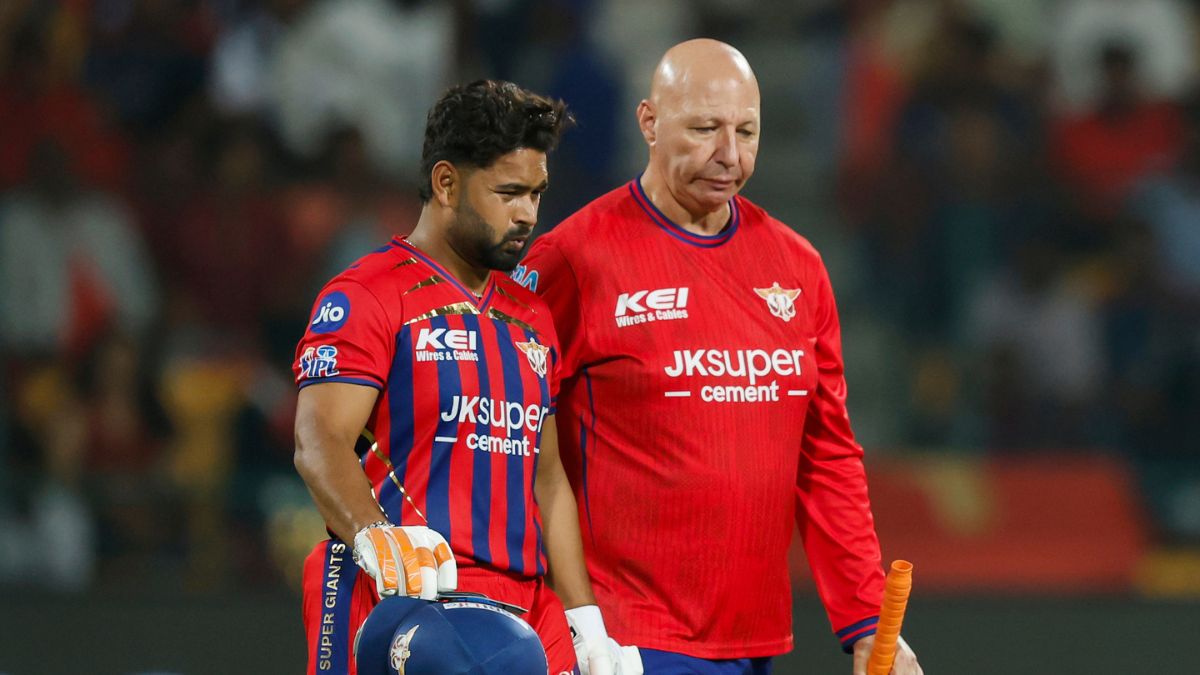
Pant goes down. He clutches his arm. His face contorts. Not the face of a man in pain. The face of a man who knows this is serious. The physio runs out. Patrick Farhart. Farhart has seen everything in Indian cricket. If Farhart looks worried, you know it is bad.
Pant leaves the field. Retired hurt. Zero runs. Three balls. LSG collapse to 146 all out. Pant comes back to bat in the sixteenth over because the team is falling apart. He bats with one arm. Literally one arm.
He cannot extend his left elbow. He manages one run off six balls. Caught behind. He cannot keep wickets in the second innings. Nicholas Pooran takes over. RCB chase the target in 15 overs.
The next morning, the scans are pending. The swelling needs to reduce. But everyone knows. A wicketkeeper with a damaged elbow is like a singer with a damaged throat. The season might be over. And Pant is holding his elbow and wondering when it all went wrong.
The Test Match Paradox
Here is the cruel joke. While Pant struggles in the IPL, he is breaking records in Test cricket. He averages 42 in Tests. He has eight centuries. He is chasing Adam Gilchrist’s records. In the longest format, where patience is supposed to be everything, Pant is outlier.
But in T20, where attack is supposed to be everything, he defends. He waits. He gets stuck. The same batsman. The same wrists. The same bat speed. Different results.
Fans on social media have noticed this. They say he throws everything at the ball in T20s. They say he has lost the joy. They say the IPL has made him corporate. They say he needs to go back to being the happy go lucky boy from Delhi.
Maybe they are right. Maybe the problem is not technical. Maybe the problem is that twenty seven crore buys you the player but kills the boy. Maybe captaincy gives you power but steals your freedom. Maybe the Goenka meetings make you careful when you should be carefree.
The Way Back
There is a solution. It is not complicated. It just requires courage. The courage to admit that making Pant captain was a mistake. The courage to tell Goenka to stay away from the boundary rope.
The courage to let Pant bat at number four and fail if he must, but fail while trying to hit sixes, not while trying to rotate strike.
Wasim Jaffer says Pant needs to hit straight. Down the ground. Over mid off. Stop trying to flick everything to square leg. The field is set there now. Everyone knows his pattern. He is predictable. The magic was in his unpredictability.
The elbow will heal or it will not. That is biology. But the mind can heal faster. Pant needs to stop calculating. He needs to stop justifying his price tag. He needs to remember that the twenty seven crore was paid for the batsman he was, not the batsman he is trying to become.
He is 28 years old. He survived a car crash. He can survive this. But survival is not enough. He needs to fly again. Not for LSG. Not for Goenka. Not for the twenty seven crore. For himself. For the boy who used to bat like he was late for a train.
The season is slipping away. The playoffs look distant. The elbow throbs. But somewhere in that dressing room, there is still a batsman who can hit 128 not out and make it look easy. The question is whether he can find that boy again, or whether the man with the price tag has buried him too deep.
Safe was never his game. Safe is for other players. Pant was always dangerous. The only question left is whether he can be dangerous again.