



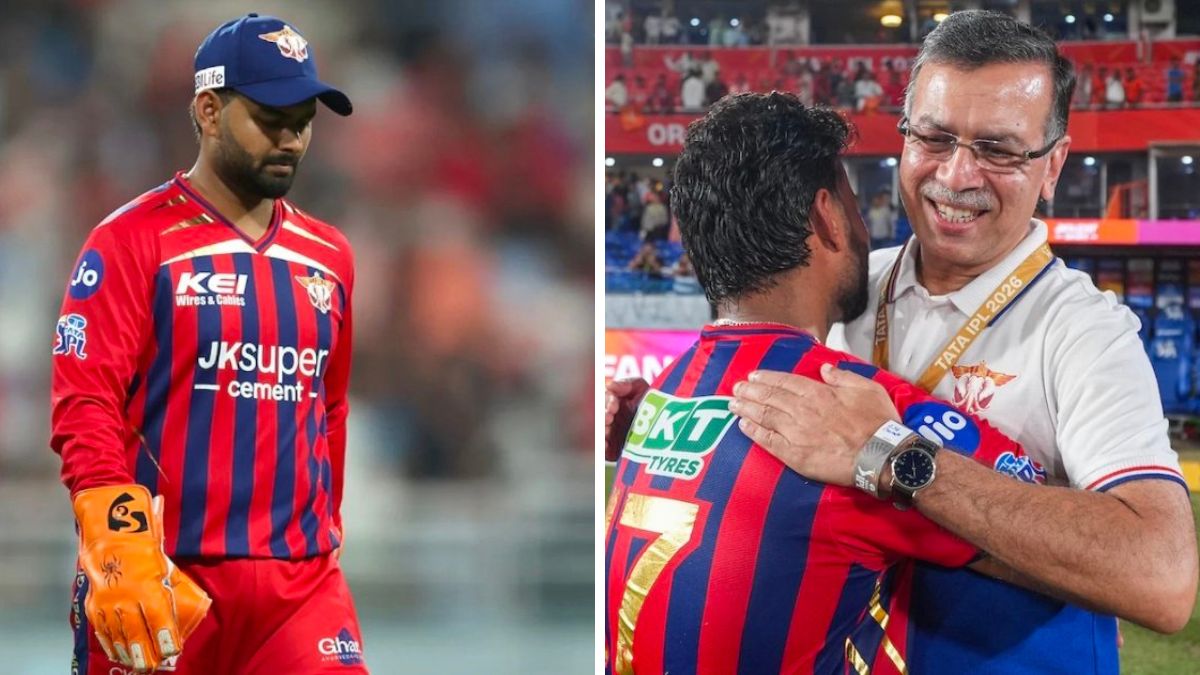
There was a time when Rishabh Pant was seen saying, “Thank God it was not Punjab,” when asked if he feared being in any other team after Lucknow Super Giants (LSG) rolled out ₹27 crore to buy him in the IPL mega auction of 2025. During that same interview, owner of the LSG, Sanjiv Goenka, was seen calling it a masterstroke that he got Pant for ₹27 crore.
Cut to May 2026 and in just a year and a half and two seasons of the IPL, Pant has resigned, Goenka is nowhere to be seen and is being mocked by his brother-in-law and inaugural IPL commissioner Lalit Modi, sitting in England. The entire air out of that ₹27 crore balloon has been sucked out, and no PR campaign can bring that back in. Maybe a new balloon can, but the Return on Investment (ROI) on propping just this one is too heavy for the franchise to go on making it about a single personality every season now.
For a franchise heavily driven by metrics, data, and ROI, the final numbers on Pant’s ledger are a brutal reality check.
The Raw Numbers: The Multi-Crore Slump
To fully comprehend the depth of this financial miscalculation, we must look at the exact output Pant delivered over his 28-match tenure.
Rishabh Pant’s Two-Season Record at LSG
| Season | Matches | Runs Scored | Average | Strike Rate | Centuries / Fifties | Team Standings |
| IPL 2025 | 14 | 269 | 24.45 | 133.17 | 1 / 0 | 7th Place |
| IPL 2026 | 14 | 312 | 28.36 | 138.05 | 0 / 1 | 10th Place (Last) |
| Total Ledger | 28 | 581 | 26.40 | 135.74 | 1 / 1 | Playoff Drought |
The Math: Calculating the Per-Run Price
In the corporate-led structure of modern sports franchises, marquee contracts are evaluated by translating total salary into hard performance metrics. Pant’s ₹27 crore per-season contract means LSG shelled out a total of ₹54 crore across his two-year stint.
Player Cost= 27 crore x2= 54,00,00,000
Total runs scored by Pant in two seasons=581
LSG paid Rishabh Pant= Player Cost divided by Totals Runs= 54 crore ÷ 581= Rs 9.92 Lakh
Lucknow Super Giants paid an astonishing ₹9.29 lakh for every single run that came off Rishabh Pant’s bat.
To put this premium in perspective, a standard elite Indian international batter occupying a ₹15 crore retention slot who scores a reasonable 450 runs in a season costs a franchise roughly ₹3.33 lakh per run. LSG paid a 179% financial premium for Pant, only to receive lower aggregate runs and deteriorating strike rates compared to his prime years.
Deducing the Debacle: Why the Premium Failed
Paying nearly ₹10 lakh per run can only be justified if those runs translate into high-impact, match-winning tournament equity or severe brand dominance. Instead, the investment yielded a compounded net loss for three distinct reasons:
1. The Missing “Volume” and Isolated Spikes
A marquee anchor player must provide consistent volume. Pant faced just 428 balls across two entire seasons. Rather than anchoring the team, his ledger was defined by vast stretches of single-digit scores, punctuated by isolated, meaningless spikes. His lone century (an unbeaten 118 in 2025) came against RCB in a dead-rubber final league game when LSG’s playoff hopes were already dead.
2. Tactical Disarray and Coaching Friction
Marquee status is meant to bring structural stability. Instead, Pant’s presence triggered tactical chaos. In an effort to unlock his form, the management shuttled him across the order—using him as an opener, at No. 3, and demoting him down to No. 5.
This tactical disconnect reached its boiling point on Sunday, April 26, 2026, after a devastating Super Over loss to the Kolkata Knight Riders (KKR) at the Ekana Stadium. Following severe backlash for handing a critical final over to domestic spinner Digvesh Rathi, and experiencing clear dugout interference regarding batting choices in the Super Over, a visibly frustrated Pant openly fractured his relationship with management. Speaking directly to the broadcaster, he lamented:
“See, there are always times in cricket where you can change things a little… I was looking for a wicket. I just didn’t get one. That was the thought process behind it. And too many minds don’t make it easy on the ground.”
The explosive comment essentially threw a support staff packed with massive names—Justin Langer, Tom Moody, Lance Klusener, and Bharat Arun—under the bus, laying bare the deep cracks in the franchise.
3. Zero Leadership Dividend
When a franchise hands a player the highest contract in league history, they are buying a captaincy dividend—the ability to extract 120% value out of low-cost domestic players. Under Pant, LSG regressed severely. They went from a team that consistently qualified for the playoffs under KL Rahul to finishing 7th in 2025 and dead last (10th) in 2026, managing a dismal four wins all season.
The Weight of Dead Money: How Pant’s ₹54 Crore Froze LSG’s Roster and Compounded Their Collapse
From a financial perspective, Sanjiv Goenka’s ₹54 crore gamble resulted in complete capital erosion. Because the IPL operates under a rigid salary cap, locking up an unprecedented ₹27 crore per year in a single asset starves the rest of the squad of much-needed depth, leaving the team visually unbalanced and thin on domestic bowling resources.
By stepping down from the captaincy, Pant has essentially acknowledged that the burden of the ₹27 crore price tag was unsustainable for both himself and the roster. For LSG, the resignation is an embarrassing, high-profile corporate write-off, forcing Director of Cricket Tom Moody and the executive board to initiate a painful, total restructuring of their asset portfolio ahead of the next cycle.
Though Pant may not have given expected returns, the entire blame is not on him. Given that he has had success with Delhi Capitals and the Indian team, maybe what was needed was a looser hand from the owner, a better understanding from the coach, and harmony in the dressing room. All those faults have now been covered by the resignation tendered by the most expensive mistake. But will that be enough? One would have to wait for the next season for that.