



India’s emergence as a global chess powerhouse has produced world champions, Olympiad winners and teenage grandmasters. Yet beneath the country’s golden generation lies another reality: for every Dommaraju Gukesh or R Praggnanandhaa, there are dozens of talented youngsters whose biggest challenge isn’t beating opponents, it is paying tournament entry fees.
One such player is 15-year-old Sabarinathan Iyyappan, a FIDE-rated chess player from Tamil Nadu whose story was first reported by Sportstar. His father, Iyyappan, works as a construction labourer, earning around Rs 600-700 a day when work is available. Much of that income has gone into keeping his son’s chess ambitions alive.
“There was a point when I told my father that chess was costing us too much and I could stop,” Sabarinathan told Sportstar.
His father’s response has stayed with him ever since. “Play as long as I am alive. You can think about stopping after that.”
A familiar story behind India’s chess boom
India’s rise in world chess has largely been associated with elite academies, strong junior circuits and the influence of five-time world champion Viswanathan Anand.
But away from Chennai’s celebrated chess ecosystem, many talented youngsters still depend on personal sacrifice rather than institutional backing.
Sabarinathan, who studies in a government school in Nagapattinam district, discovered chess through his younger brother. Both wanted to compete professionally, but financial constraints meant only one child could continue travelling to tournaments.
The decision changed the course of the family. Today, Sabarinathan carries FIDE ratings of 1476 (classical) and 1450 (rapid) and has competed in several rated tournaments across India, including an international FIDE-rated event in Assam.
Each tournament, however, brings another financial calculation. Entry fees, travel expenses, accommodation and food often exceed what his father earns in an entire day.
When technology became a luxury
Before receiving outside support, Sabarinathan trained and even played online tournaments using his father’s ageing touchscreen mobile phone.
According to Sportstar, one promising online event slipped away when connectivity issues forced him out of contention despite being in a winning position.
His daily routine remains relentless. School ends in the evening, followed immediately by tuition classes before two more hours of online chess training every night.
Social media stepped in where the system didn’t
The family’s fortunes began changing after Mohamed Ashik, who runs the Instagram page A Broke College Kid, highlighted Sabarinathan’s story online.
The campaign led to donations that included an iPad, a professional chessboard and access to structured coaching under coach Balamurugan.
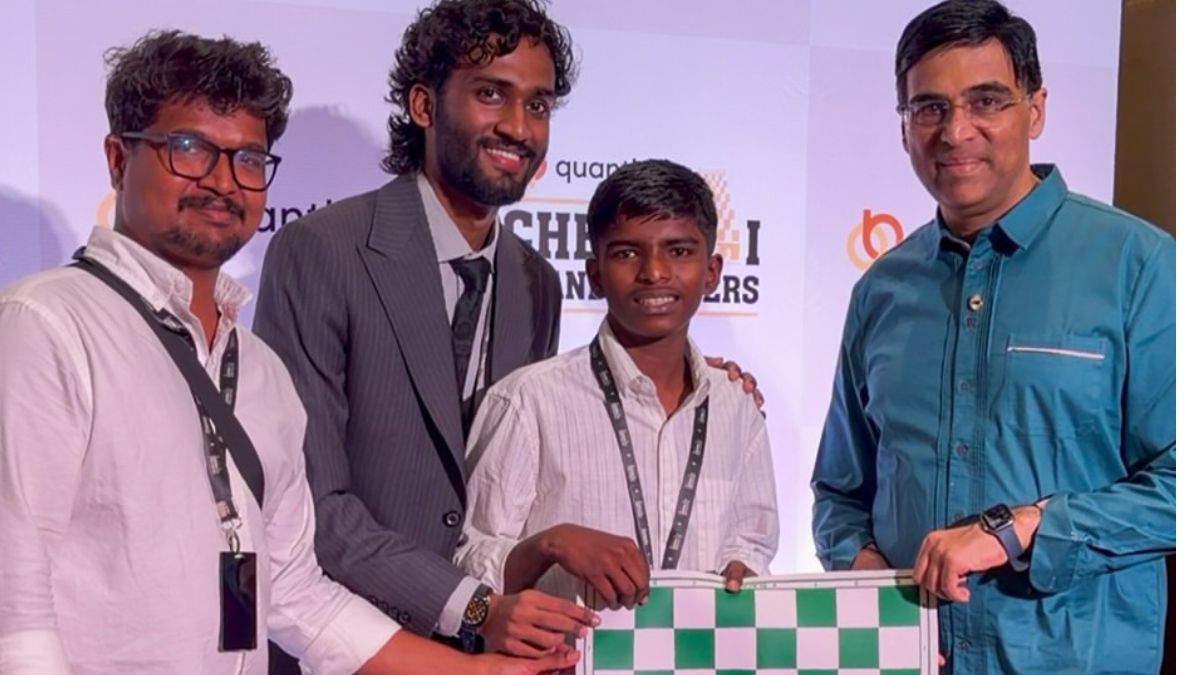
Chess content creator Suthershun, popularly known as GoofyGenChess, later gifted him a chessboard signed by Viswanathan Anand.
Ashik also arranged for Sabarinathan to attend the Chennai Grand Masters, where the teenager met Anand for the first time. For a player who had largely followed elite tournaments through limited internet access, it was a glimpse into the world he hopes to one day belong to.
The bigger challenge isn’t talent
One successful fundraiser cannot build a chess career. Competitive chess demands continuous investment—coaching, tournament exposure, travel and access to international competition.
That is why Sabarinathan’s family has appealed for structured support from the Sports Development Authority of Tamil Nadu (SDAT) and state authorities.
His father’s request remains modest. “I want chess and education for him together,” he told Sportstar. “If there is a school that can support both, that is all I ask.”
India’s next grandmaster?
India currently boasts one of the youngest and strongest chess talent pools in the world, led by players such as Gukesh, Praggnanandhaa, Arjun Erigaisi and Nihal Sarin.
Those names dominate headlines, but the country’s long-term success will depend just as much on players who have yet to receive sponsorships, federation backing or academy scholarships.
For Sabarinathan, every tournament is still a question of affordability before it becomes one of strategy. His father remains convinced the investment will eventually pay off.
“I believe my son can become a Grandmaster,” he told Sportstar.
Whether India discovers another elite chess player may depend less on talent than on whether promising youngsters like Sabarinathan receive sustained support before financial reality forces them away from the board.