



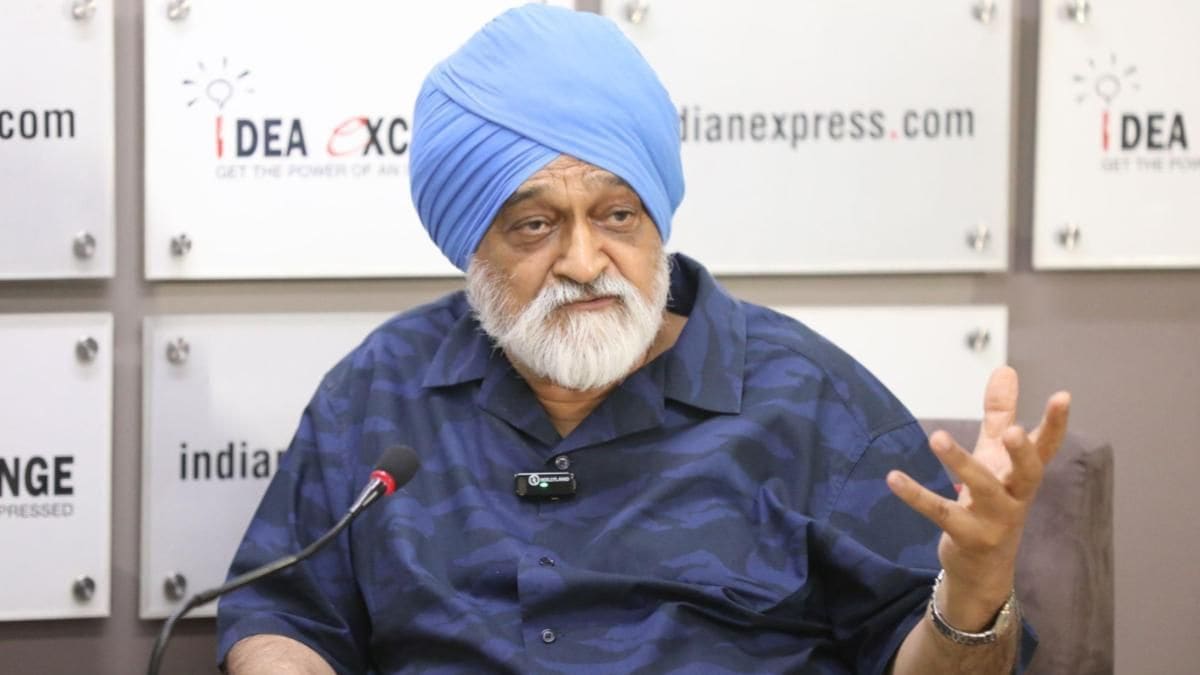
Former Planning Commission deputy chairman and economist Montek Singh Ahluwalia has warned that India should prepare for a period of elevated crude oil prices and possible supply constraints in critical sectors if the West Asia conflict does not ease soon.
Speaking at The Indian Express Idea Exchange, Ahluwalia said India would be “well advised” to work with the assumption that oil prices could remain “north of $100 per barrel” for the next few months, even as the eventual trajectory would depend heavily on the decisions taken by US President Donald Trump on Iran.
“I think we would be well advised to think that oil prices are going to be north of $100 per barrel, or maybe for the next four, five, six months, we don’t know,” Ahluwalia said.
The remarks come at a time when global crude markets have seen sharp swings on hopes of a possible de-escalation in the Iran conflict, even as traders continue to price in the risk of renewed supply disruptions. Brent crude has recently eased from earlier highs, but remains vulnerable to developments around the Strait of Hormuz, one of the world’s most important energy transit routes.
‘Trump has created uncertainty’
Ahluwalia said the uncertainty around the conflict had been amplified by the unpredictability of US decision-making.
“This is one of those areas where what happens depends critically on what President Trump decides,” he said. “He’s created a very special technique of generating uncertainty, in the sense that today people are not sure whether he’s going to unleash an aerial bombardment of Iran or declare victory.”
He said the crisis could settle quickly if the US were to “declare victory and move on”. However, if Washington was seeking “serious concessions” from Iran on its nuclear programme, the situation may not be resolved easily.
“If he’s actually trying to get serious concessions from Iran on their nuclear programme, I don’t think that’s going to be very easy. So this thing could drag on for a while,” Ahluwalia said.
Why this matters for India
For India, any prolonged period of high oil prices has direct macroeconomic implications. India remains dependent on imported crude oil, and higher crude prices typically feed into the import bill and inflation expectations.
Ahluwalia’s remarks fit into the broader macroeconomic risk that Sitharaman has flagged. For India, a prolonged West Asia crisis is not just a fuel price issue. It can affect the present situation of three linked pressure points: fuel, fertiliser and forex reserves
The immediate concern is not just petrol and diesel prices. A sustained West Asia disruption can affect LPG, LNG, fertilisers, petrochemicals and other inputs that are linked either to energy prices or supply chains passing through the Gulf.
Ahluwalia also flagged fertiliser and helium supplies as areas of concern.
“That also means for helium and fertiliser supplies, there will be a serious supply constraint,” he said. “And we should organise our lives on that basis, recognising that this kind of supply constraint in critical sectors will impact the growth.”
The third is foreign exchange. Higher crude and gold prices tend to widen India’s import bill and increase pressure on the rupee and reserves, making Sitharaman’s “forex” warning central to the government’s assessment of the crisis.
Fuel prices and growth trade-off
As per experts interviewed by Reuters, prolonged crude-linked shocks can complicate the government’s balancing act. Passing on higher prices to consumers risks stoking inflation and household stress. As per the Reuters report, in such a situation absorbing the shock through oil companies or tax cuts can strain public finances. Delayed pass-through, meanwhile, can hurt the balance sheets of state-run fuel retailers if high prices persist.
The policy challenge is sharper because India’s energy demand has continued to rise with economic activity, urbanisation, transport growth and industrial consumption. While India has diversified crude sourcing in recent years, a large part of its energy and fertiliser ecosystem remains exposed to developments in West Asia.
Government officials have repeatedly said India’s crude supply position remains secure and that procurement has been diversified across multiple geographies.
However, Ahluwalia’s warning points to a wider planning question: whether households, firms and policymakers should assume that the oil shock will be short-lived, or prepare for a longer phase of elevated prices and constrained supplies.
Fertiliser supply adds another layer
The fertiliser concern is particularly important for India because disruptions in imports or inputs can have a direct bearing on farm costs, subsidy requirements and food inflation. West Asia is a key region for fertiliser supplies and feedstock, including gas-linked inputs used in domestic fertiliser production.
As per experts interviewed by PTI, if supply constraints deepen ahead of key agricultural cycles, the government may have to intervene through higher procurement, inventory management or subsidy support. This could increase pressure on the fiscal side at a time when fuel-related pressures are already being watched closely.
Oil market remains hostage to geopolitics
The larger message from Ahluwalia’s comments is that energy markets are now being shaped slightly more by geopolitical uncertainty than by routine demand-supply calculations. Even when prices fall on ceasefire hopes, the risk premium can return quickly if shipping routes, Gulf exports or Iran-related talks deteriorate.
For India, that means the economic impact of the conflict cannot be measured only by the day-to-day Brent crude price. The bigger risk lies in the duration of uncertainty, its impact on supply chains and the possibility that firms and consumers may have to adjust spending, transport and production decisions if fuel and input costs remain elevated.
A consequence of the war’s impact on Indian consumer markets can also be seen via the rise in the prices of popular FMCG products. As Ahluwalia put it, India may have to “organise our lives” around the possibility that critical supplies remain constrained for several months.