




The ongoing West Asia war, which has escalated, has demonstrated that for a country, defence is not just a matter of policy, but economic and sovereign survival.
This is particularly true when you have combative neighbours. A robust defence posture dissuades hostile actors or countries from launching offensives or incursions.
Fortunately, India has been making sizeable investments in defence. From a once import-dependent nation for defence, today we have progressed some distance to becoming self-reliant or Aatmanirbhar.
The government has walked the talk on ‘Make in India’ as regards defence. The focus has moved from assembly to indigenous design and development. The key platforms include LCA Tejas, INS Vikrant aircraft carrier, Prachand helicopters, BrahMos missiles, Arjun MBT, and Akash system, with the support of the private sector.
L&T, Bharat Forge, Data Patterns, Paras Defence & Space Technologies, Premier Explosive, MTAR Technologies, and Solar Industries are some of the companies involved in the manufacture of defence equipment, as are the public sector ones such as Bharat Electronics, Bharat Dynamics, Mazagon Dock Shipbuilders, HAL and more.
Defence Public Sector Undertakings (DPSUs) and other PSUs account for approximately 77% of total production, while the private sector contributes 23%, according to the government.
India has recorded the highest-ever defence production of Rs 1.54 lakh crore in FY 2024 25, compared to Rs 46,429 crore in 2024-15.
India’s defence exports have increased nearly 34x
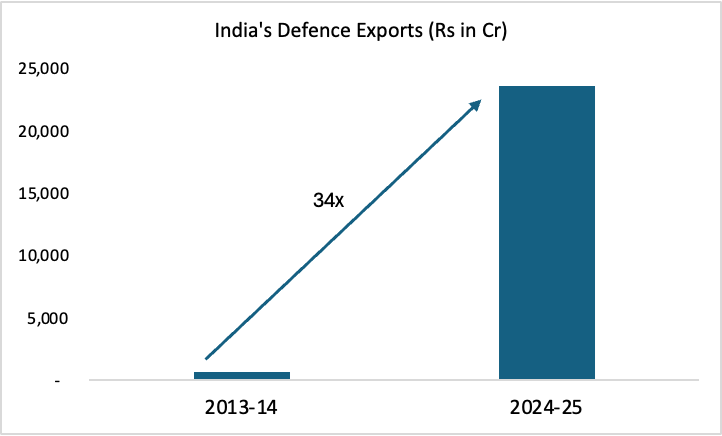
Speaking of India’s defence exports, private sector companies involved in defence contribute around 64% to India’s defence exports, and public sector companies around 36%. India exports to over 100 nations today, including the United States, France, and Armenia.
By 2029, the government aims to achieve defence manufacturing worth Rs 3 lakh crore and Rs 50,000 crore in defence exports, reinforcing India’s role as a global defence manufacturing hub while boosting economic growth.
To get there, India consciously focused on the defence budget, which has increased from Rs 2.53 lakh crore in 2013-14 to a record Rs 7.85 lakh crore in the Union Budget 2026-27.
India today ranks fifth in defence expenditure, as per the Stockholm International Peace Research Institute 2025 report.
Is the defence allocation justified?
Well, considering the ongoing war in West Asia, between Russia and Ukraine, and looming geopolitical risks in other parts of the world, the allocation seems quite well-reasoned. Today, India’s defence spending is roughly about 2% of its GDP.
BlackRock Geopolitical Risk Indicator
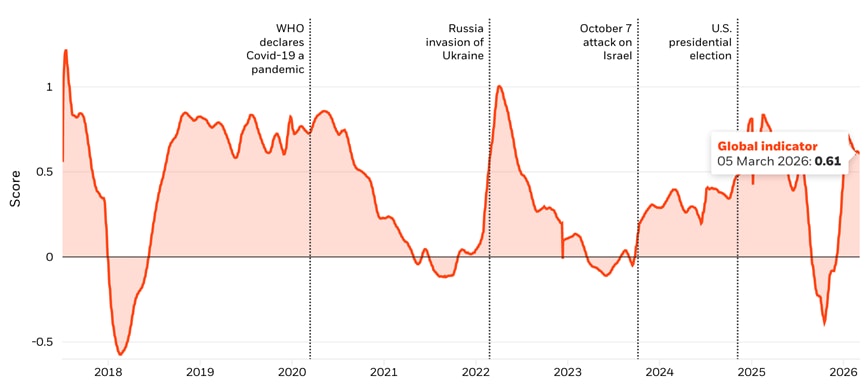
As per the global BlackRock Geopolitical Risk Indicator (BGRI), the geopolitical risk has elevated as 2026 has got off to an extraordinary start. The Middle East tensions have threatened energy infrastructure and increased volatility. The war is showing no signs of abating; on the contrary, it is escalating.
Outside the Middle East, countries such as Azerbaijan and Cyprus have been struck by Iran, as they hosted US military assets. On 4 March 2026, a US submarine torpedoed an Iranian navy frigate, INS Dena, in the Indian Ocean, off the southern coast of Sri Lanka, and around 100 nautical miles south of India, triggering a major security debate. So, the strikes are not too far from India’s coast.
Besides war, there is a high risk of major terror attacks. We’ve witnessed this several times in the Kashmir valley, the 2008 Mumbai carnage, and a series of bomb blasts in the country over the past few decades.
Wealth creation in uniform: The rise of the Nifty India Defence Index
The Nifty India Defence Index – which tracks the performance of a portfolio of stocks that broadly represent the defence theme – has, as a result, created significant wealth for investors.
Since its inception, this index has clocked a total return (including dividends) of approximately 31.9% CAGR. The real ‘alpha’ generation began post-2020, driven by a fundamental shift in government policy.
Exponential Growth of the Nifty India Defence Index
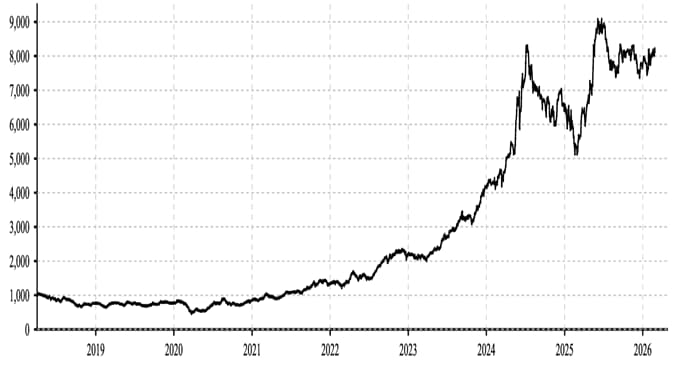
Source: NSE Indexogram Factsheet
The Nifty Indian Defence index has shown high-growth momentum and has consistently outperformed the bellwether, Nifty 50 Index. Even
Several constituents of this index have been multibaggers — multiplied wealth over the last decade. For example, Bharat Electronics, Bharat Dynamics, Mazagon Dock Shipbuilders, Cochin Shipyard, Solar Industries, HAL, Data Patterns, etc.
Many defence companies today have strong order books (stretched into 2030-2032), healthy balance sheets, and the transition from licensed production to indigenous design and innovation, with margins of these companies having improved significantly, which means there is further growth potential.
Performance of Defence Mutual Funds in India
With top constituents of the Nifty India Defence Index having performed very well, the defence mutual funds in India have also delivered handsome returns, outpacing the Nifty 50 and the broader BSE 500 Index.
Here are the top 3 defence funds on portfolio characteristics and longer period returns.
- HDFC Defence Fund
- Motilal Oswal Nifty India Defence Index Fund
- Aditya Birla Sun Life Nifty India Defence Index Fund
Note, these funds haven’t completed a 3-year track record, and hence their longer period risk ratios are not available to comment on.
The first is an actively managed defence fund, while the other two are passively managed index funds tracking the Nifty India Defence Index.
The Portfolio Characteristics of the Top 3 Defence Funds in India
| No. of Stocks | Top 10 Stock (%) | PB Ratio | PE Ratio | |
| HDFC Defence Fund | 22 | 83.4 | 8.8 | 52.7 |
| Motilal Oswal Nifty India Defence Index Fund | 18 | 89.8 | 10.2 | 47.2 |
| Aditya Birla SL Nifty India Defence Index Fund | 18 | 89.5 | 10.2 | 47.2 |
HDFC Defence Fund
This scheme is India’s first pure-play actively managed defence mutual fund, launched in June 2023. The fund has reported a significant growth in its assets since its launch. As per the February 2026 portfolio, its AUM is Rs 8096 crore.
The fund currently has about 96% of its assets in equities and around 4% in cash & cash equivalents.
Within equities, the HDFC Defence Fund has nearly 52% allocation to largecaps, 21% to midcaps, and 27% to smallcaps.
The fund holds a compact portfolio of 22 stocks, of which the top 10 are 83.4% and comprise names such as Bharat Electronics, Bharat Forge, HAL, Solar Industries, etc.
Top Holdings of HDFC Defence Fund
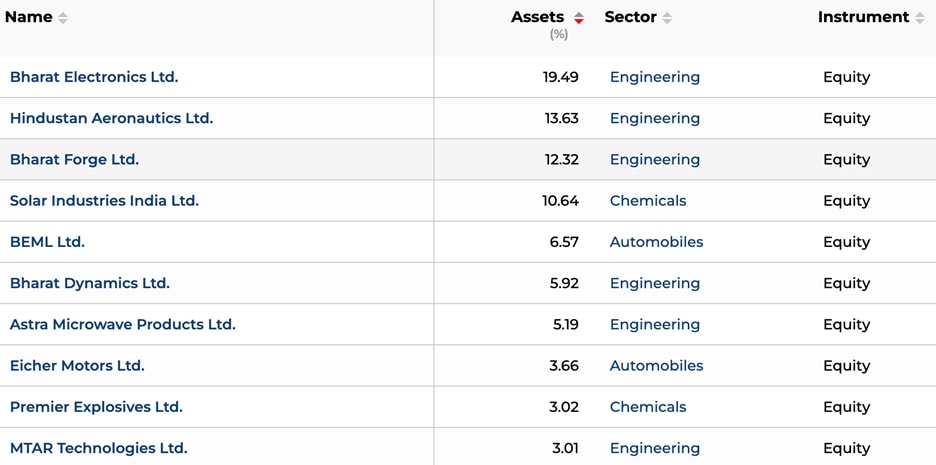
Source: Fund Factsheet
The valuation ratios – PB and PE – reveal that many of the fund’s portfolio holdings are high-growth stocks.
The fund follows a buy-and-hold strategy, as indicated by a portfolio turnover ratio of 16.3%, to reap the full growth potential. In other words, the fund holds the portfolio with conviction.
Performance of the Top 3 Defence Funds
| Absolute | CAGR | ||
| 6 Months (%) | 1 Yr (%) | SI (%) | |
| HDFC Defence Fund | -4.1 | 36.0 | 37.4 |
| Motilal Oswal Nifty India Defence Index Fund | -3.4 | 38.9 | 1.9 |
| Aditya Birla SL Nifty India Defence Index Fund | -3.5 | 38.5 | 8.0 |
| BSE 500 TRI | -8.0 | 7.0 | – |
With such a strategy followed, HDFC Defence Fund has clocked a handsome 36.0% absolute returns in the last one year, and a CAGR of 37.4% since its inception.
Currently, being conscious of the lofty valuation of the defence stocks, the fund is not accepting fresh lump sum investments. However, new SIPs (under monthly frequency options) are allowed up to Rs 5,000.
Motilal Oswal Nifty India Defence Index Fund and Aditya Birla SL Nifty India Defence Index Fund
These funds are passively managed index funds replicating the underlying index, i.e. the Nifty India Defence Index (TRI).
Motilal Oswal Nifty India Defence Index Fund was launched in July 2024, while Aditya Birla SL Nifty India Defence Index Fund was launched in August 2024.
Their investment objective is to provide returns that, before expenses, correspond to the total returns of the securities as represented by Nifty India Defence TRI, subject to tracking error.
In other words, these Nifty India Defence Index Funds do not make a deliberate or conscious attempt to outperform the underlying index. If it does outperform (or underperform), it is purely due to the tracking error (which is the standard deviation of the difference between the fund’s returns and the index returns). There is no active portfolio management.
Hence, both these funds have the exact number of stocks, i.e. 18, which are the present total constituents of the Nifty India Defence Index as of 28 February 2026. The top constituents of this index by weightage are as follows:
Top 10 Constituents of the Nifty India Defence Index
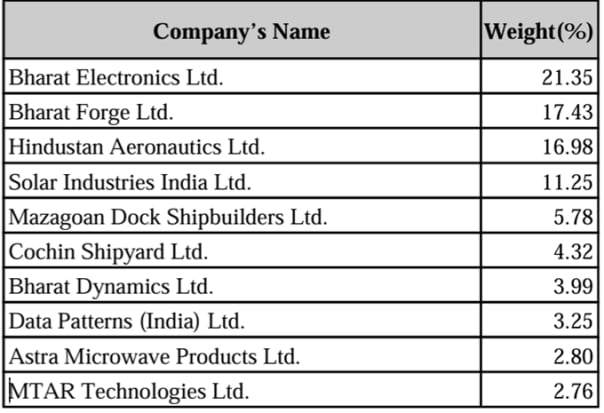
Motilal Oswal Nifty India Defence Index Fund and Aditya Birla SL Nifty India Defence Index Fund top 10 holdings are 89.8% and 89.5%, respectively, whereas that of the index is 89.9% as per the February 2026 portfolio.
Given that these funds replicate the underlying index, as regards market cap allocations too, these funds are similar.
Whenever the index constituents change, it reflects in the portfolio turnover as well.
With a passive investment strategy, the Motilal Oswal Nifty India Defence Index Fund and Aditya Birla SL Nifty India Defence Index Fund have clocked an absolute return of 38.9% and 38.5%, respectively, over the last one year, much higher than the broader BSE 500 – TRI.
Can defence mutual funds defend your portfolio in the current times of war?
Defence mutual funds are proving to be a geopolitical hedge, showing significant resilience compared to the broader market in times of geopolitical uncertainty.
While over the past one-month defence funds have fallen in the range of 1.5-2.4%, the drawdown is lesser compared to the BSE 500, which has sunk 8.4%. Over the long-term defence funds have created wealth for investors.
That being said, be mindful that the price-to-equity (PE) ratio of the Nifty India Defence Index is hovering over 54 levels currently, which is higher than the 5-year median of around 45. On price-to-book, the Nifty India Defence Index is trading at around 10 times.
So, the froth is visible, and thus you need to approach cautiously and tactically. Keep in mind that when you approach defence funds, there is significant sector concentration risk involved. Meaning, the fortune of the fund will be closely linked to the performance of the defence sector.
Hence, given this, only a small portion of your satellite portfolio, which may be around 5-10%, may be allocated to a worthy defence fund, depending on your risk appetite, rather than going gung-ho. This tactical allocation can potentially provide a buffer to your mutual fund when the rest of the market reacts to war-induced panic.
Invest sensibly, be thoughtful in your approach.
Happy investing!
Note: We have relied on data from www.valueresearchonline.com, www.financialexpress.com, and the factsheets published by the respective fund houses throughout this article. Only in cases where the data was not available, have we used an alternate, but widely used and accepted source of information.
Returns data as of 16 March 2026. Direct Plan and Growth Option Considered.
Portfolio data as of 28 February 2026. The average of the price-to-book value ratios and price-to-equity ratios of all underlying stock holdings in proportion to their portfolio weights is considered.
Disclaimer
Disclaimer: The above content is for informational purposes only. Mutual Fund investments are subject to market risks. Please consult your financial advisor before investing.
Rounaq Neroy has over 20 years of experience in the financial markets and investments. He is a close observer of the Indian economy and writes deeply on the capital markets, mutual funds, stocks, precious metals, asset allocation, wealth management, and investment strategy. His editorials provide interesting, actionable investment ideas to guide readers in the journey of wealth creation and make wise decisions. Rounaq was the Head of Content at PersonalFN (Quantum Information Services Pvt. Ltd.), which also owns Equitymaster.com – India’s oldest and trusted equity research house.